
The U.S. Army has quietly begun rehearsing how to dig mass graves for American soldiers, a grim preparation not seen on this scale since the Korean War and one that reflects mounting concern over a potential large-scale conflict with Iran.
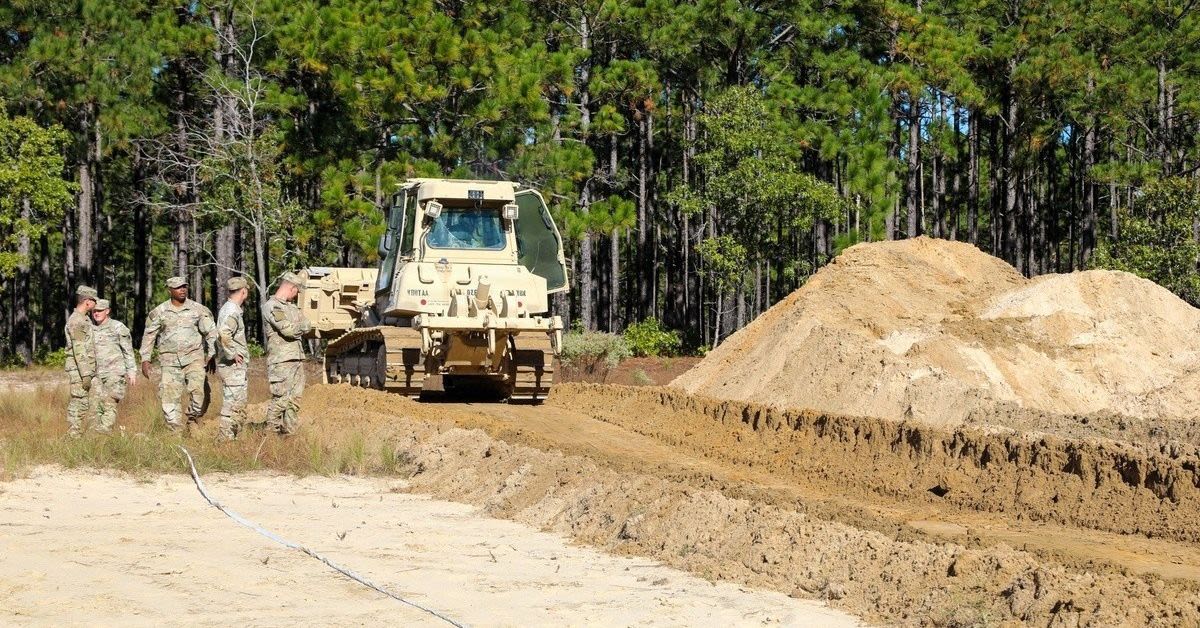
According to the Daily Mail, the recent field exercise was designed to determine whether modern heavy equipmentbulldozers and excavatorscould rapidly create large temporary burial sites while preserving the integrity of human remains for later identification and repatriation. The drill, conducted at Fort Bragg, North Carolina, featured an Army D6 bulldozer carving out deep trenches as operators carefully held the blade 18 inches above the ground, allowing loose soil to fall naturally into the trench rather than compacting it under pressure.
The Armys test involved placing model skeletons and sealed water containers at the bottom of a trench before it was filled, a method intended to simulate the weight and fragility of human bodies under tons of earth. When the trench was later reopened, both the skeletons and the containers were found intact, suggesting that the technique could protect remains from being crushed and thus aid in proper identification and respectful return to the United States.
Planners timed the operation and found that a single trench could be dug in roughly one hour and 15 minutes, a rate that scales dramatically when multiplied by a full engineering company. Based on those results, the Army estimated that a unit equipped with eight bulldozers and four military excavators could dig and fill enough trenches to inter as many as 2,400 bodies in a single day, operating continuously around the clock.
In a statement, the service acknowledged the sobering nature of the effort, noting that The exercise served as a critical test of concept to validate the feasibility of battlefield temporary interment, an operational reality the US Army has not executed at scale since the Korean War. Nearly 37,000 American personnel were killed in that conflict between 1950 and 1953, a casualty level that would overwhelm the peacetime mortuary systems built around smaller, counterinsurgency-style engagements.
The timing of the drill has fueled public unease, coming as Americas top Middle East commander, Admiral Brad Cooper, has reportedly briefed President Donald Trump on options to resume military operations against Iran. Trump is said to be weighing a range of choices, including renewed strikes and the continuation of a U.S. blockade in the region, a posture that could quickly escalate into a high-intensity conflict with significant American casualties.
Participants in the burial exercise included soldiers from the 3rd Corps Sustainment Command and the 20th Engineer Brigade, supported by Army chaplains and religious affairs personnel who were integrated into the process from the outset. Although the training took place on October 22, details only recently became public, prompting questions about why the Army is now preparing for mass fatalities on the battlefield after decades of relatively low-intensity operations.
Sgt. 1st Class Delbert Ruede, the senior fatality management noncommissioned officer for the 3rd Corps Sustainment Command, framed the effort as both practical and moral. This exercise allowed us to take a critical look at how we respect, honor, and systematically manage our fallen in a high-intensity conflict, he said, emphasizing that the goal is to avoid improvisation under fire.
Ruede was blunt about the stakes if the United States were suddenly thrust into a major war. If we went to war tomorrow, we would be making this up as we went along. What we are doing here is taking a scientific, field-tested approach so that we can maintain positive control and respectfully care for our fallen, he explained, underscoring the need for planning rather than reactive crisis management.
The drill also exposed how outdated some of the Armys burial guidelines have become in light of modern engineering equipment. Existing instructions called for a seven-foot corridor between trenches, a standard that proved two feet too narrow for todays larger bulldozers to pass without disturbing the burial sites.
To resolve that problem, crews widened the trenches to 15 feet and left nine feet of undisturbed soil between them, a configuration that allowed heavy machinery to maneuver without compromising the integrity of the graves. These measurements, along with the test data on soil pressure and equipment performance, will feed into updated Army doctrine intended to align burial layouts with current capabilities.
When engineers later unearthed the model skeletons and water containers, they confirmed that the remains had not been crushed, validating the basic concept of the burial method. However, they cautioned that soil type would significantly affect operations, with dry sand, frozen ground, clay and mud each presenting distinct engineering challenges that must be factored into future planning.
Getting our operators actual stick time on this specific task gives us data rather than assumptions, said 1st Lt. Connor Thompson, an engineer officer with the 27th Engineer Battalion, stressing that real-world testing is essential for refining procedures. A follow-on exercise scheduled for next spring will repeat the process under both daylight and blackout conditions, using night-vision systems to simulate combat environments where lights could draw enemy fire.
For the first time in more than two decades, Army chaplains and religious affairs personnel also rehearsed their roles in temporary battlefield burials, recognizing that spiritual care does not stop when casualty numbers surge. For much of the post-9/11 era, American troops killed in counterinsurgency operations were quickly flown home through well-established mortuary channels, allowing for individualized services and family-centered ceremonies.
The new training acknowledges that a large-scale war could make such individualized treatment impossible, at least in the initial phases of combat. The exercise therefore explored how to honor fallen soldiers when intense fighting prevents immediate repatriation and leaves little time for traditional funeral rites, a scenario more reminiscent of World War II or Korea than Iraq or Afghanistan.
In a high-intensity, contested combat environment, fatality management teams cannot stop a 24-hour interment operation for individualized religious gravesite services, said Lt. Col. Ruska, chaplain for the 3rd Corps Sustainment Command. Chaplains involved in the drill identified a pressing need for clear, standardized procedures that allow religious support to continue while burial crews work continuously to keep pace with casualties.
Before the first trench was dug, Maj. Warwick Fuller, chaplain for the 20th Engineer Brigade, offered a prayer to consecrate the burial ground, a step intended to provide a measure of dignity and spiritual assurance in the absence of full ceremonies. Ruska noted that battlefield realities often make it impossible to immediately determine a fallen soldiers identity or religious affiliation, complicating efforts to tailor rites to individual beliefs.
To address that problem, chaplains consulted with representatives of smaller faith communities within the military to determine acceptable practices when specific religious details are unknown. They agreed that consecrating the ground in advance could help reassure families that their loved ones were treated with dignity, even when individual memorial ceremonies were not possible, a compromise between doctrinal precision and wartime necessity.
Master Sgts. Amelia Alston and Lakesha Copeland led the effort to fully integrate religious affairs specialists into the burial process, from coordinating logistics to supporting troops and monitoring the respectful handling of remains. After the simulated bodies were lowered into the trenches, Maj. Cornelius Muasa and Capt. David Chacko offered committal prayers as engineers covered the graves with soil, blending military efficiency with spiritual observance.
The training also underscored the human toll on those tasked with caring for the dead, a burden that goes beyond physical fatigue. Army planning estimates suggest that religious support teams exposed to heavy casualties could reach physical, emotional and spiritual exhaustion within four to six hours, a sobering reminder that even caregivers require protection and relief.
As a result, planners concluded that teams must be rotated regularly to sustain operations over time, ensuring that those providing comfort and conducting burials remain capable of doing so without breaking under the strain. In an era when Washington debates war with Iran and other adversaries with alarming casualness, the Armys preparations serve as a stark reminder of what large-scale conflict really entails: not just strategy and firepower, but the solemn duty to honor the fallen, even if that means preparing for mass graves on foreign soil.
Login