
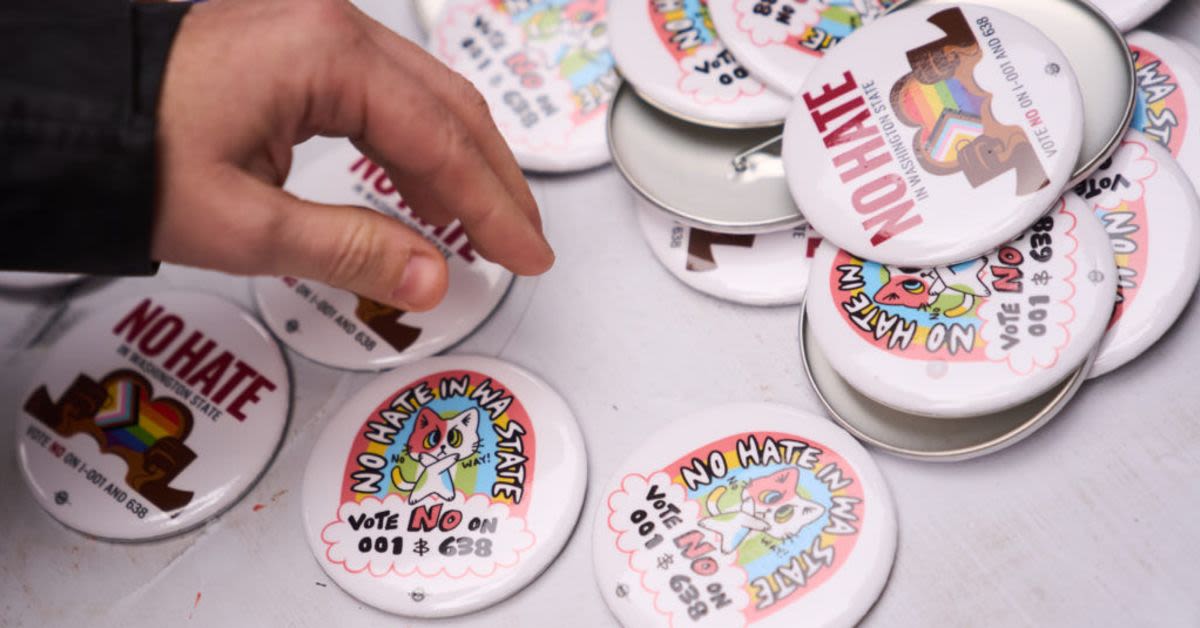
For the first time in the modern gender-policy debate, it is not lawmakers, bureaucrats, or judges but ordinary citizens who will decide at the ballot box whether school athletics remain rooted in biological sex.
Several states will vote on the issue on November 3, and notably, two of them Washington and Colorado are among the nations bluest jurisdictions. As reported by The Daily Wire, that alone signals that the old elite-driven consensus is eroding, even in progressive strongholds that once treated skepticism of gender ideology as beyond the pale.
Voters who have watched the practical consequences play out on tracks, courts, and playing fields are being asked whether they still believe that fairness for girls requires sex-based categories and whether they are willing to say so publicly. In Washington, Initiative 638 would bar biologically male students from competing in girls K12 events and require verification of biological sex for female-designated competitions.
Lets Go Washington, which commissioned a poll of 7,500 likely voters, found 56% support for the measure, including nearly half of Democrats, a figure that would have been unthinkable just a few years ago in such a deep-blue state. That support has been forged not in theory but in lived experience, as Washington residents have watched biological males claim consecutive girls 400-meter state titles in 2024 and 2025 and seen Camas High School girls walk off a cross-country start line rather than race against a teammate who began the season in the boys division, finishing at the bottom, then self-identified into the girls races weeks later and landed on the podium every time.
The human cost of this policy experiment is increasingly visible in the stories of young women and their families who never sought the spotlight. Frances Staudt, a Tumwater athlete, refused to play basketball against a male competitor and was subsequently investigated for harassment after stating what most people still regard as obvious biological reality.
Another student, Ahnaleigh Wilson, lost a middle-school title and has spoken out ever since, while Sarah Burns, a mother from Camas, captured the sentiment of many parents when she said simply, Im just a mom. These are not professional activists or political operatives; they are ordinary Americans who reached the point where the cost of silence outweighed the fear of backlash.
Colorados Proposition 134 would similarly require K12 and collegiate teams to be designated male, female, or co-ed based on biological sex, restoring a standard that only recently became controversial. The measure qualified for the ballot with more than the required signatures and without the benefit of major institutional funding, a sign of organic grassroots concern rather than top-down orchestration.
By contrast, the opposition campaign, Families Not Politics, has raised more than $4.4 million, with the ACLU contributing $250,000 and Planned Parenthood emerging as a major donor, all to promote the familiar narrative that this is a transphobic assault that will supposedly lead to invasive genital checks and harm all girls. The actual text of Proposition 134 does not mandate such examinations, a fact that has done little to slow the rhetoric.
The scare campaign does not depend on legal accuracy so much as emotional volume, and on that front, the well-funded progressive coalition has ample resources. The strategy is clear: frame any attempt to preserve sex-based categories as bigotry, then drown out dissenting voices before they can explain that the goal is to protect girls, not persecute anyone.
When the public is allowed to see the plain language of the measures and the real-world examples behind them, support tends to rise which is precisely what activists on the Left are trying to prevent. The cultural pressure is not confined to states with ballot initiatives.
Earlier this month in Portland, Oregon just across the river from Washington about two dozen women wearing XX-XY Athletics shirts unfurled a Save Womens Sports banner at a Portland Thorns match. They were struck with flagpoles, surrounded by hostile fans, and then forcibly removed by stadium security, an incident now under review by the Department of Justice.
Portland has no sports-related ballot measure this year, yet the intensity of the reaction reflects the growing anxiety among gender-ideology activists as voters next door in Washington signal they are no longer willing to pretend that male athletic advantage disappears with a change of pronouns. When argument falters, coercion often follows, and Oregons neighbor Colorado offers a telling example of how policy can be used to police speech.
The state has already made refusal to use preferred names or pronouns admissible as evidence of discrimination under its anti-discrimination law, a civil standard that nonetheless functions as a form of compelled speech. If citizens cannot accurately describe the sex of the athlete taking the medal, the podium, or the scholarship, the entire debate is effectively pre-censored before it begins.
The side that cannot prevail on the merits has every incentive to make the language of reality itself legally risky, thereby driving the discussion out of the public square. Across the country, the temperature is rising as parents and athletes push back against a decade of social coercion and cancellation.
The tactics that once silenced dissent public shaming, professional threats, and accusations of bigotry are losing their grip as more families decide to speak in their own names. Girls are walking off courses rather than quietly accepting unfair competition, and voters in states that have spent years treating biological sex as optional are being asked directly whether they still believe in fairness and whether they want that fairness for their daughters.
The response from the activist Left has been predictable: more money, more censorship, and, in places like Portland, physical force and removal from public venues. No one should imagine that these ballot measures, even if successful, will resolve the broader cultural conflict.
Laws can set boundaries and protect rights, but they do not, by themselves, restore a culture of honesty about the differences between men and women. Even if both Washingtons Initiative 638 and Colorados Proposition 134 pass, 20 states will still lack clear protections for female athletic categories, leaving many girls vulnerable to losing places, titles, and privacy.
And even if the measures fail, the young women who have already been displaced from podiums and locker rooms are unlikely to retreat into silence; they have learned that when they are heard, they resonate with a public that instinctively understands their plight. The faade that trans women are women in every context is cracking because the reality beneath it has always been visible to anyone willing to look squarely at the facts.
Male athletic advantage is real and significant, and female sports exist precisely because of that biological truth, not in spite of it. The activists who spent years insisting that trans women are women and bullying anyone who questioned their pithy little tagline are discovering that ordinary voters and especially ordinary mothers can still tell the difference.
As one side leans ever harder on censorship and intimidation, the other is rediscovering the courage to say what used to be common sense. At the heart of this debate is a simple proposition: Biology is real, and it matters. And so do our girls. We wont accept a policy that tells them they dont matter anymore.
Whatever the outcome on November 3, those determined to defend reality and the dignity of women and girls show no sign of backing down, and the more their stories are told, the harder it becomes for political and cultural elites to maintain the fiction that this is a fringe concern. The ballot fights in Washington and Colorado are only one chapter in a larger struggle over whether the country will prioritize ideological conformity or the basic fairness owed to every girl who trains, competes, and dreams of standing on a level playing field.
Login