
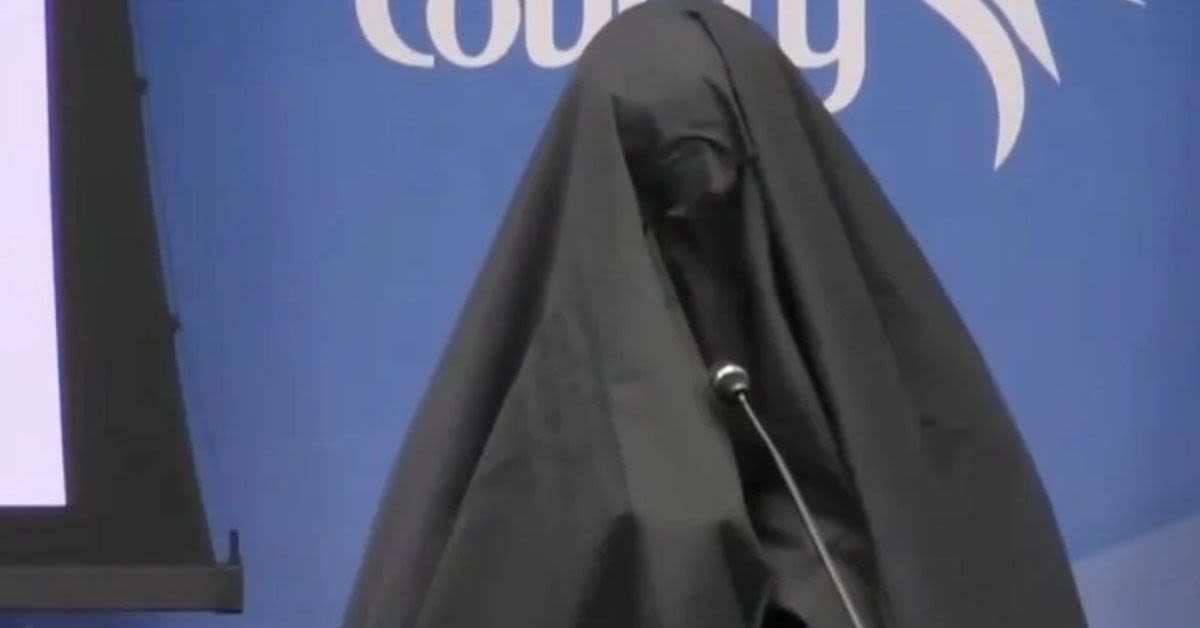
A woman in a full black burka was removed from a Pinellas County Commission meeting after she refused to stop playing a recording of the Islamic call to prayer during a tense public debate over the expansion of a local mosque.
The confrontation unfolded during the public comment period of the Pinellas County Board of County Commissioners, as reported by The New York Post, where residents were addressing a controversial land-use change tied to Masjid Al Rahman. The woman, covered from head to toe with only her left eye visible, approached the podium and, instead of speaking, activated an audio recording of the call to prayer, leaving officials and attendees uncertain whether the act was intended as a protest, a show of support, or simply a disruptive stunt.
The recording continued for nearly a minute before Board Chairman Dave Eggers intervened, reminding the woman and the audience that county rules require speakers to offer verbal remarks rather than play audio clips. Maam, youre going to have to stop stop the music, stop the tape, Eggers said, attempting to restore order as the call to prayer echoed through the chamber.
When the woman refused to comply, a deputy from the Pinellas County Sheriffs Office moved to the podium and escorted her out of the meeting room and then out of the building. Her removal immediately inflamed tensions in the audience, with several attendees shouting and arguing with Eggers, reflecting the broader unease over both the mosque expansion and the way it has been handled by local government.
Eggers appealed for calm and mutual respect as the crowd grew more agitated. Please. Just please exercise some decorum and kindness of your own, he told the audience, adding, Were all people living together here.
He then reiterated the boards longstanding rules on public participation, emphasizing that the issue was procedural rather than religious. We dont allow taped things, he said. You can record the meeting, but we dont allow taped activity like that. We ask you to come here and make comments, and that was not a comment. Thats why she was asked to step out.
The disruption came amid ongoing backlash to an Oct. 13 vote in which the commission, by a narrow 43 margin, approved a land-use amendment enabling the expansion of Masjid Al Rahman. The mosque was described in official presentations and zoning documents not as a house of worship but as a community assembly facility, a choice of wording that has fueled suspicion among residents who expect transparency from their local government.
The vote reclassified the property from residential rural to public and semi-public, clearing the way for the owner to demolish the current structure and build a new facility roughly 1,000 square feet larger. For many residents, the issue goes beyond square footage and into questions about cultural integration, womens rights, and whether local officials are being forthright about what is being approved in their neighborhoods.
During Tuesdays meeting, several speakers criticized the mosque expansion, with some focusing on the treatment of women in Muslim-majority countries and warning about the ideological implications. It is about the big picture and the long term, one woman told the commission. By allowing this mosque to expand in our area, you are participating in the expansion of a totalitarian ideology which is fundamentally opposed to Western American values. Expansion of the ideology of Islam is not good for womens rights.
Not all residents shared that view, and one woman spoke in favor of the project and of the mosques presence in the community. They want to turn it to face Mecca, and they want it to look a little more like a mosque instead of a house, she said. We have no problems with them. Weve been their neighbors for many years.
Commissioner Vince Nowicki, reflecting concerns about government transparency rather than theology, questioned why the mosque was not plainly identified as such in the official paperwork. Residents read these materials to understand what is being proposed near them, and they should get the same plain description in every case, no matter the applicant, Nowicki wrote in an email to County Administrator Barry Burton, according to Florida Politics.
The Pinellas County Sheriffs Office later confirmed that the woman in the burka was escorted from the premises without further incident and will not face criminal charges. As the county moves forward with the approved land-use change, the episode underscores a broader debate over religious accommodation, honest labeling in government documents, and the right of citizens to challenge projects they believe may conflict with Western American values and local community standards.
Login