
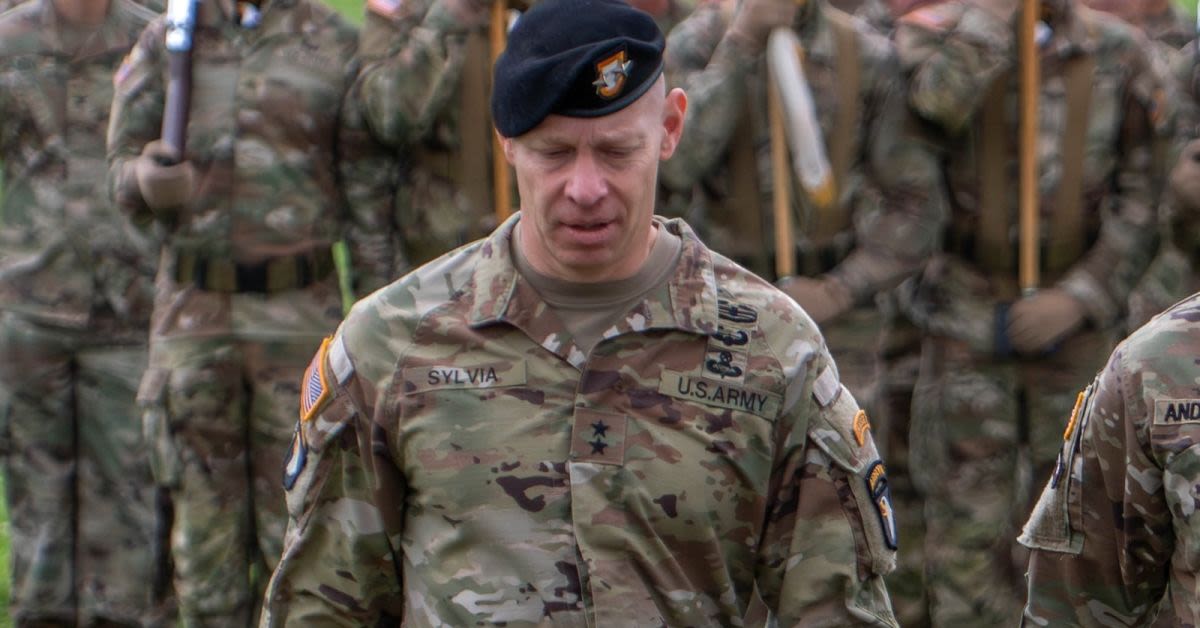
Defense Secretary Pete Hegseth has dismissed the Pentagons top military strategist even as President Trump weighs whether to expand U.S. military action against Iran in an eight-month-old war that has reshaped American force posture in the Middle East.
Army Lt. Gen. Brett Sylvia was removed as director of strategy, plans and policy on the Joint Chiefs of Staff, a position widely known in Pentagon circles as the J5. According to the New York Post, he is the second senior officer to be pushed out of that powerful planning role under Hegseth, following Lt. Gen. Joseph McGee, who was forced into retirement last October.
A defense official, speaking on condition of anonymity due to the sensitivity of personnel decisions, said no successor has been named and no public justification has been offered for Sylvias abrupt ouster. The move, first reported by The Atlantic, underscores the sweeping and often opaque shake-up of senior ranks that has become a hallmark of Hegseths tenure.
A Joint Staff spokesperson offered only a formal farewell, saying the Chairman, the Joint Staff, and the Joint Force extend our deepest gratitude to Lt. Gen. Brett Sylvia and his family for their 32 years of distinguished service to our nation and they wish him and his family the best. Typically, the J5 director and staff are charged with crafting and synchronizing military plans for both the chairman of the Joint Chiefs and the president, giving the post outsized influence over war planning and global posture.
Sylvias removal comes as Trump has repeatedly signaled that fresh operations against Iran remain firmly on the table. The president has vowed to finish the job in Iran after launching the war with Israel eight months ago and has said that new strikes are an option once next weeks midterm elections are over.
U.S. officials have quietly warned several Middle Eastern governments and regional partners to brace for potential renewed American military action after Tuesdays vote, two diplomats briefed on the conversations said. Those same officials have also cautioned that Iran may seek to retaliate against neighboring states if Washington escalates, though they emphasize that Trump has not yet made a final decision on additional strikes.
In anticipation of possible conflict expansion, a third U.S. aircraft carrier strike group and thousands more American troops are moving toward the region. The buildup reflects a traditional conservative approach to deterrence: projecting overwhelming strength to dissuade adversaries while preserving the option of decisive force if diplomacy fails.
Before joining the Joint Staff, Sylvia commanded the famed 101st Airborne Division at Fort Campbell, Kentucky, until May 2025, according to his official biography, which has since been removed from public view. He had previously served as the J5s vice director, making his elevation to the top planning job a conventional, merit-based progression that now ends in an unexplained dismissal.
Sylvia is only the latest in nearly two dozen generals, admirals and other senior leaders to be fired, pushed into retirement or otherwise moved out under Hegseth, with the Pentagon offering little public explanation in most cases. Those departures have included the civilian secretaries of the Army and Navy as well as several top uniformed officers, signaling a broad effort to reshape the militarys upper echelons.
The Pentagon did not respond to requests for comment late Wednesday, continuing a pattern of silence around high-profile personnel changes. Hegseth, however, has been explicit about his broader intent, saying last month that he ordered the services to double planned reductions in top brass to achieve a 20% cut in general and flag officer billets by Jan. 1, 2027, from a current total of roughly 800 positions.
I call it accountability and long overdue, Hegseth told junior officers and enlisted leaders at Marine Corps Base Quantico on Sept. 30, framing the downsizing as a necessary correction after decades of bureaucratic bloat. His stance reflects a long-standing conservative critique that the Pentagon has become top-heavy with career managers and politicized brass, even as warfighters shoulder the real burden.
Some lawmakers, particularly on the Democratic side, have denounced the reductions as a destabilizing purge that will hollow out the institutions leadership bench. Hes got some kind of like deep-seated grievance about leadership in the military, Sen. Mark Kelly, D-Ariz., a former Navy combat pilot and vocal critic of Hegseth, said last month.
Hes purging a generation of great leaders of the military, and its going to take a generation to recover from it. Supporters of Hegseths approach counter that entrenched leadership has too often prioritized progressive social experiments and bureaucratic self-preservation over war-fighting readiness, and they argue that a leaner, more accountable command structure is precisely what is needed as the United States confronts Iran and other adversaries who respect strength far more than process.
Login