
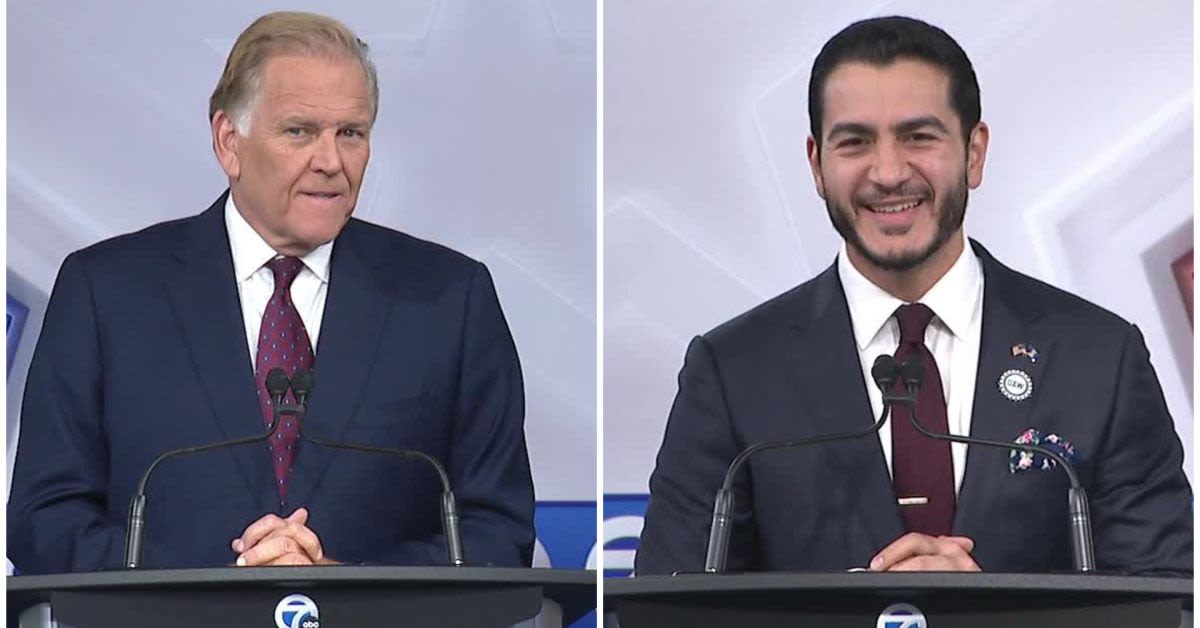
Michigan Republican Senate candidate Mike Rogers refused to allow Democratic nominee Abdul El-Sayed to cast himself as a victim during a heated debate, pressing him on his past support for defunding the police and his documented ties to the Muslim Brotherhood.
The exchange unfolded after a moderator asked Rogers what he would do to make Michigan safer, prompting the former congressman and ex-FBI agent to highlight his background in law enforcement and his record of combating crime. He pointed to the cooperation between federal and state authorities in cities such as Memphis that helped drive down crime during the Trump administration, drawing a sharp contrast with El-Sayeds record and rhetoric.
According to Western Journal, Rogers used that contrast to underscore what he framed as a fundamental divide between a law-and-order approach and a progressive agenda that undermines public safety. Rogers reminded viewers that El-Sayed had openly embraced the defund the police movement in 2020, at the height of the left-wing push to strip resources from law enforcement.
He also noted that El-Sayed has spoken favorably about the Muslim Brotherhood, an Islamist organization whose political offshoots have destabilized countries across the Middle East. In a 2020 interview with Detroit Public Radio, El-Sayed declared, I believe we need to defund the police insofar as defunding the police is disinvesting in the means of incarcerating someone or killing them on the streets, and investing more in the means of educating and empowering, engaging communities with the means of being able to take on systemic poverty, according to Bridge Michigan.
Yet when the political winds shifted and defund the police became a liability for Democrats, El-Sayed appeared to retreat from his earlier stance. CNN reported in November 2025 that El-Sayed deleted social media posts calling for defunding the police, scrubbing his online footprint of the very rhetoric that had endeared him to the activist left.
That same month, he attempted to recast his position in an interview with The Detroit News, insisting, I actually never, never called for defunding. My goal in that conversation was to help everybody to understand what we were talking about. Rogers seized on that discrepancy during the debate, pressing El-Sayed on why he had gone to such lengths to erase his prior statements.
Why would you take all of that time to delete all of the material: X, videos, comments, podcasts? Why? Because he was passionate about defunding the police. As a matter of fact, he asked the new Muslim Brotherhoods head, [Mohamad] Morsi, in Egypt to defund the police there, too. I mean, its unbelievable. His reference to Egypts brief experiment with Muslim Brotherhood rule was not incidental; it was central to his argument that El-Sayeds ideological commitments extend far beyond domestic policy.
In 2012, El-Sayed joined 45 other Egyptian-American leaders in signing a letter supporting then-Egyptian President Mohamad Morsi, a senior Muslim Brotherhood figure, urging him to purge the media and police. That appeal aligned with the Brotherhoods broader project of consolidating power and sidelining institutions that might check its authority.
Morsi soon granted himself sweeping powers after taking office, as The Washington Free Beacon reported, only to be overthrown by the Egyptian military in 2013 after barely a year in power. El-Sayeds sympathy for the Muslim Brotherhood predates Morsis presidency.
In a 2011 column for the Huffington Post, he argued that Americans had nothing to fear from the organization, which has been designated a terrorist group by the U.S. State Department. Even if the Muslim Brotherhood were to take power [in Egypt], there are several reasons why the ensuing state would look nothing like Iran, El-Sayed insisted, adding that the Muslim Brotherhood definitely would not resemble Hamas.
Those assurances now sit uneasily alongside the Brotherhoods record in Egypt and the broader Islamist agenda it has pursued across the region. The Democrats attempts to distance himself from the Brotherhood have also come under scrutiny.
Earlier this month, during an appearance on NBCs Meet the Press with host Kristen Welker, El-Sayed flatly claimed that his family had no ties to the organization, a statement critics quickly labeled deceptive. However, his half-sister, Eman Abdelhadi, a University of Chicago assistant professor, had proudly proclaimed in 2012, just days after Morsi took office, My family has long been MB.
Their mother, Fatten Elkomy, was active in the Brotherhood in college in Egypt in the 1970s, Abdelhadi said, according to The Free Beacon. Those remarks, made years before El-Sayeds Senate run, undercut his insistence that any suggestion of Brotherhood links is a baseless smear.
They also raise questions about why he now reacts so angrily when his past associations and ideological sympathies are brought to light. On the debate stage, El-Sayed tried to turn the tables by accusing Rogers of engaging in bigotry and questioning his patriotism.
He complained that Rogers keeps raising this question about this organization that Ive never been a part of. Because of my mom, whos a nurse in Missouri. Its really quite beneath you, Mike. Casting himself as a proud American unfairly maligned because of his faith, he added, To bring into question my commitment to the Constitution is really beneath you. I am proud of America. Im proud to be an American. Im proud of our Constitution, that guarantees all of us the right to pray as we choose to pray and the question that you would ask, I think, is actually really quite shameful.
Rogers refused to accept that framing, drawing a sharp line between religious liberty and extremist ideology. I wore the uniform of the United States proudly so you could pray any way you want. I know you want to make this about you being a victim. This is about an ideology thats banned in five Muslim countries he replied, referencing his service as a U.S. Army officer in the 1980s.
His point was clear: the concern is not that El-Sayed is a Muslim, but that he has aligned himself with a radical movement rejected even by many Muslim-majority nations. From a conservative perspective, that distinction is crucial.
The issue at stake is not personal faith but public policy and El-Sayeds record reflects a pattern of embracing radical causes, from defunding the police at home to defending the Muslim Brotherhood abroad. His positions exemplify what critics describe as the Red-Green Alliance, the uneasy but increasingly visible partnership between Western socialists or communists and Islamist movements, a coalition that has already contributed to social unrest and political turmoil in places like France.
For Michigan voters, the choice in this Senate race is not merely between two personalities but between two fundamentally different visions of governance and national security. Rogers stands for traditional law-and-order principles, respect for the Constitution, and a clear-eyed view of the threats posed by extremist ideologies, foreign and domestic.
El-Sayed, by contrast, has spent years championing policies that weaken law enforcement and defending an Islamist organization with a troubling record, only to backpedal when those positions became politically inconvenient. As the debate over crime, immigration, and national security intensifies nationwide, Michigans decision will reverberate far beyond its borders.
A vote for Rogers is a vote for stability, accountability, and a firm stand against the radical currents reshaping the Democratic Party, while keeping Abdul El-Sayed and the ideology he has repeatedly excused out of the halls of power in Washington.
Login