
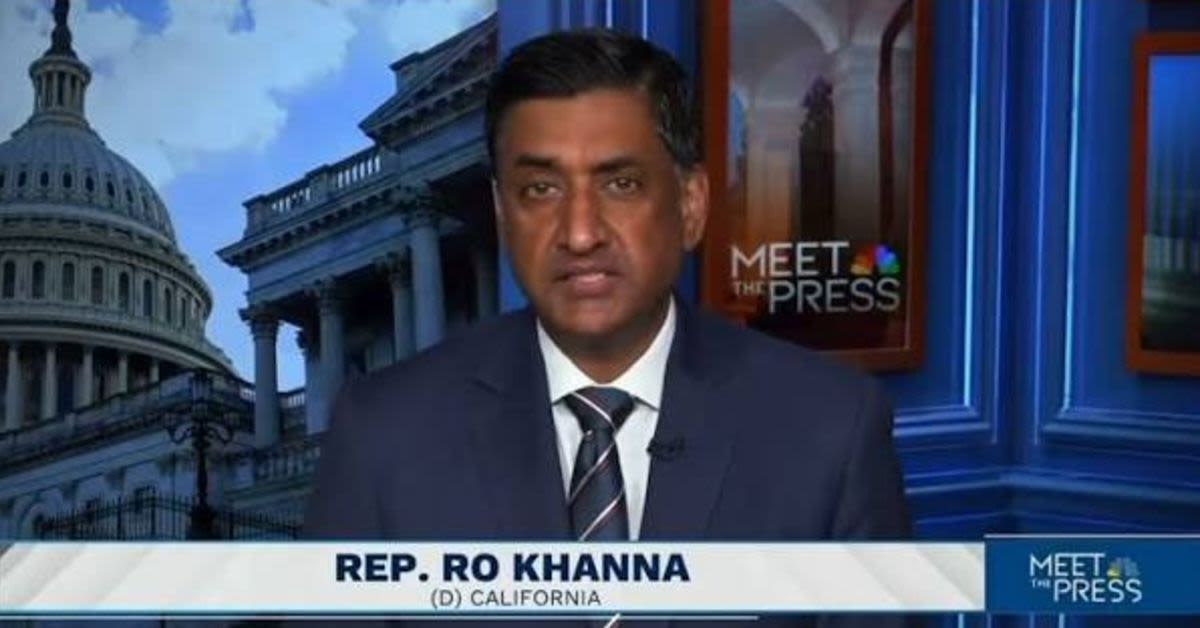
Rep. Ro Khanna, D-Calif., is openly framing the prospect of a third impeachment of President Donald Trump as a matter of setting a standard for presidential accountability should Democrats regain control of the House in November.
Appearing on NBC News Meet the Press, Khanna dismissed the notion that another impeachment drive would be a political misstep for his party, insisting instead that such a move would be a principled stand to uphold constitutional values. According to Newsmax, the California Democrat argued that impeachment should be viewed less as a partisan weapon and more as a constitutional tool to restrain executive overreach, particularly under a future Trump administration.
Khanna laid out his rationale in sweeping terms, casting impeachment as a safeguard against unilateral military action and abuses of power within the federal bureaucracy. Impeachment says that you can't get into an illegal war in Iran without constitutional approval, Khanna said, underscoring long-standing progressive opposition to robust presidential war powers that many conservatives view as essential to national security.
He went on to broaden the indictment, tying impeachment to disputes over the presidents authority to manage the executive branch and conduct foreign policy. Impeachment says that you can't just start firing federal employees in defiance of what Congress says. Impeachment says you can't do deals with foreign governments to allegedly enrich your own family. It's about setting a standard, he added, reviving familiar Democratic talking points from prior efforts to remove Trump from office.
Khanna further contended that Democrats could pursue impeachment proceedings without abandoning the economic concerns that dominate voter priorities. The Democrats can impeach to uphold constitutional values and, at the same time, have a first-hundred-day agenda that deals with the cost of living, he said, suggesting his party could simultaneously wage an aggressive oversight campaign and advance a domestic agenda heavy on government intervention.
Beyond impeachment, Khanna used his television appearance to press the Biden administrations critics on foreign policy by urging the current White House to accept a seven-day proposal from Iran aimed at reopening the Strait of Hormuz and securing a ceasefire. He argued that Washington need not accept every Iranian demand to move forward, but he emphasized that one concession was, in his view, non-negotiable.
In my view, the biggest thing that we need to give the Iranians is an ironclad commitment that we will not have [a] regime-change war, Khanna said, echoing a long-running progressive preference for diplomatic assurances over the credible threat of force that many conservatives see as vital to deterrence. He also criticized Trumps past remarks at the United Nations in which the president threatened further military action against Iran, disputing Trumps claims about the extent of damage inflicted on Irans nuclear facilities and casting doubt on the effectiveness of his maximum-pressure strategy.
Khannas comments come as House Minority Leader Hakeem Jeffries, D-N.Y., has already signaled that senior Democrats on the House Judiciary and Oversight committees would spearhead efforts to hold a future Trump administration to account if their party wins the majority. That posture suggests Democrats are preparing not only for routine oversight but for the possibility of another impeachment battle, even as many Americans remain weary of the partisan warfare that has dominated Washington in recent years.
For conservatives, Khannas remarks will likely reinforce concerns that Democrats are more interested in relitigating the Trump years than in restoring stability, restraining federal spending, or securing the border. Yet his insistence on setting a standard through impeachment and offering an ironclad commitment to avoid a regime-change war with Iran signals that the left is prepared to double down on expansive congressional checks on the presidency and a more conciliatory posture toward hostile regimes, setting the stage for another fierce clash over the proper scope of American power at home and abroad.
Login