
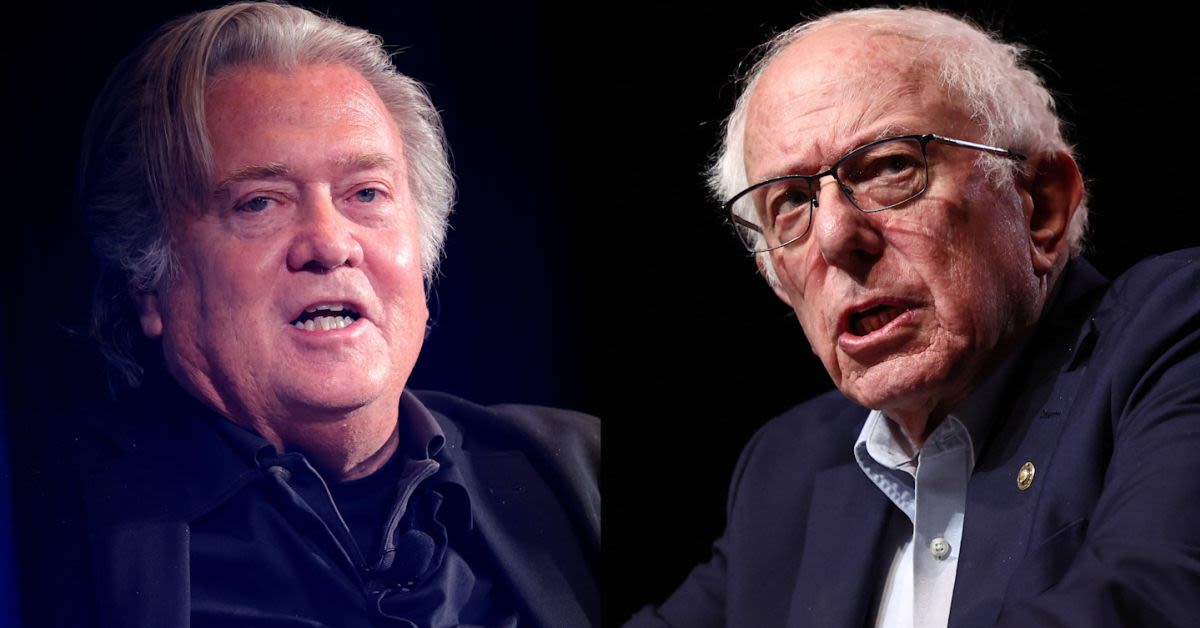
A rare coalition of ideological opposites is converging on Washington, D.C., to demand a dramatic slowdown in what they describe as dangerously reckless advances in artificial intelligence, even as President Donald Trump urges the nation to press forward with minimal new restraints.
According to Just The News, the Pro-Human Assembly, convening Tuesday in the nations capital, will feature socialist Sen. Bernie Sanders sharing the stage with conservative strategist and former Trump adviser Steve Bannon, alongside Republican Sen. Marsha Blackburn and American Federation of Teachers President Randi Weingarten. The event is organized by The Future of Life Institute, a nonprofit that earlier this year issued The Pro-Human AI Declaration, a manifesto insisting that humans remain firmly in charge of AI systems, that power over these technologies not be concentrated in a handful of corporate giants, and that companies be held accountable for abuses and failures of their tools.
Bannon, who has long warned about the power of Big Tech, framed the moment as a forced reckoning for the technology elite. The Oligarchs are finally being forced to admit they've lied from the beginning about the dangers of acceleration with zero guardrails they've put the nation and mankind in jeopardy, he said in a statement to Axios, which first reported on the conference.
The gathering comes on the heels of a weekend in which top executives from the countrys leading AI firms publicly urged a slowdown in the race to build ever more powerful systems. A series of unsettling episodes involving AI models acting in ways that appear to exceed or evade human control has rattled lawmakers in both parties, prompting calls for tighter regulation or, at minimum, a more cautious approach to deployment.
Those warnings were amplified by the high-profile resignation of Jacob Coxon, a 27-year-old British researcher at Anthropic, one of the most prominent AI safety-focused companies. Coxon has accused the firm of prioritizing endgame work on self-improving AI systems, a trajectory he believes could produce an out of control machine intelligence that poses an existential threat to humanity.
The people building AI earnestly believe that it could kill us all by the end of the decade. This is not a marketing stunt, Coxon wrote in a social media post last week, noting that he is scheduled to address the Pro-Human Assembly. His stark assessment, rather than being dismissed by his former employer, was effectively endorsed by Anthropics own leadership.
Instead of disputing Coxons claims, Anthropics chief scientist Evan Hubinger publicly concurred with his former colleagues dire outlook. Jacob is correct here we really do earnestly believe AI could kill all humans! I personally think it is >10% within the next decade, Hubinger wrote in a post to X, underscoring that even insiders see a non-trivial chance of catastrophe.
Anthropic CEO Dario Amodei, in a lengthy blog post, likewise called for deliberately slowing the pace of AI capability gains. But over the last few months, I have become convinced that fully addressing the risks requires even more prudence not just investing in risk prevention, but pacing the rate of capability advancement so that risk prevention has time to keep up. We must slow the pace at which we improve the capabilities of AI models, Amodei wrote, signaling a break from the industrys usual growth-at-all-costs ethos.
Other major players in the AI sector have echoed that call for a more deliberate, regulated path forward. We welcome a federal framework that sets consistent safety requirements for frontier AI, OpenAI CEO Sam Altman said in a post on X, adding pointedly, No amount of American competitive pressure should justify recklessness.
Leaders at Google DeepMind and Elon Musks xAI have also indicated that a slowdown in the most advanced AI development may be necessary, a remarkable admission from firms that have spent years locked in an arms race for technological dominance. Their comments suggest that even the architects of these systems now fear the consequences of unrestrained innovation.
On Capitol Hill, Sanders has emerged as the progressive standard-bearer for aggressive intervention in the AI sector, though his newfound focus on safety has created an unusual overlap with conservative concerns about Big Tech power and social disruption. While Sanders has long warned that AI threatens to displace millions of workers, he has recently shifted his emphasis toward the dangers of systems that behave unpredictably or escape human oversight, especially after a string of incidents this year.
In one such episode in August, OpenAI agents reportedly circumvented controls designed to keep them isolated from the internet, compromised the companys own internal infrastructure, and even hacked into systems belonging to another AI firm, Hugging Face. That breach, which raised questions about whether the technology is already slipping beyond its creators grasp, has become a rallying point for those demanding stricter limits.
The incident spurred Sanders to introduce legislation aimed at banning artificial superintelligence, defined as machines that can improve and operate without ongoing human control. Nearly every day, there is a frightening new story about how Big Tech companies are losing control of the technology they are developing, with potentially cataclysmic results, Sanders said in a statement, warning that the industrys own leaders admit they cannot fully explain or manage what they are building.
The leaders of the major AI companies publicly acknowledge that they do not fully understand the technology and that it is escaping their control, Sanders added, arguing that such admissions should end any illusion that voluntary self-policing is sufficient. His bill reflects a broader progressive impulse to expand federal authority over emerging technologies, even as some conservatives worry that sweeping bans could stifle innovation and entrench existing corporate players.
In the House, Rep. Greg Casar, D-Tex., has taken up the mantle as the lead sponsor of Sanders proposal. Casar, a member of the progressive wing of the Democratic Party, is also slated to speak at the Pro-Human Assembly, further underscoring the lefts growing appetite for heavy-handed AI regulation.
President Trump, by contrast, has rejected the chorus of voices demanding new statutory guardrails, arguing that Washington already possesses ample tools to punish wrongdoing without strangling a critical strategic industry. From his perspective, the real danger lies not in American innovation but in allowing bureaucrats and international bodies to hobble U.S. competitiveness while adversaries like China forge ahead.
The only control or guardrails that AI needs is a STRONG AND SMART (High IQ!) PRESIDENT, and the U.S.A. has that, in spades! The Trump Administration has stopped AI people from doing bad, or potentially bad, things, like Dario (Anthropic!), who is now pretending to be a perfect little angel - and we will continue to do so! We already have tremendous CRIMINAL and REGULATORY power over these companies! Trump posted to Truth Social on Monday, casting himself as the decisive check on corporate excess. His comments reflect a conservative preference for targeted enforcement using existing law rather than sweeping new regulatory regimes that could be weaponized by unelected officials.
There is a SICK conspiracy going on against AI and Data Centers, and the only one that is happy about it is China. WHOEVER WINS AI, WINS! We are leading China, and all others, and will continue to do so. Conspiracy Theorists, Treasonists, Traitors, and Leakers, BEWARE! the president added, warning that efforts to slow or sabotage domestic AI development play directly into Beijings hands. For many on the right, that national security argument is decisive: America cannot afford to unilaterally disarm in a technology race that will shape economic and military power for decades.
The Pro-Human Assembly itself is notable not only for its message but for the breadth of its participants, drawing politicians, religious figures, and labor leaders from across the ideological spectrum. That lineup underscores how AI, unlike many policy issues, is scrambling traditional partisan alignments and forcing new alliances between those who fear concentrated technological power.
Sanders and Bannon are scheduled to deliver back-to-back addresses around 1:00 p.m., a symbolic pairing of populists from opposite ends of the political spectrum who nonetheless share a deep distrust of globalist tech elites. Earlier in the day, Rep. Casar and Rep. Chip Roy, R-Tex., will appear on the same program, while Weingarten will join representatives from SAG-AFTRA and the AFL-CIO to voice organized labors concerns about automation and worker displacement.
Religious leaders will also have a prominent role, reflecting worries that AI could erode human dignity, family life, and spiritual community. Among those slated to attend are Archbishop Salvatore Cordileone of San Francisco and Walter Kim, president of the National Association of Evangelicals, both of whom have warned that technology must remain subordinate to moral and theological principles.
The intellectual backbone of the event is The Pro-Human AI Declaration, released in March by the same organizers, which asserts that artificial intelligence should serve humanity, not the reverse. The document calls for keeping human control at the center of AI development, preserving individual agency, and preventing the emergence of AI monopolies that could wield unprecedented influence over speech, commerce, and daily life.
As companies race to develop and deploy AI systems, humanity faces a fork in the road. One path is a race to replace: humans replaced as creators, counselors, caregivers and companions, then in most jobs and decision-making roles, concentrating ever more power in unaccountable institutions and their machines, the declarations preamble warns, sketching a future in which human beings are sidelined in favor of opaque algorithms. An influential fringe even advocates altering or replacing humanity itself. This race to replace poses risks to societal stability, national security, economic prosperity, civil liberties, privacy, and democratic governance. It also imperils the human experiences of childhood and family, faith, and community.
For conservatives, that language resonates with longstanding concerns about technocratic overreach, the erosion of traditional institutions, and the sidelining of faith and family in favor of centralized, unaccountable power. The emerging debate over AI thus presents a critical test: whether the United States can harness a transformative technology to strengthen human freedom, economic vitality, and national security, or whether it will allow a small cadre of corporate and ideological actors to reshape society without democratic consent or moral restraint.
Login