
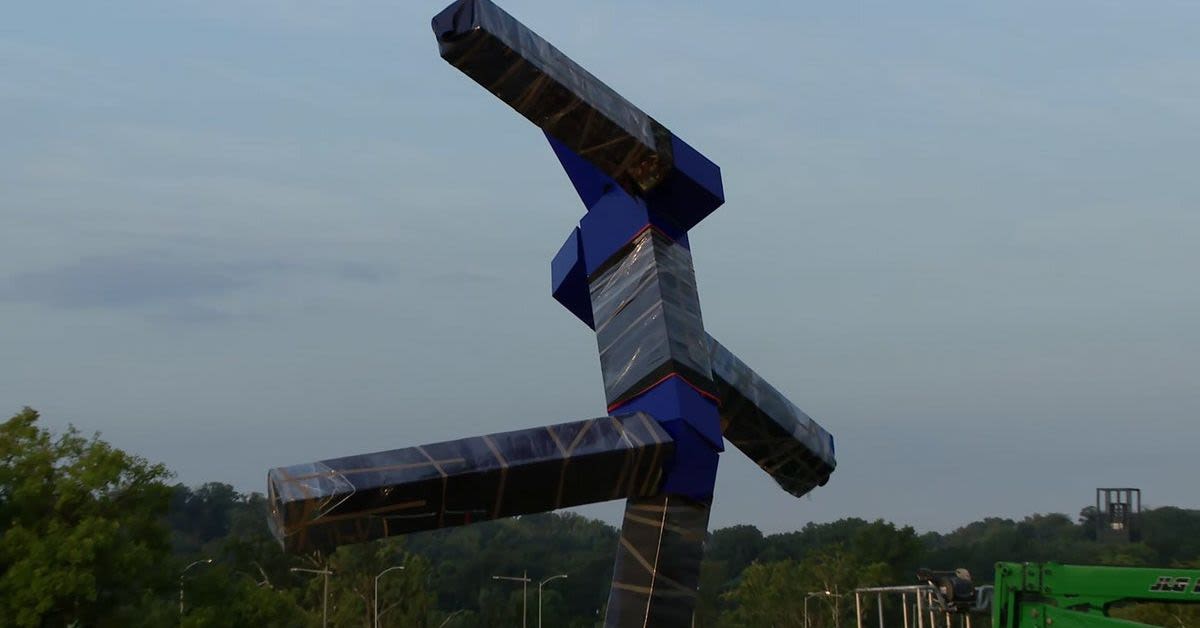
The New York Times has discovered a sudden reverence for public art now that a modernist steel sculpture outside the Kennedy Center is being carefully taken down, even though the same paper cheered when historic American monuments were toppled, defaced, or carted away during the Black Lives Matter statue purge.
The work in question, a towering blue steel construction by Joel Shapiro titled simply "Blue," resembles a stick figure caught mid-stride and was installed at the Kennedy Center as a gift from the artist in 2019. According to The Post Millennial, the Times now laments its removal, even as workers methodically dismantle the piece, which as of Wednesday was being taken apart section by section.
During the BLM-era wave of monument destruction, the Times did not mourn the loss of painstakingly crafted bronze equestrian statues and other tributes to American history; instead, the paper praised their removal as a moral and cultural necessity. "Blue" is not a historical artifact, nor does it commemorate any figure from the nations past, yet its removal has prompted a level of concern and ceremony that was conspicuously absent when statues of American heroes were hauled away.
The Times reports that Shapiros sculpture had been slated for removal by the Trump administration after his return to office in 2025, as part of a broader effort to reshape the Kennedy Center, including adding his name to the building. As the piece came down, its segments were "wrapped in protective material," and "an arm was the first to be removed," a level of care that stands in stark contrast to the treatment of Confederate General Stonewall Jacksons statue in Charlottesville, which was torn down amid the BLM fervor that saw hundreds of monuments to Americas past stripped from public spaces.
The bronze statue of Stonewall Jackson, created by sculptor Charles Keck and donated to the city of Charlottesville by a philanthropist in 1921, was not preserved or respectfully relocated. Instead, after its removal, it was transferred to a gallery in Los Angeles, which then handed it over to artist Kara Walker, who dismembered the work and transformed it into a grotesque "mutant" intended to combat "white supremacy." Shapiros "Blue" will not meet such a fate, despite the Times earlier enthusiasm for the literal mutilation of historic art.
The Kennedy Center has chosen to give "Blue" to a foundation dedicated to Shapiros work, allowing that organization to determine the sculptures future and potential exhibition sites. In a statement steeped in appreciation, the institution said, "We are deeply grateful to Joel Shapiro for the years 'Blue' has spent animating our campus and connecting visitors to his vision. We are honored to have been stewards of his vibrant work and part of his enduring legacy," underscoring the respect afforded to this contemporary piece.
Not everyone close to the artist is satisfied with the decision, however, and Shapiros family has voiced disappointment. His daughter remarked, "In Joel's mind, it was one of his greatest site-specific commissions, which celebrated joy, freedom and creativity," suggesting that the removal represents more than just a logistical adjustment to ongoing renovations.
Former Kennedy Center curator of visual arts and special programming, who was dismissed in March, also criticized the process and the lack of openness surrounding it. He argued that "The Kennedy Center is in effect holding these pieces in trust for the American people and there should be a lot more transparency," implying that decisions about public art should be subject to broader scrutiny and debate.
Yet this call for transparency and stewardship was nowhere to be found when countless statues were removed from American cities under the banner of fighting "white supremacy" during the BLM years. Activists, the Times reports, have now rallied to defend Shapiros "Blue," with the group Hands Off the Arts posting, "First they came for the facade and now they come for the grounds," a reference to Trumps decision to add his name to the Kennedy Center while overseeing a sweeping renovation, and staging a protest that featured a drag queen dancing in front of the sculpture.
The Times, which now treats the dismantling of "Blue" as a cultural loss, previously ran at least three pieces celebrating the destruction and reimagining of the Stonewall Jackson monument by Kara Walker. In those articles, the paper lauded Walkers remade work and the broader effort to tear down traditional monuments, describing the resulting exhibit as "radically new," as though erasing and mutilating historical art were a bold step forward rather than an act of cultural vandalism.
When left-wing activists in New York succeeded in pressuring officials to remove the statue of President Theodore Roosevelt from the entrance of the American Museum of Natural Historya statue he himself had commissionedthe Times again sided with the iconoclasts. The paper reported approvingly that "the equestrian memorial to Theodore Roosevelt has long prompted objections as a symbol of colonialism and racism," framing the removal as a moral correction rather than a loss of heritage.
"The decision," the Times wrote, "proposed by the museum and agreed to by New York City, which owns the building and property, came after years of objections from activists and at a time when the killing of George Floyd has initiated an urgent nationwide conversation about racism." In that context, the destruction of monuments to American leaders was cast as an enlightened response to a political moment, not as an erasure of history or an affront to artistic legacy.
Now, as the Kennedy Center undergoes renovations and prepares to replace Shapiros "Blue"potentially with a work of greater aesthetic or historical resonancethe Times suddenly discovers the virtues of "thoughtful, careful removal" and institutional stewardship. When the target is a contemporary steel abstraction and the villain, in their telling, is Donald Trump, the paper demands reverence and restraint, but when the subject is American history cast in bronze, they have been more than willing to applaud its destruction.
Login