
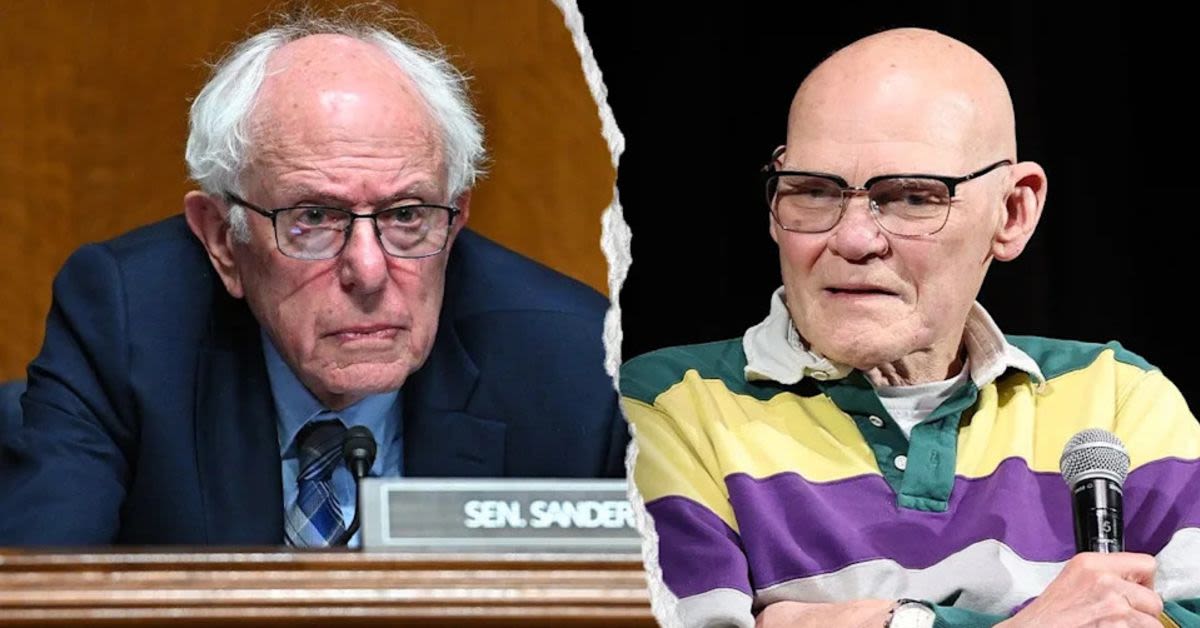
Independent Sen. Bernie Sanders of Vermont has escalated the Democratic Partys internal civil war by effectively telling longtime party strategist James Carville to leave if he cannot accept the partys increasingly socialist direction.
According to Western Journal, Sanders delivered his rebuke during an interview with CNNs Abby Phillip, where he was pressed to choose between Carville and left-wing influencer Hasan Piker, a prominent figure among younger progressives. Well, thats not much of a choice, Sanders replied, making clear his preference for the partys radical flank over its old-guard operatives.
The exchange came as Democrats held primary elections across the country, with Sanders closely watching Michigan, where his ideological ally Abdul El-Sayed narrowly won the partys Senate primary. The Vermont socialist used that moment to underscore his message to Carville, declaring, If Mr. Carville doesnt want to be in my party, in the party that I belong to, that Piker, that El-Sayed belongs to, he can start his own party.
Carville, speaking days earlier to Fox News, had already drawn his own line in the sand, insisting that the Democratic Party cannot accommodate both his brand of Clinton-era liberalism and Pikers hard-left activism. I am not going to be in the same party with Hasan Piker, Carville said, adding pointedly, If he becomes a force in the Democratic Party, Im out of here.
Their dueling comments, later juxtaposed in a clip shared on X, crystallized the widening gulf between traditional Democrats and the partys ascendant socialist wing. That wing has embraced figures such as Piker.
Carvilles alarm carries particular weight given his status as a Democratic icon, having engineered now-former President Bill Clintons 1992 victory and helped define the partys centrist, Third Way strategy of the 1990s. Sanders, by contrast, has spent the last decade trying to pull Democrats sharply leftward, mounting presidential bids in 2016 and 2020 that, while unsuccessful against former Secretary of State Hillary Clinton and now-former President Joe Biden, nonetheless shifted the partys policy agenda toward big-government economics.
In the years since Sanders first national run, the Democratic Partys far-left faction has not only persisted but gained institutional power. Democratic Mayor Zohran Mamdani of New York City, a self-described socialist, toppled former Democratic Gov. Andrew Cuomo of New York to capture the 2025 mayoralty of the nations largest city, a result that would have been unthinkable in the Clinton era.
That upset was not an isolated event but part of a broader pattern of progressive consolidation. In June, three Mamdani-endorsed socialist candidates for the U.S. House in New York ousted establishment-backed rivals in Democratic primaries, signaling that the partys activist base is increasingly hostile to moderates and open to full-throated socialism.
Rather than ebbing after those victories, the socialist surge has continued to roll through Democratic contests in other states. El-Sayeds win in Michigan on Tuesday stands as the latest data point, reinforcing the impression that the partys grassroots are steadily rewarding candidates who promise expansive government, identity politics, and aggressive cultural progressivism.
Despite Carvilles warnings, rank-and-file Democrat voters appear less interested in Clinton-style triangulation and more enamored with Sanders-style class warfare and redistribution. That shift has emboldened Sanders and his allies, who now see themselves not as insurgents on the fringe but as the partys ideological core.
Within that movement, Sanders reportedly views Democratic Rep. Alexandria Ocasio-Cortez of New York as the natural heir to his national project, a sign of how thoroughly the partys younger left has embraced democratic socialism. Yet even that succession plan is not uncontested, as Sanders insiders reportedly see Democratic Rep. Ro Khanna of California as a potential rival to Ocasio-Cortez for leadership of the movement.
For conservatives, the spectacle of Sanders effectively telling a party legend to start his own party underscores how far Democrats have drifted from the pro-growth, tough-on-crime, relatively moderate posture that once made them competitive nationwide. As socialisms influence grows and figures like Carville are pushed toward the exits, voters are left to decide whether the Democratic Party they once knew still exists or whether it has been replaced by a radical project that prioritizes ideological purity over common sense, public safety, and economic freedom.
Login