
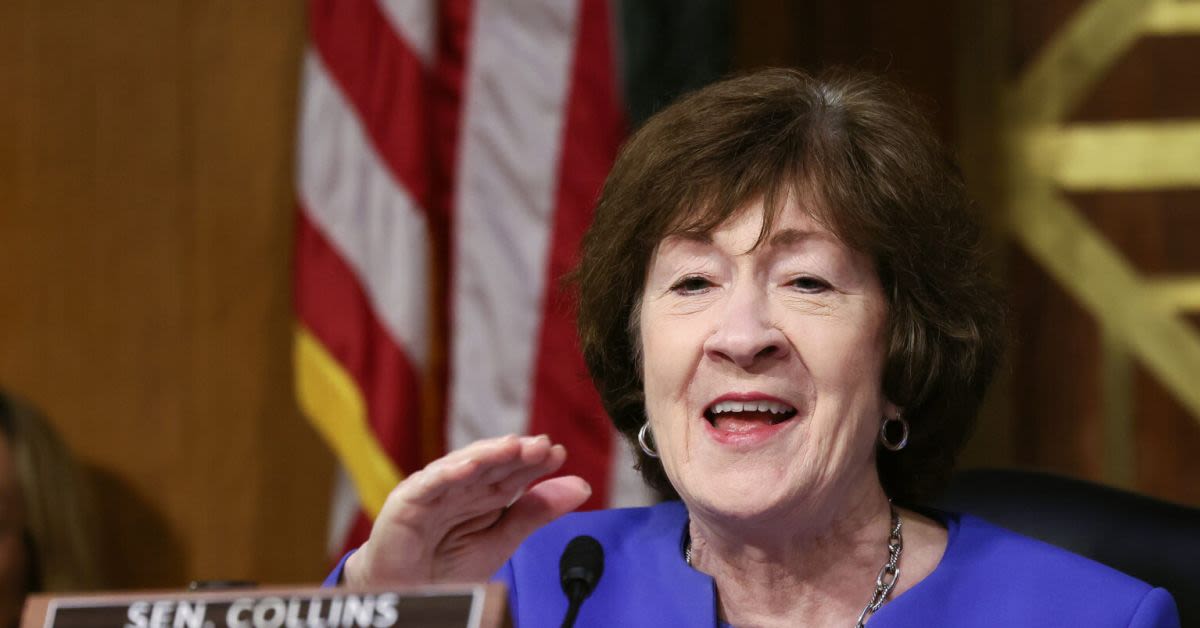
Sen. Susan Collins (R-ME) now appears narrowly ahead or locked in statistical dead heats against the leading Democrats vying to replace scandal-plagued Graham Platner on the ballot, as the embattled progressives campaign collapses under a wave of sexual assault allegations.
As reported by Breitbart, Platner suspended his U.S. Senate bid on Wednesday after a cascade of Democrats demanded he step aside, a dramatic reversal for a candidate once embraced by the partys left flank. A new Z to A Research poll released in the wake of his implosion shows a suddenly volatile race, with Democrats scrambling to find a viable alternative while Collins, a moderate Republican long targeted by national progressives, remains highly competitive in every tested matchup.
The survey of 988 likely voters, conducted July 78 with a margin of error of plus or minus 3 percent, pitted Collins against former Maine Center for Disease Control and Prevention Director Nirav Shah, Secretary of State Shenna Bellows and former state Senate President Troy Jackson, per NOTUS. In each scenario, Collins either leads or is within the margin of error, underscoring the difficulty Democrats face in converting outrage over Platners alleged conduct into electoral advantage.
The poll found Shah edging Collins 47 percent to 46 percent, Bellows tied with Collins at 4747, and Jackson trailing Collins 48 percent to 47 percent. All three results fall within the surveys margin of error of plus or minus 3.1 percentage points, meaning none of the Democrats can claim a clear lead despite Maines blue tilt in recent federal races.
Shah and Jackson have already declared their candidacies, moving quickly to fill the vacuum left by Platners collapse. Bellows, meanwhile, has said she is seriously considering entering the race, a decision that could further fracture the Democratic field and complicate efforts to consolidate support.
The Z to A Research poll was commissioned by a pro-Shah outside group, according to a person directly familiar with the research, highlighting the behind-the-scenes jockeying among Democratic factions. That sponsorship may raise questions about the surveys framing, but the topline numbers still suggest Collins remains far from the easy target national Democrats once imagined.
According to Politico, Platners own campaign scrambled to conduct a flash poll on Tuesday, seeking to identify which Democrat would be strongest against Collins after his scandal broke. That internal survey reportedly found that his former ally Troy Jackson had the best shot, leading Collins 49 percent to 44 percent, while Bellows and Shah were each tied with the Republican incumbent.
Maine U.S. Senate candidate Graham Platner (D) formally suspended his campaign on Wednesday after multiple women accused him of sexual assault and misconduct, allegations that have rocked the states Democratic establishment. He has denied the claims while attempting to shift blame onto what he describes as a hostile political and media environment.
My name might be on the ballot right now, but that ballot line belongs to the people of Maine, Platner wrote in a caption accompanying a video posted to X announcing his decision. In the video, he opened by telling supporters, As many of you know, over the past couple days, I have faced some very serious allegations, before insisting, I just want to make it clear: this is all false. The things that have been claimed did not happen. Its not real.
Platner went on to argue that the corporate media and political establishment had acted as judge and jury without affording him a full and fair investigation into the accusations. That framing, while echoing some populist critiques of media bias, has done little to stem the exodus of Democratic support as party leaders rush to distance themselves from the controversy.
On Tuesday, conservative commentator Lyndsey Fifield, who dated Platner between 2013 and 2014 and had previously accused him of physical abuse, told the Washington Post that he repeatedly removed condoms during sex after she explicitly told him she was not on birth control. The Platner campaign rejected her account, calling the allegations categorically false and politically motivated, but the detailed nature of her claims has intensified scrutiny of the former candidate.
He would pull condoms off, Fifield said. He would do it in a sneaky way. He wouldnt tell me. The outlet reported that Fifield first described the alleged condom removal during a June 20 interview that was off the record, but later chose to go public.
She told the Post she decided to speak on the record in part because she wanted to demonstrate that another accuser, Jenny Racicot, was not alone in experiencing issues with Platner involving sexual consent. Removing a condom during sex without consent, known as stealthing, is classified as a form of sexual assault in several countries, including Britain, Canada, and parts of Australia, and in the United States, Maine, California, and Washington state have enacted laws addressing the nonconsensual removal of condoms during sex.
Fifield alleged that Platner removed condoms an estimated six times during intercourse, and that when she confronted him, he brushed off her concerns. I confronted him both during and after [sex] because he knew that I was not on birth control and how dangerous that was, she said in one interview.
He would act like cute about it, like Oh sneaky me, she said in another, describing behavior that, if proven, would place Platner squarely within the legal and moral debates over consent that Democrats have often used as a political cudgel against Republicans. Fifield also shared this account with the New York Times in a previous off-the-record conversation, explaining that she initially declined to go public out of embarrassment about her private life.
At least one close friend, Emily Zanotti, corroborated that Fifield had confided in her about the alleged stealthing after the relationship ended. That contemporaneous disclosure could bolster Fifields credibility if any formal inquiry were to proceed, further undermining Platners insistence that the accusations are fabricated.
Fifields account followed an earlier allegation from Jenny Racicot, who told CNN that Platner sexually assaulted her in 2021, entering her home and raping her while intoxicated. Racicot said that one night in November or December 2021, Platner arrived at her house drunk after she had asked him not to come, then forcibly had sex with her despite her repeated pleas for him to stop, at one point knocking over a sewing cabinet and leaving a needle lodged in her leg.
When she confronted him the next morning, Racicot said, he claimed he did not remember what had happened. Her accusation triggered an immediate backlash within Democratic ranks, with prominent figures who had championed Platners candidacy suddenly demanding his withdrawal.
The pressure campaign included Sen. Bernie Sanders (I-VT), one of Platners most loyal allies, who joined scores of Democrats in urging him to exit the race to unseat Collins. For Republicans, the episode underscores the hypocrisy of a party that has long weaponized #MeToo rhetoric against conservatives, only to rally behind its own progressive standard-bearers until the political cost becomes too high.
As Democrats now scramble to anoint a replacement and repair the damage, Collins finds herself in a familiar position: underestimated by national progressives yet resilient with Maine voters who value stability over ideological crusades. With the race tightening and the left mired in a scandal of its own making, the party that promised moral clarity is instead confronting the consequences of its double standards, while a veteran Republican senator stands poised to benefit from the chaos.
Login