
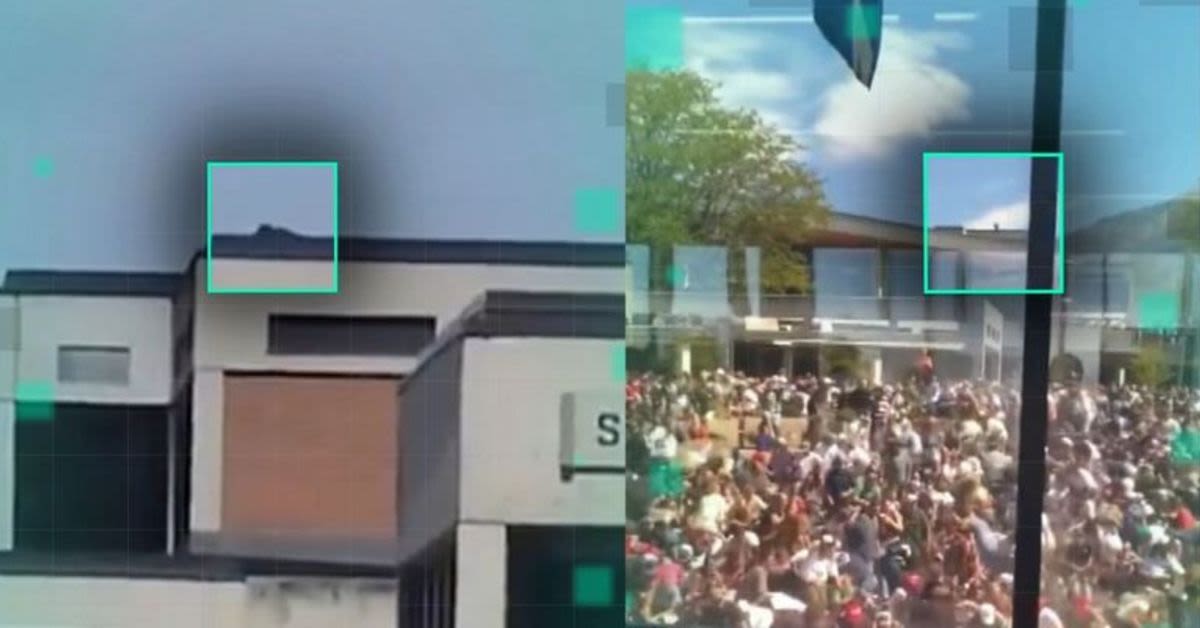
A former campus police officer told a Utah courtroom that he discovered what appeared to be a sniper pad on a rooftop overlooking the site where conservative activist Charlie Kirk was assassinated, as prosecutors moved to persuade a state judge they have sufficient evidence to put a Utah man on trial for murder.
According to The Associated Press, former Utah Valley University police officer Christopher Bagley testified that he was present on campus on Sept. 10 when Kirk, a prominent conservative organizer and ally of President Donald Trump, was shot while addressing a crowd of thousands. Bagley said he watched Kirk speaking when a single gunshot rang out, sending the event into chaos and prompting him to search for the source of the attack.
He then made his way to a nearby gravel rooftop, where he said the scene suggested that someone had been lying in a prone firing position with an unobstructed line of sight to Kirk.
It looks like a sniper pad, Bagley testified, describing impressions in the gravel that, to his eye, indicated a shooter had been positioned there. You've got markings of elbows, knees, and feet, he added, underscoring prosecutors theory that the killing was a calculated, long-range assassination rather than a spontaneous act of violence.
The hearing unfolded under the watchful eyes of Kirks parents, Kathryn and Robert, and his widow, Erika, who attended the proceedings for the first time since the case began. They were joined in the courtroom by Donald Trump Jr., son of the president, whose political partnership with Kirk had helped galvanize a new generation of conservative voters.
Prosecutors are seeking the death penalty for the defendant, 23-year-old Tyler Robinson, who is charged with aggravated murder in what authorities describe as the targeted assassination of a nationally known conservative leader. The five-day preliminary hearing that opened Monday represents the most extensive presentation of evidence so far, a crucial step in determining whether Robinson will face a full jury trial.
While the first day did not produce dramatic new revelations, prosecutors did introduce previously unseen video that investigators say shows Robinson entering and exiting his vehicle on Sept. 10 and 11. Robinsons parents were also present in the courtroom, seated a few rows behind the Kirk family, a quiet but visible reminder of the human cost on both sides of the case.
Robinson surrendered to authorities the day after the shooting, a fact that has not yet been fully explained in open court. He has not entered a plea, and his defense team has declined to comment publicly on his guilt or innocence, focusing instead on procedural and evidentiary challenges.
Defense attorneys have already attempted, unsuccessfully so far, to remove the death penalty from consideration, a move that would dramatically alter the stakes of the prosecution. For now, the state continues to pursue the ultimate punishment, arguing that the killing of a high-profile political figure at a public event, with others in harms way, meets Utahs statutory aggravating factors.
During Mondays session, prosecutors played multiple videos of the shooting for state District Judge Tony Graf as they sought to establish the sequence of events and Robinsons alleged role. Attorneys for both sides angled their monitors away from the public gallery after Judge Graf ruled that the graphic assassination footage could not be disseminated publicly, citing its disturbing content.
Utah State Bureau of Investigations Agent David Hull took the stand to describe the videos in detail for the record. He testified that the footage showed the crowd mingling at the event, Kirk interacting with attendees, the moment the shot was fired, and the frantic efforts of Kirks security team as they lifted him, carried him away, and administered first aid.
Throughout the hearing, Robinson sat quietly between his lawyers, watching the prosecutions exhibits on a monitor and occasionally jotting down notes. His wrists were shackled to a chain around his waist, a stark visual of the gravity of the charges he faces.
Kirks family, visibly shaken, briefly left the courtroom on two separate occasions as the testimony and evidence became especially painful.
They stepped out once when Bagley began recounting Kirks arrival on campus the day of the shooting, and again when prosecutors prepared to show the graphic videos, but each time they returned to their seats.
Although the proceeding has the feel of a condensed trial, the legal threshold at this stage is significantly lower than what prosecutors must meet at a full criminal trial. They need only show that there are reasonable grounds to believe Robinson killed Kirk and should be bound over for trial, rather than proving guilt beyond a reasonable doubt.
That lower standard gives the state a considerable advantage at this juncture, according to legal experts. This standard is extremely low and the chances of them not getting through it are, quite frankly, almost nothing, said Mark Kouris, a former prosecutor and state judge in Salt Lake City who now teaches at the University of Utahs S.J. Quinney College of Law.
Bagley, called as the prosecutions first witness, testified that he had a clear view of the right side of Kirks body as the activist spoke to the crowd. Kirk was in the middle of answering a question when the shot rang out, Bagley said, describing the sudden shift from routine campus event to deadly ambush.
I saw him go to the left ... I could no longer see the right side of his body, Bagley recalled from the stand. Then everybody started getting up and started to run, more of a chaos situation, he added, painting a picture of panic as attendees scrambled for safety.
During cross-examination, defense attorney Kathryn Nester pressed Bagley about an empty pistol holster he said he found on the ground after the crowd dispersed. Bagley conceded that he never took custody of the holster and did not know whether it had been tested for fingerprints, a point the defense may use to question the thoroughness of the investigation.
The issue is particularly notable in Utah, an open-carry state where law-abiding citizens may carry firearms openly or concealed without a permit. That legal context raises questions about how many weapons were present at the event and whether investigators fully accounted for all potential sources of ballistic evidence.
Nester repeatedly objected to the states evidence, challenging the admissibility and reliability of certain exhibits. Judge Graf overruled most of her objections, allowing prosecutors to continue building their narrative, but did side with the defense on one key evidentiary dispute.
Graf blocked the introduction of a compilation of Utah Valley University surveillance videos after learning that some clips had been altered with zooms and circles drawn around individuals. Prosecutors responded that they would attempt to submit the footage again on Tuesday, this time stripped of any visual enhancements that could be construed as prejudicial.
Looking ahead, prosecutors have indicated they will present DNA evidence allegedly linking Robinson to the suspected murder weapon, along with autopsy results, additional witness statements, and more video of the killing. They also intend to argue that the shooting placed numerous other people at risk during Kirks campus appearance, an aggravating factor that could support a death sentence under Utah law.
The state further alleges that Robinson effectively confessed in a handwritten note left for his roommate, who was also his romantic partner. I had the opportunity to take out Charlie Kirk and I'm going to take it, the note reportedly read, a chilling declaration that, if authenticated, would underscore the premeditated nature of the crime.
Robinsons roommate is not expected to testify in person during the preliminary hearing, but recorded testimony is likely to play a central role in the prosecutions case. In addition to the note, prosecutors say Robinson texted the roommate that he targeted Kirk because he had enough of his hatred, a statement that, if accurate, suggests a politically or ideologically motivated attack on a conservative figure.
Before his death, Kirk and the organization he co-founded, Turning Point USA, were instrumental in mobilizing young conservative voters and bolstering support for Trumps successful bid for a second term.
His assassination has been viewed by many on the right as not only a personal tragedy but also a direct assault on a leading voice for limited government, free markets, and traditional American values.
President Trump has publicly stated that he hopes Robinson receives the death penalty, reflecting the anger and grief felt across much of the conservative movement. For many of Kirks supporters, the case has become a test of whether the justice system will respond forcefully when political violence is directed at those on the right, just as it does when the targets are on the left.
Despite the enormity of her loss, Erika Kirk has spoken of forgiveness, a stance that stands in sharp contrast to the hatred prosecutors say motivated the attack. At her husbands memorial service, she said she forgives Robinson, and ahead of Mondays hearing she issued a statement thanking supporters for their prayers and compassion.
Every court proceeding serves as a painful reminder of his death, she wrote, and the loss that has irrevocably impacted our lives and the lives of his children. Her words underscore the enduring human cost behind the legal arguments, as a young family grapples with the permanent absence of a husband and father whose public mission was to champion conservative principles and energize Americas youth.
As the preliminary hearing continues, the court will weigh a growing body of physical evidence, digital records, and witness testimony against a relatively modest legal standard.
For conservatives who saw Charlie Kirk as a vital defender of constitutional liberties and a counterweight to progressive dominance on campus, the proceedings are about more than one mans fate; they are a measure of whether the rule of law will respond decisively to an apparent act of political assassination carried out in the heart of academia.
Login