
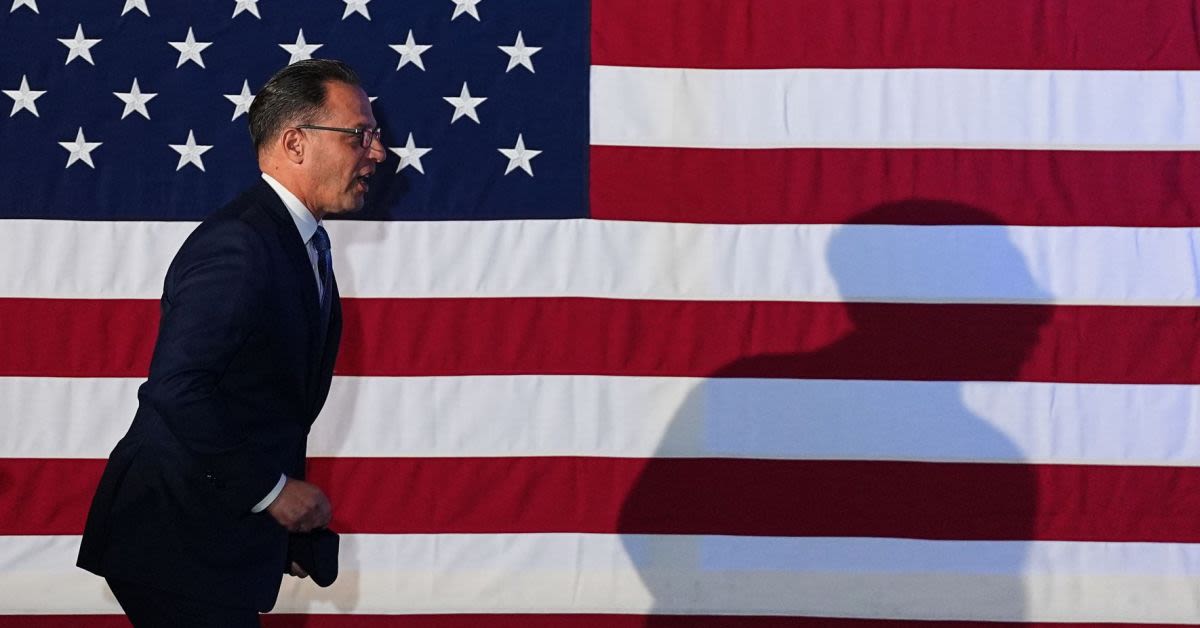
The Democratic Partys dwindling moderate wing is sounding the alarm as the far-left faction tightens its grip on the partys agenda and identity.
At a time when many Democrats appear content to chase the loudest voices on the fringe, Pennsylvania Governor Josh Shapiro and Senator John Fetterman stand out as two of the last remaining figures even loosely associated with moderation. According to RedState, their presence only underscores how thoroughly the party is being pulled toward its most radical elements, a shift that should trouble not only centrist Democrats but also any voter who still expects a major party to be tethered to reality rather than ideological extremism.
Shapiros latest warning came during an appearance on CNNs State of the Union with host Dana Bash, where he was pressed about the rise of openly socialist and far-left candidates within his party. Bash highlighted one such figure, Darializa Avila Chevalier, a Columbia PhD candidate and activist whose platform reads like a wish list for the hard left.
There is Darializa Avila Chevalier, she was a PhD candidate at Columbia, an organizer, she called for the abolition of prisons, open borders, end to deportations, even of people convicted of violent crimes, Bash said, noting that Chevalier attended a pro-Palestinian rally on October 8th, 2023. Um, a rally that reportedly featured some real antisemitic rhetoric justifying the attack. How do you feel as a Democrat about someone with those views being in the United States Congress? The question laid bare the tension between the partys traditional base and its increasingly radical activist class.
Shapiros response was cautious but revealing, acknowledging both the democratic process and his deep disagreement with Chevaliers agenda. Well, her district voted for her. But I have profound differences from that particular candidate, based on the citations that you read there, he replied, making clear that her views are far outside his own value set.
He continued by distancing himself further from the far-left platform Chevalier represents. And she's not someone who, you know, seemingly, I would agree with on many things, or that we share similar values. She ran on the Democratic ticket, I guess as a socialist, her voters in that district determined that she was the one they wanted representing (them.)
Bash then pressed the obvious follow-up: What does that tell you about your party? It was a question that forced Shapiro to confront the broader ideological drift within Democratic ranks.
His answer was striking in its candor, and in its implicit admission that the party has avoided a serious internal reckoning for decades. I think that what our party has to go through, that will be very healthy, and something that we've not really done since the 1992 elections, is to have a battle over what we believe in, Shapiro said, effectively calling for an ideological showdown that many party leaders have long tried to avoid.
He is not wrong to see such a battle as overdue, but the timing may be disastrous for those hoping to salvage a sane, center-left coalition. Between years of Trump Derangement Syndrome and the steady advance of what can only be described as a communist wing inside the party, the old guard has either retreated or capitulated, embracing policies they would have rejected outright not long ago.
A report in the New York Post, cited in the discussion, underscores Shapiros precarious position. It notes that Shapiro is widely seen as a comparatively moderate figure within the Democratic Party, though unlike Sen. John Fetterman (D-Pa.), the Pennsylvania governor is careful about picking fights with the far left. That caution reflects the reality that the far-left activists are no longer a mere sideshow but a powerful internal bloc.
The same report observes that Chevalier campaigned heavily against Israel, an issue that will likely become a problem for Shapiro if he runs for the Democratic presidential nod in 2028. In a party where anti-Israel sentiment and open hostility to Jewish self-determination are increasingly tolerated, a Jewish governor who supports Israel finds himself on a collision course with his own base.
Prediction: Shapiro will not run for president in 2028, not because he lacks ambition or political skill, but because the party he would need to lead is rapidly becoming unrecognizable to anyone with even a modest attachment to traditional liberalism. The fringe may no longer be the fringe at all; it is fast becoming the center of gravity, while those who once defined the partys mainstream are pushed to the margins or silenced.
The Irish poet William Butler Yeats captured this kind of moment in his famous lines: Turning and turning in the widening gyre / The falcon cannot hear the falconer; / Things fall apart; the centre cannot hold; / Mere anarchy is loosed upon the world, / The blood-dimmed tide is loosed, and everywhere / The ceremony of innocence is drowned; / The best lack all conviction, while the worst / Are full of passionate intensity. For todays Democrats, the centre is plainly failing to hold, and the passionate intensity is coming from the most radical corners of the party.
The problem for the few remaining moderates is not only ideological but moral, particularly on the question of Israel and antisemitism. The same far-left faction that demands abolition of prisons, open borders, end to deportations, even of people convicted of violent crimes is also the faction that turns out for rallies that reportedly featured some real antisemitic rhetoric justifying Hamass October 7th atrocities, a reality that cannot sit easily with a Jewish governor like Shapiro.
Shapiro is correct that Democrats need to have a battle over what we believe in, but the activists driving the party leftward show little interest in honest introspection. They operate with a near-religious zeal, convinced of their own righteousness and contemptuous of dissent, a pattern conservatives have long recognized in committed ideological radicals.
Whether the Democratic Party can survive this internal conflict as a coherent national institution is an open question. It is not unthinkable that the party could fracture, Whig-style, into competing factionsone openly socialist and anti-Israel, the other clinging to a fading vision of center-left governanceleaving voters to decide whether there is any room left in Democratic politics for moderation, sanity, and support for Western values.
Login