
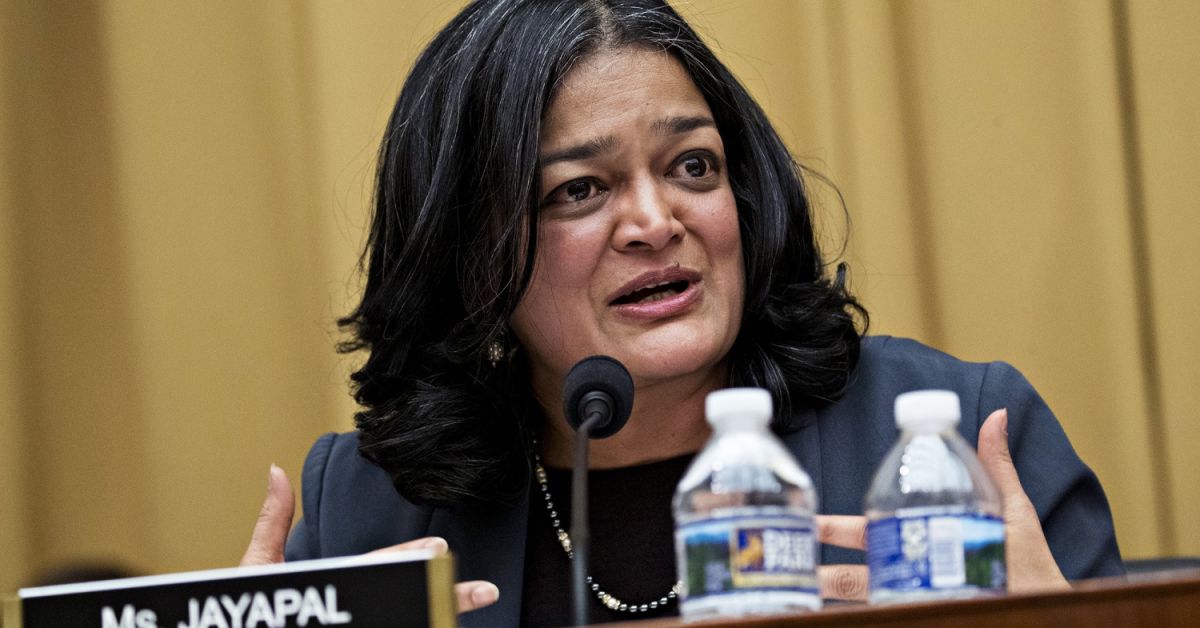
Democrat Rep.
Pramila Jayapal of Washington has acknowledged working directly with foreign diplomats to help move oil into communist Cuba in defiance of aggressive US sanctions enacted under President Donald Trump.
According to The Post Millennial, Jayapal told constituents at a recent town hall that she has been in contact with ambassadors from Mexico and other Latin American nations to coordinate energy shipments to Havana, despite clear US policy aimed at isolating the regime. The remarks raise serious questions about a sitting member of Congress engaging with foreign governments to undermine sanctions that President Trump has framed as vital to American national security and to countering the Cuban dictatorship.
"I was in conversations with the ambassadors from Mexico and some other places, other countries in Latin America, trying to figure out how to get oil there," Jayapal admitted, noting that Russia has also "pledged to send another tanker." She stressed the importance, in her view, of maintaining a steady flow of oil to the island, even as federal restrictions are designed to cut off precisely that lifeline to the communist regime.
The congresswoman went further, denouncing US sanctions as an "economic bombing of the infrastructure of Cuba," and asserting that "it is illegal" and "against international law." Yet as a member of the US House of Representatives, her constitutional duty is to American law and American interests, not to vague notions of international norms that often serve as a shield for authoritarian governments.
In separate public comments, Jayapal framed her position in the language of climate activism, declaring, "The climate crisis is the single biggest threat facing humanity, and if we are going to address it at the scale needed to limit global warming to not more than 1.5 degrees Celsius, we are going to have to work together." She added that "We are going to need unprecedented levels of global cooperation and collaboration to meet everyone's basic needs, including food, clean water and keeping the communities we call home habitable."
She then attempted to link sanctions policy to environmental and humanitarian concerns, arguing, "At the same time, we increasingly rely upon sanctions as a key foreign policy lever. The material impact of sanctions is known to undermine the human rights of civilians who can get cut off from access to basic needs, often the same basic needs that are threatened by the very climate crisis, as we see increasingly more frequent extreme weather events."
President Trump, now in his second administration, has taken a markedly different approach, signing a January 2026 executive order imposing tariffs on "goods from countries that sell or otherwise provide oil to Cuba." The order makes clear that the sanctions are intended to protect "US national security and foreign policy from the Cuban regime's malign actions and policies," and the president strengthened those measures on May 1, 2026, by adding penalties on foreign banks and firms that continue doing business with Havana.
Jayapal has portrayed these steps in the harshest possible terms, claiming the sanctions are designed to "ensure that [Cuba's] infrastructure collapses." Her rhetoric aligns with a long-standing progressive campaign to dismantle the embargo, even as the Cuban regime continues to repress dissent, jail political opponents, and export instability across the region.
The current policy framework toward Cuba was further solidified in June 2025, when President Trump issued a National Security Presidential Memorandum to ensure that "engagement between the United States and Cuba advances the interests of the United States and the Cuban people." During his first term, he restored Cubas designation as a State Sponsor of Terrorism, reversing the Obama-era normalization push that had rewarded the regime without securing meaningful reforms.
Jayapal, who led a congressional delegation to Cuba in early April, has emerged as one of the most vocal opponents of President Trumps embargo, choosing to side with a communist government over her own countrys carefully calibrated sanctions strategy. Her admission of back-channel coordination with foreign ambassadors to move oil into Cuba will likely intensify scrutiny over whether progressive lawmakers are actively working to blunt US pressure on hostile regimes at the very moment the administration is seeking to hold them accountable.
Login