
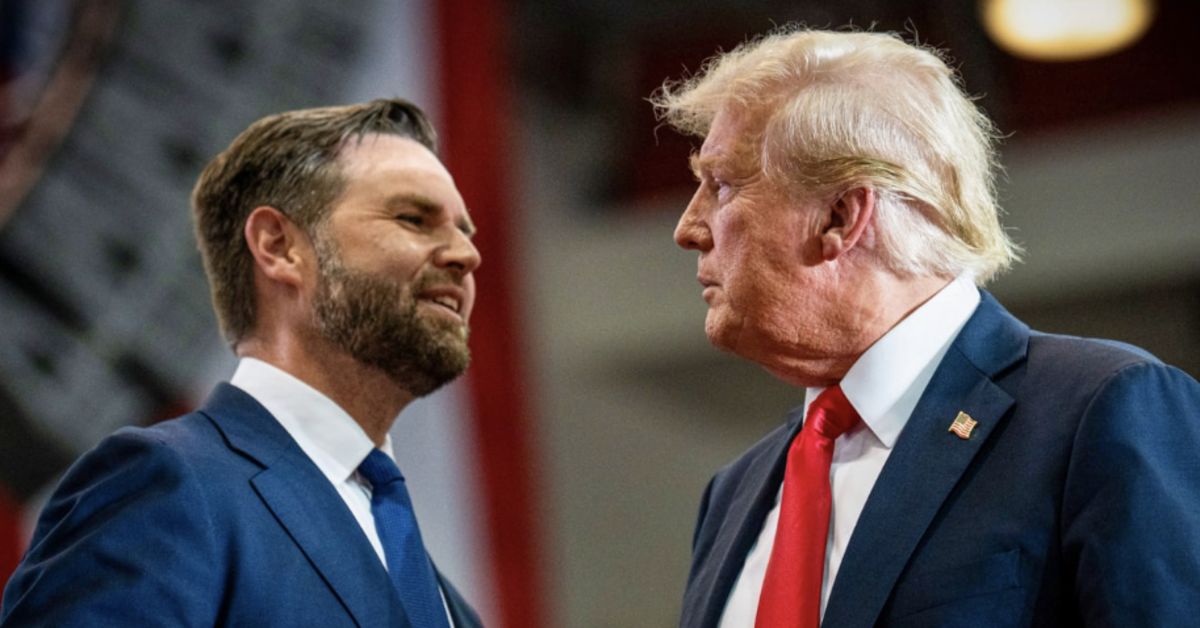
Vice President J.D. Vance is framing the escalating conflict with Iran in explicitly moral and spiritual terms, stressing that American leaders must pray the United States is aligned with Gods will as it seeks to block Tehran from ever acquiring a nuclear weapon.
Speaking at a press conference in Hungary, Vance was pressed on whether he shared President Donald Trumps oft-repeated assertion that God is on our side in relation to U.S. military operations against Iran, as reported by Western Journal. Trump has argued that America stands on the side of good in the confrontation, casting the struggle as one between a free nation and a terror-sponsoring regime bent on destabilizing the region and threatening its neighbors.
The Washington Posts Natalie Andrews directly challenged Vance on this theological framing, asking, Theres been some rhetoric from your administration about this war, about God supporting the United States and this war and the strikes against Iran being part of Gods will. Do you agree with that and what do you make of the idea that God is on the side of the U.S. and these strikes?
Vance responded by emphasizing humility before God rather than presuming divine endorsement of every American action, while still defending the moral basis of the administrations strategy. I think my attitude towards military conflict has always been to pray that we are on Gods side and my own view is we are doing this for the right reasons. Were doing this because we dont want a regime that has committed acts of terrorism to have the worlds most dangerous weapon, Vance said.
He underscored the human cost that would follow if Iran were allowed to cross the nuclear threshold, making clear that the administration views prevention as a moral imperative, not merely a geopolitical calculation. Because that would mean a lot of innocent people [would be] dead. I certainly hope that God agrees with the decision that Iran shouldnt have a nuclear weapon, but Ill keep praying about it, and if He gives me a good answer, youll be the first to know, Natalie.
Vances remarks came as the U.S. military executed a major strike campaign against Iranian assets, signaling that Washington is prepared to back its diplomatic demands with force. The United States launched strikes on more than 50 military targets on Kharg Island on Tuesday, just ahead of Trumps 8 p.m. deadline for Tehran to accept terms to end the war.
The operation unfolded while Iran continued efforts to assert control over the Strait of Hormuz, the strategic chokepoint through which a significant share of the worlds oil exports pass, tightening its grip on global energy flows. That brinkmanship has already hit American consumers, with gas prices in the U.S. surging by 35 percent since the conflict began on Feb. 28, a reminder of how foreign policy weakness can quickly translate into economic pain at home.
Reporters also pressed Vance on whether a diplomatic breakthrough remained possible before the deadline, or whether the region was sliding toward a broader and more protracted confrontation. Vance laid out a stark choice for Tehran, saying Iran could either agree to end the war and abandon its terror campaigns, or face mounting isolation and economic devastation.
If the Iranians dont come to the table, and they stay committed to terrorism [and] to terrorizing their neighbors, not just Israel, but of course their Arab neighbors too, then the economic situation in Iran is going to continue to be very, very bad and frankly will probably get worse, Vance said. And so, what the president has asked his entire team to do, particularly Steve Witkoff and Jared Kushner, is to figure out what are the contours of a potential deal. What are they willing to do? Because militarily, it frankly doesnt matter one way or the other to us, its fundamentally a question of what does this look like afterwards and thats what the negotiations have been focused on.
Trump, for his part, has not softened his rhetoric, warning that the stakes extend far beyond a simple territorial dispute or a temporary blockade. On Tuesday, he cautioned that a whole civilization will die because Iran appears unlikely to negotiate in good faith or reopen the Strait of Hormuz by the deadline, a grim assessment that reflects years of Iranian intransigence and sponsorship of terror.
At a Monday briefing, Trump was also asked whether he believed God was on his side in the conflict, a question that goes to the heart of how he views Americas role in the world. I do, because God is good, Trump said.
He elaborated by tying divine goodness to the protection of innocent life and the rejection of needless suffering, pushing back against critics who claim he relishes confrontation. Because God is good and God wants to see people taken care of. God doesnt like whats happening. I dont like whats happening. Everyone says, I enjoy, I dont enjoy this. I dont enjoy it.
Taken together, the comments from Trump and Vance reflect a conservative worldview that sees the United States as having both a right and a duty to confront regimes that export terror and seek nuclear weapons, even as leaders acknowledge the gravity of invoking God in matters of war and peace. With Iran tightening its hold on a vital energy corridor, American gas prices spiking, and the White House insisting that Tehran must choose between negotiation and deepening isolation, the administration is signaling that moral clarity, strategic strength, and a willingness to actbacked by prayer rather than apologywill define its approach in the days ahead.
Login