
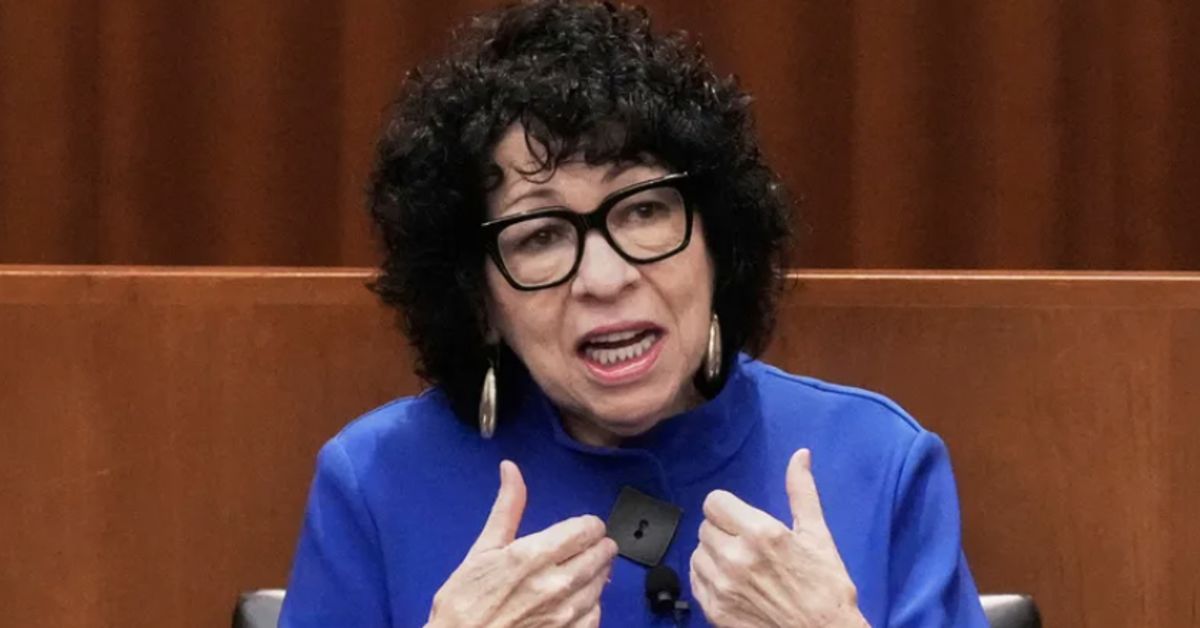
Liberal Justice Sonia Sotomayor has again thrust the Supreme Court into the political spotlight, this time by publicly disparaging a colleague in a manner that breaks sharply with the courts long-standing norms of restraint and mutual respect.
Speaking at an event hosted by the University of Kansas School of Law, Sotomayor delivered remarks that, according to Western Journal, were widely understood as a pointed rebuke of Justice Brett Kavanaugh, despite her refusal to mention him by name. She revisited a prior immigration case in which the court temporarily halted lower-court efforts to block Immigration and Customs Enforcement agents from carrying out their duties, a decision accompanied by a concurrence from Kavanaugh that emphasized the limited nature of the detentions.
I had a colleague in that case who wrote, you know, these are only temporary stops, Sotomayor said, leaving little doubt as to whom she meant. That concurrence, which treated the detentions as brief and largely inconsequential, has long been a target of progressive criticism, but it is unusual for a sitting justice to single out a peer so directly in a public forum.
Sotomayor went further, turning from legal analysis to personal background as she questioned whether Kavanaugh could truly grasp the realities faced by working-class Americans. This is from a man whose parents were professionals, she said. And probably doesnt really know any person who works by the hour.
In contrast to Kavanaughs view that such detentions would be short and uneventful, Sotomayor argued that even a brief interruption can be devastating for hourly workers living paycheck to paycheck. Those hours that they took you away, nobodys paying that person, she said. And that makes a difference between a meal for him and his kids that night and maybe just cold supper.
Her latest comments follow an increasingly strident pattern. As the New York Post reported, Sotomayor joined an angry dissent last September that declared, We should not have to live in a country where the government can seize anyone who looks Latino, speaks Spanish, and appears to work a low wage job.
While she again avoided naming Kavanaugh, the implication was unmistakable and raises the prospect of palpable tension when the justices next convene behind closed doors. For generations, the court has prized decorum, symbolized by traditions such as the judicial handshake, and embodied in unlikely friendships like that between conservative Justice Clarence Thomas and the late liberal Justice Ruth Bader Ginsburg.
Recently, however, that civility has shown signs of strain, and the friction has often centered on the courts most junior member. Kavanaugh has already had to defend himself in March when ultra-progressive Justice Ketanji Brown Jackson publicly chided him at a separate event, injecting ideological theater into what once would have been a staid judicial appearance.
Nor is the discord confined to ideological clashes between left and right. Reports suggest that Jackson herself has drawn criticism from fellow liberal justices, hinting at broader fractures within the courts progressive bloc even as President Trumps second administration continues to appoint jurists committed to textualism and constitutional limits on government power. For conservatives who value judicial restraint and institutional dignity, Sotomayors latest broadside underscores a growing concern: that some on the left are increasingly willing to sacrifice decorum and collegiality in service of a political narrative that paints immigration enforcement and traditional jurisprudence as inherently suspect.
Login