
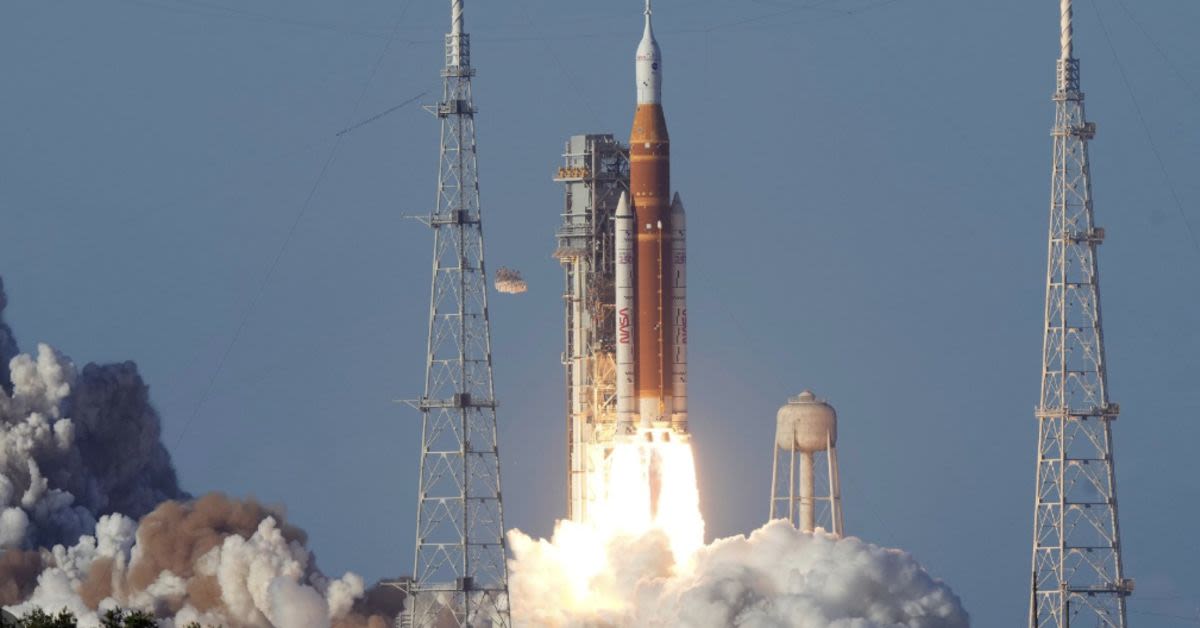
Sitting alone in a grocery store parking lot with a smartphone balanced in hand, a Western Journal writer found himself transported back to childhood as he watched NASAs Artemis mission roar toward the moon only to be jolted back to earth by a live comment section that insisted none of it was real.
The launch itself, which the author describes as a historic and joyful moment that God willing, will see a crew of four astronauts return home after making a pass around the moon, quickly became secondary to the spectacle unfolding beneath the video. According to the Western Journal columnist, YouTube viewers flooded the stream with claims that the mission was an outright fake, despite the fact that the liftoff was visible to countless people in real time.
In the comments, artificial intelligence was blamed for fabricating the images, aliens were cited as shadowy players, and some insisted the entire event was a diversion from looming catastrophes such as the planets magnetic field dying or hidden germs in Antarctica. As reported by the author, a surprising number of users confidently asserted that a Hollywood studio was the true launch site, repeating that assertion more times and by more people than I could count.
Initially, the writer tried to dismiss the online paranoia, but the unease lingered long after the rocket cleared the tower. It was not a matter of wounded pride that others did not share his enthusiasm for a lunar mission; rather, it was the dawning realization that more and more people are treating even basic facts as negotiable or as if everything is objective.
The Western Journal piece argues that this erosion of shared reality extends far beyond spaceflight. When the author reminds people that Israel exists in a constant state of fighting for survival and that its founding was shaped by the Holocaust, he encounters individuals who simply deny that the Holocaust ever occurred. Some go so far as to tell him that his own grandfather did not actually witness a German death camp in 1945 in the way he recounted in his later years, and a few even insinuate that such reminders of history mark him as an agent of Mossad.
The same pattern emerges when he recounts having met Apollo 11 astronaut Neil Armstrong, a memory he describes as a genuine pleasure. According to the author, his smile has at times faded when he is informed that Armstrong was just an actor who never even left the Earths atmosphere, a claim that neatly erases one of the most documented achievements in human history.
This pattern of suspicious, goal-post-moving thought, the writer warns, is not sustainable as it continues to spread. He is careful to note that he is no nave defender of government power; in fact, he recalls that in his youth he was branded a right-wing extremist and a conspiracy theorist more times than I could ever count.
From his perspective, skepticism toward authority is not only understandable but necessary in a free society. I understand as well as anyone the importance of scrutinizing what I am being told by authority, he writes, yet he now finds himself derided as a sheep simply for saying he watched a spacecraft take off from Florida on Wednesday evening.
The descent into unreality is captured in a single, chilling refrain from the livestream chat: space isnt real. According to the Western Journal author, that sentiment is no longer a fringe opinion, but one that has seeped into mainstream online discourse, especially among younger and deeply disillusioned audiences.
Conservative commentator Michael Knowles of The Daily Wire became a case study in this phenomenon during his own livestream of the Artemis launch. As reported by the columnist, Knowles walked into the background of his shot and interacted with the environment to show it was real, and not simulated, attempting to prove to viewers that he was physically present in Florida.
Even that was not enough for the doubters, who instantly shifted the narrative rather than concede the point. The author notes that it didnt matter to many who were watching, as doubters pivoted to claiming the grass was fake, a textbook example of how conspiracy thinking continually moves the target to preserve itself.
The writer concedes that people are right to distrust authority, pointing to years of media lies, government coverups, curated narratives, and failures in Washington that have conditioned citizens to assume they are being misled at least part of the time. From a conservative vantage point, this distrust is a rational response to institutions that have repeatedly abused power, manipulated information, and sneered at ordinary Americans.
Yet the technological environment has supercharged that distrust into something more corrosive. According to the Western Journal piece, AI, deepfakes, and out-of-context videos have made nearly everything look or sound suspicious at first glance, blurring the line between legitimate skepticism and reflexive nihilism.
Once people feel they have been lied to enough, the author argues, they naturally default to doubt, and that instinct is being ruthlessly exploited. It doesnt help that they are being taken advantage of by hucksters online, he writes, pointing to a digital ecosystem where grifters monetize outrage, paranoia, and endless suspicion.
After two decades of social media dominance, the writer sees a grim pattern emerging. Sadly, it appears the true function of social media after two decades is that it has replaced shared facts with personal realities, he observes, suggesting that the platforms have fractured the public square into countless, self-contained echo chambers.
Within those echo chambers, so many people have formed hives wherein they build their own version of the world and defend it. The result, according to the Western Journal columnist, is a society that cannot even agree on basic facts, like whether Michael Knowles was in Florida on Wednesday, or whether the planet is spherical.
That breakdown raises an urgent question: How long can we go on like this? The author warns that our interconnected lives rely on at least some shared understanding of what is real, and that is disappearing quickly, threatening everything from civic order to scientific progress.
Once a shared objective reality is stripped away, he cautions, everything and I mean everything is in danger of crumbling. The mainstreaming of radical doubt, where people now question even something as simple as the clouds in the sky, does not, in his view, point to anything or anywhere good.
From a conservative standpoint, the stakes could not be higher, because a free society depends on both healthy skepticism and a baseline of agreed-upon truths. We can either strive for a world where fundamental realities matter, the Western Journal writer concludes, or we can accept that at this rate, nothing will matter at all, and confusion will rule.
That leaves a final, unresolved challenge hanging over the Artemis launch and everything it symbolizes: The question is, where do we go from here? How do we get people in the same book, or even on the same page one where everyone agrees the lines on the page are actually there?
Login