
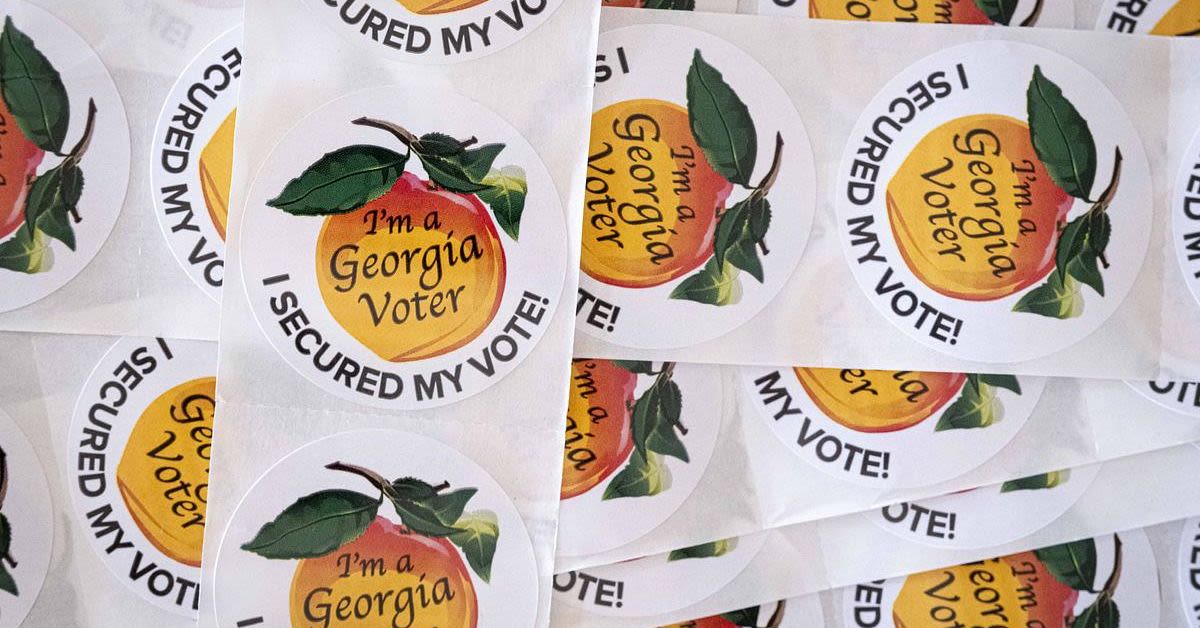
The Georgia General Assembly adjourned its annual session early Friday without agreeing on how to comply with a looming July deadline to overhaul the states voting equipment, leaving the mechanics of Novembers elections in a key battleground state mired in uncertainty.
According to The Associated Press, lawmakers departed Atlanta after months of wrangling without a concrete plan to replace or reprogram the Dominion Voting Systems machines now used statewide, despite a 2024 statute that bans the use of barcodes or QR codes to tabulate votes. The failure to reconcile that new prohibition with existing lawwhich still mandates the use of the Dominion machineshas created a legal and logistical collision course that could force courts, or possibly a special legislative session, to step in where the legislature has so far refused to act.
Democrats, who have long sought to cast doubt on Republican stewardship of Georgias elections, seized on the stalemate to accuse the GOP majority of dereliction, even as many Republicans themselves had pushed for reforms in response to grassroots concerns about election integrity. Theyve abdicated their responsibility, Democratic state Rep. Saira Draper said, blaming Republicans who control both chambers for failing to resolve the conflict before the clock ran out.
At the center of the dispute is Georgias current system, in which voters make their selections on Dominion touchscreens that then print a paper ballot containing both human-readable text and a QR code, with scanners reading the code to tally votes. Those machines have been repeatedly targeted by President Donald Trump following his 2020 election loss, and Trumps Georgia supporters responded by enacting a law in 2024 that bans using barcodes to count votes, a move cheered by many conservatives who have demanded that what voters see on their ballots is exactly what gets counted.
Yet the legislature stopped short of funding or mandating any specific replacement, leaving counties in a bind: state law still requires them to use the Dominion machines, but the new statute forbids the very QR-based counting method those machines rely on. No money has been allocated to reprogram them, and lawmakers failed to agree on a replacement, creating a scenario in which local election officials are left to navigate contradictory legal commands with no clear path forward.
House Governmental Affairs Committee Chairman Victor Anderson, a Republican from Cornelia, warned colleagues that the state is now on track for a direct statutory clash once the barcode ban takes effect.
Well have an unresolvable statutory conflict come July 1, Anderson said, noting that he had backed a proposal to keep using the machines through 2026a compromise that House Republicans and Democrats supported but Senate Republicans refused even to consider.
Under Andersons plan, Georgia would have been required to adopt a voting process that did not rely on QR codes by 2028, giving the state several years to test, fund, and implement a new system without throwing the 2026 or 2028 election cycles into chaos. Election officials, who must actually administer whatever system lawmakers choose, preferred that phased approach, seeing it as the only realistic way to maintain orderly elections while addressing voter concerns about machine-based tabulation.
Draper, however, used the Senates refusal to move on the House-backed compromise to paint the upper chamber as reckless and politically motivated. The Senate has shown that theyre not responsible actors, Draper said, adding that Lt. Gov. Burt Jones, a Trump-endorsed Republican now running for governor, appeared more focused on preserving the presidents favor than on doing right by Georgia voters.
A spokesperson for Jones did not immediately respond to a request for comment early Friday, leaving his office silent amid accusations that political ambition had trumped practical governance. That silence has fueled speculation that internal GOP divisionsbetween those who want immediate, sweeping changes and those who favor a more measured transitionare complicating efforts to present a unified conservative approach to election reform.
On the front lines of election administration, county officials are now looking to the executive branch and the courts for direction in the absence of legislative clarity. Joseph Kirk, Bartow County election supervisor and president of the Georgia Association of Voter Registration and Election Officials, said he will look to the secretary of state for guidance and assumes a judge will ultimately have to instruct election officials how to proceed, acknowledging, This is uncharted territory.
The office of Secretary of State Brad Raffensperger, a Republican who is also running for governor and who has often found himself at odds with Trump-aligned activists, signaled that it will adhere strictly to whatever legal framework is ultimately determined. Robert Sinners, a spokesperson for Raffensperger, said officials are ready to follow the law and follow the Constitution, a statement that underscores the tension between statutory mandates that now appear to conflict.
Republican House Speaker Jon Burns defended his chambers cautious posture, arguing that sweeping changes so close to a major election could undermine both administrative competence and public confidence. You cant change horses in the middle of the stream, Burns said, explaining that House leaders had sought to minimize disruptions this year even as they recognized the need to address the QR code issue in the longer term.
Burns added that he would meet with Gov. Brian Kemp to take his temperature" on the possibility of calling lawmakers back to Atlanta for a special session, a move that could allow the General Assembly to repair the statutory conflict before it fully takes effect. A spokesperson for Kemp, the outgoing Republican governor, did not answer questions about what he would do, leaving open whether the executive branch will intervene to force a legislative fix or allow the courts to sort out the mess.
Anderson warned that if no action is taken, Georgia could be forced into a rapid and potentially chaotic shift to hand-marked and hand-counted paper ballots for the November election. He said that scenario, while favored by some activists, would be extraordinarily difficult to implement on such short notice, especially in a high-turnout presidential year when logistical missteps could fuel further controversy over election integrity.
Election officials across the state have echoed those concerns, stressing that while they can adapt to new rules, they cannot conjure up new systems, training, and equipment overnight simply to satisfy political demands. They argue that switching to a new system within just a few months, as advocated by some Republicans, would be nearly impossible without risking delays, errors, and confusion at the polls.
Cherokee County elections director Anne Dover criticized lawmakers for imposing a deadline without providing a workable path to meet it, suggesting that the legislature had prioritized symbolism over substance. They made no way for this to happen except putting a deadline on it," Dover said of the mandated switch away from barcodes, noting that one practical problem under some proposed plans is that a very large number of ballots would have to be printed and managed securely.
In Paulding County, Election Supervisor Deidre Holden voiced frustration that political theater appeared to have overshadowed the nuts-and-bolts realities of running elections. Lawmakers seemed more concerned about scoring political points than making practical plans, she said, warning that such an approach leaves local officials to shoulder the burden of implementing laws that are disconnected from operational reality.
Holden emphasized that election workers are prepared to do their part but cannot succeed if the legislature continues to pass mandates that are technically or logistically unworkable. If anyone is resilient and can get the job done, its all of us election officials, but the legislators need to work with us, and they need to understand what we do before they go making laws that are basically unachievable for us, Holden said.
Supporters of hand-marked paper ballots, many of them on the right, argue that the current machine-based system has eroded public trust and that a return to visible, voter-verified paper records is essential to restoring confidence. They contend that when voters can see exactly what is printed on their ballotsand know that the scanner is reading that text rather than a QR codesuspicions of hidden manipulation or software vulnerabilities are less likely to take root.
Right-wing election activists lobbied lawmakers aggressively for an immediate switch to hand-marked paper ballots, pressing for a clean break from Dominion machines and QR-based tabulation before November. But the House ultimately turned away from a Senate proposal to do so, reflecting concerns among many Republicans that a rushed overhaul could backfire by creating the very chaos and confusion that critics of the current system have long decried.
Anderson acknowledged that even a special session might not be immune from the same political crosswinds that derailed a solution during the regular session, with activists on both sides pressuring lawmakers to adopt maximalist positions. Still, he insisted that the responsibility for resolving the conflict rests squarely with the legislature, not with judges or election administrators forced to improvise under duress.
This is a legislative problem, Anderson said.
Its a legislative solution that has to happen.
For conservatives who have spent years demanding stronger election safeguards, the current impasse is both an opportunity and a warning: an opportunity to insist on reforms that enhance transparency and voter confidence, and a warning that poorly drafted or unfunded mandates can undermine those very goals. Whether through a special session or judicial intervention, Georgia must now reconcile its desire to move away from QR-based tabulation with the practical necessity of running secure, orderly elections, a task that will test not only the states political leadership but also its commitment to both election integrity and limited, competent government.
Login