
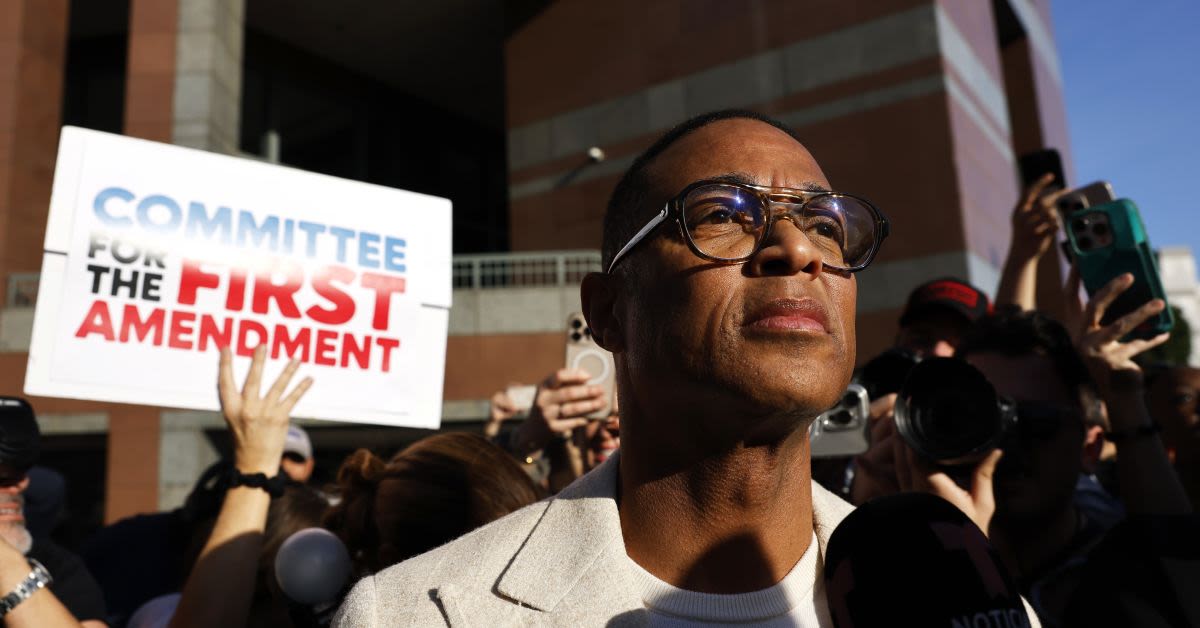
Former CNN anchor Don Lemon, now styling himself as an independent journalist, has used his time away from network television to float the notion that he is fit to occupy the Oval Office, despite having struggled to sustain his own prime-time show.
Appearing on the left-wing podcast Pod Save America with host Alex Wagner, Lemon could not resist turning a conversation about President Donald Trump into a platform for his own political fantasies, as reported by Western Journal. He openly mused about a presidential run, presenting himself as a viable alternative to Trump while insisting he is not yet at the point of launching a campaign.
Do I ever think about it, yes. Could it happen? Lemon asked during the interview. Yeah, it could happen. If the opportunity presented itself.
He then leaned into the self-aggrandizement that helped make him a polarizing figure at CNN, predicting how his comments would be received but pressing ahead anyway. I know people are going to think Im crazy, this is going to be the headline, people are going to laugh about it, I think I could be president of the United States. I could definitely run this country better than Donald Trump.
Lemon, who now claims to be an independent, made clear that any hypothetical campaign would be firmly rooted in the Democratic Party. He framed his musings as a natural extension of his public profile, as though celebrity and ideological alignment alone were sufficient qualifications for the presidency.
Am I at that point now? No, and I know people are going to say, Don Lemon is crazy but yeah look, why cant I think about running for office, Lemon said. Why cant I think about being president of the United States when look at what we have.
In attempting to justify his ambitions, Lemon invoked former President Barack Obama as a precedent, suggesting that Obamas rise from relative obscurity to the White House opened the door for media personalities like himself. He cast his own hypothetical candidacy as part of a broader narrative in which unconventional figures can ascend to the highest office in the land.
Did anybody think Barack Obama, as he says, this guy with a funny name is from a mixed background, did anybody ever think that he would become president, that he had that aspiration? I dont have an aspiration to become president, but I do think that I could run this country a lot better than Donald Trump, the former CNN host continued.
Lemons rhetoric also revealed a theological outlook that departs sharply from traditional Judeo-Christian teaching, a point that will not be lost on religious conservatives. In comments to Fox News, he described a creator who is explicitly female, underscoring the progressive identity politics that have long shaped his public persona.
As a child, my parents taught me I could be and do anything I wanted, and I believed them. As a person of faith, Id have to first consult with my creator about that. If she (my creator) gives me a sign, and so do the people, then its game on. Somebody has to fix all of the s**t Donald Trump f***ed up, Lemon said.
Lemons confidence appears to rest less on a record of achievement than on the broader cultural shift that followed Trumps 2016 victory, when celebrities and television personalities began to imagine themselves as plausible presidents. Yet the comparison between Trump and Lemon only highlights the gulf separating the two men in terms of experience, accomplishment, and leadership.
Trump entered politics as a billionaire businessman with a reputation for relentless work and a track record of building and managing large enterprises, qualities that resonated with voters tired of career politicians. Lemon, by contrast, is best known for his on-air grievances and identity-driven commentary, a media figure whose notoriety stems more from controversy than from competence.
From a Democratic Party perspective, however, a figure like Lemon may not be entirely out of place. The party has already elevated candidates whose primary political assets are demographic boxes checked and ideological reliability rather than substantive accomplishments.
Former Vice President Kamala Harris, for example, ascended rapidly through the ranks of Democratic politics despite a thin record of concrete achievements. Her 2024 presidential campaign, mounted as the partys standard-bearer after President Joe Bidens decline, collapsed under the weight of its own emptiness and the publics clear lack of enthusiasm.
When Harris was thrust into the spotlight as Bidens heir apparent, voters quickly recognized that representation alone could not compensate for a lack of vision, clarity, or executive ability. Her failure underscored the risks of elevating candidates primarily because they fit a preferred narrative rather than because they have demonstrated the capacity to govern.
Viewed through that lens, Lemons self-promotion begins to look less like an aberration and more like a symptom of a broader problem within the modern Democratic Party. A media personality with no governing experience, steeped in progressive identity politics and convinced of his own superiority to Trump, is not so far removed from the partys recent choices.
If Democrats remain committed to symbolism over substance, a Don Lemon candidacy would be less an outlandish fantasy than a logical extension of their current trajectory. His remarks, and the worldview behind them, raise a deeper question for voters: whether the presidency should be treated as the pinnacle of public service and proven leadership, or as the next trophy for whichever celebrity happens to command the most attention in the progressive media ecosystem.
Login