
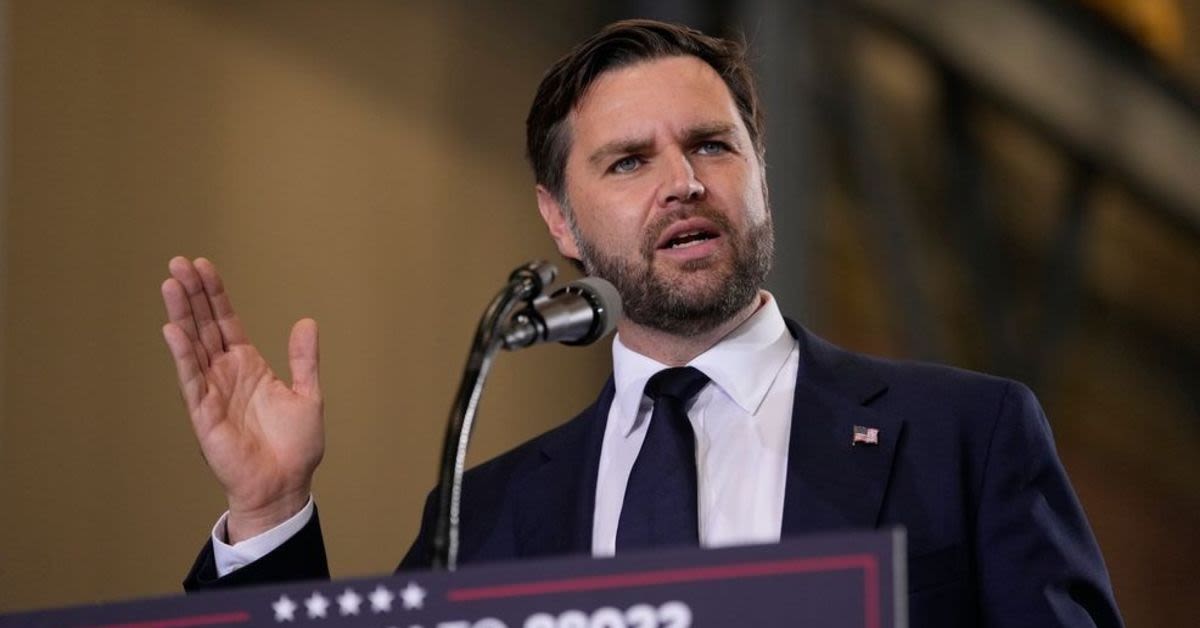
Democrats wasted no time turning President Trumps newly announced war on fraud into a political snare for Vice President JD Vance, branding the rising MAGA standard-bearer the administrations fraud czar and betting that the title will haunt him in 2028.
According to WND, the moment Trump used his State of the Union address to elevate Vance as the point man on government waste, Democratic operatives began openly salivating over the potential political fallout. It will be blocks of cement around his ankles, a senior Democratic official told RealClearPolitics last month after the speech to Congress, while another operative predicted that, come 2028, the new role will be an albatross around his neck.
A third liberal strategist, dismissing Vances new responsibilities as little more than a consolation prize, sneered, It will be incredible to watch its like he just needed a job but cant have foreign policy. Their calculation is straightforward: special assignments for vice presidents can later be weaponized as evidence of failure, providing a ready-made yardstick for measuring promises against results.
Democrats are already rehearsing the lines of attack, accusing the Trump administration of hypocrisy for allegedly targeting political opponents while ignoring what they claim is fraud originating in the Oval Office. They have not forgotten how Republicans relentlessly hammered former Vice President Kamala Harris over her supposed role as border czar, turning her limited engagement with the southern border into a symbol of Democratic indifference to illegal immigration.
That label, however, was one Harris never formally accepted and never sought, giving her some political cover even as the border crisis worsened. Vance, by contrast, has chosen to lean into his new moniker, signaling that he sees the assignment not as a burden but as a defining mission.
When RealClearPolitics asked the vice president about the fraud czar title during remarks in the Oval Office, Trump jumped in before his deputy could answer, underscoring how central the initiative is to the administrations agenda. Moments later, during an exchange that could shape Vances public image heading into the next presidential cycle, the vice president embraced the label without hesitation.
So, I like fraud czar. Its certainly what were going to do. And look, we have to do it, Vance told RCP, describing the assignment as essential to safeguarding the republics long-term health. As the president said, this is a problem that has festered in this country for far too long, and far too few people have wanted to do anything about it. Thats what makes this administration different, is that we actually tackle the problems the American people have been confronting, Vance added.
Im very happy about it, he concluded, signaling that he views the role as an opportunity rather than a trap. The White House, however, is under no illusions about the political risks that come with such a sweeping mandate.
The administration has seen this movie before. Elon Musk, a former senior advisor to the president, became Public Enemy No. 1 on the left when his Department of Government Efficiency embarked on a long march through the federal bureaucracy in search of waste, fraud, and abuse to eliminate.
That DOGE initiative began with ambitious talk of finding enough savings to balance the federal budget, a goal that resonated with fiscal conservatives who have long warned about runaway spending. Yet after thousands of relatively small cuts and the closure of a handful of agencies, the effort ended without making a significant dent in the deficit, illustrating how deeply entrenched the modern administrative state has become.
Trump, characteristically, has not been deterred by that mixed outcome. Standing beside Vance in the Oval Office on Monday afternoon, the president predicted that his vice president could uncover the kind of money that would be country changing, envisioning a future in which so much fraud has been rooted out that Washington can lower your taxes substantially for people.
He made clear that he expects Vance to succeed where his Democratic predecessors failed. This will not be like a Kamala, where she was put in charge of the border, Trump said pointedly, and she never went there.
Turning to his vice president, Trump pressed him in a brief, made-for-television moment. You promise, the president asked, inviting a public commitment that Democrats are already eyeing for future attack ads.
I promise, replied the vice president, in a clip that opposition researchers are almost certain to replay in 2028 if they can argue that fraud remains rampant. For Republicans, the exchange underscored a key contrast: a vice president who is willing to own his assignment versus one who distanced herself from a crisis that spiraled on her watch.
Contrary to Republican barbs, Harris was never formally deputized to halt illegal immigration; former President Joe Biden instead tasked her with examining the root cause of the phenomenon. Even so, fully aware of the political optics, she visited the southern border just twice during her tenure, a fact that provided the Trump-Vance ticket with a steady stream of campaign ammunition.
Now Democrats are preparing to flip that script, attempting to turn Vances anti-fraud crusade into a liability rather than an asset. Their strategy is to blur the line between legitimate oversight and partisan score-settling, casting any aggressive pursuit of fraud as selective enforcement aimed at ideological foes.
JD Vances first job as fraud czar should be investigating Trump and his family for the billions of dollars they have made off of the presidency, the favors, pardons, the government positions bought by Trumps wealthy friends, and the dropped investigations into corporate bad actors after receiving massive donations, Democratic National Committee chair Ken Martin told RCP. The American people, regardless of party affiliation, want our government to take on real fraudsters, Martin continued, not abuse the office of the presidency to enrich themselves and go after their political enemies.
The White House, for its part, insists that the coming audit will be both apolitical and nationwide, targeting fraud wherever it is found rather than where it is politically convenient. Vance and his team are expected to focus on high-profile cases such as the Medicare abuse that exploded in Minnesota and shocked the country, while also combing through less-publicized schemes that quietly drain taxpayer dollars.
Although Trump has already singled out California as a prime example of blue-state mismanagement, administration officials publicly stress that both red and blue states will face the same scrutiny. That posture reflects a broader conservative argument: that fraud and waste are systemic problems baked into big government itself, not merely partisan talking points.
Good-government advocates, often skeptical of sweeping political promises, have cautiously welcomed at least one early move. They point to the administrations call to root out fraud among durable medical equipment companies, a sector long known to be particularly vulnerable to overbilling Medicare and Medicaid.
The Department of Health and Human Services has already imposed a nationwide moratorium on new suppliers, a step that immediately affects at least one deep red state. Florida, a Republican stronghold, ranks near the top in Medicare per-beneficiary spending, underscoring that conservative governance does not automatically inoculate states against federal program abuse.
Some in Congress remain perplexed that the fight against fraud has become yet another front in the partisan wars. Tackling waste and grift is bipartisan. We must make the case that government can be good and effective, Rep. Ro Khanna, a California Democrat who plans to introduce legislation calling for a full audit of all 50 states, told RCP.
From a conservative vantage point, Khannas rhetoric highlights a fundamental divide: progressives tend to see fraud-fighting as a way to restore faith in expansive government, while conservatives see it as proof that sprawling bureaucracies invite abuse and should be pared back. Republicans argue that the surest way to shield Vance from partisan attacks is not to retreat but to deliver measurable results.
The more taxpayer dollars the vice president can save, they contend, the less credible Democratic criticisms will appear to voters who care more about outcomes than talking points. Honest, tax-paying Americans are terrified by the thought that Minnesotas fraud is just one case in a nationwide pandemic of scams, said John Ashbrook, a Republican strategist close to the vice president.
And Vance is in the perfect position to uncover and root it out everywhere, Ashbrook added, framing the assignment as a chance for Vance to demonstrate competence and toughness on behalf of ordinary citizens. If the war on fraud is executed effectively, it could become a powerful credential on Vances rsum rather than the political millstone Democrats are hoping for.
If I am JD Vance, and I do a super job of identifying fraud, finding it in all 50 states, and end up saving not just federal taxpayers but state taxpayers lots of money, said Matt Weidinger, a scholar focusing on welfare at the conservative American Enterprise Institute, well, when someone calls me fraud czar, Ill take it. The stakes, then, are not merely bureaucratic but deeply political, with Vances performance likely to shape perceptions of conservative governance for years to come.
The timing of this new assignment is especially delicate for the vice president. After years cultivating a reputation as a populist skeptic of foreign entanglements, Vance has now backed a new war, this one against Iran, prompting questions about whether his views have shifted or whether he is simply aligning with the commander in chief.
The White House has repeatedly dismissed speculation that there is any daylight between Trump and his deputy, despite Vances past statements questioning U.S. involvement in the Middle East. Trump himself brushed aside the notion that Vance needed persuading, telling RCP in a brief interview last week that his vice president did not take persuading.
When RealClearPolitics put the question directly to Vance in the Oval Office, the vice president bristled at the implication of internal division, saying the press was trying to drive a wedge between members of the administration, between me and the president. He emphasized that What the president said consistently, going back to 2015, and I agreed with him, is that Iran should not have a nuclear weapon.
Asked specifically how his current support for war with Iran squares with his past condemnation of the Global War on Terror, Vance, a former Marine who deployed to Iraq, drew a sharp contrast between Trump and his predecessors. One big difference is that we have a smart president, whereas in the past weve had dumb presidents. And I trust President Trump to get the job done, to do a good job for the American people, and to make sure that the mistakes of the past arent repeated. Absolutely.
Trump has vowed a swift resolution to the conflict in the Middle East, promising a more focused and competent approach than the open-ended interventions of previous administrations. His war on fraud, by contrast, is designed to be a long campaign, stretching through the remainder of his term and likely serving as a central pillar of Vances expected 2028 presidential bid.
For conservatives, the dual track is no contradiction: a strong America abroad and a lean, accountable government at home are seen as complementary, not competing, priorities. Whether Democrats fraud czar taunt becomes the political anchor they envision or a badge of honor Vance wears into a future presidential race will depend less on their rhetoric and more on whether this administration can finally do what so many before it have promised and failed to achievesystematically exposing and dismantling the fraud that ordinary taxpayers have been forced to fund for far too long.
Login