
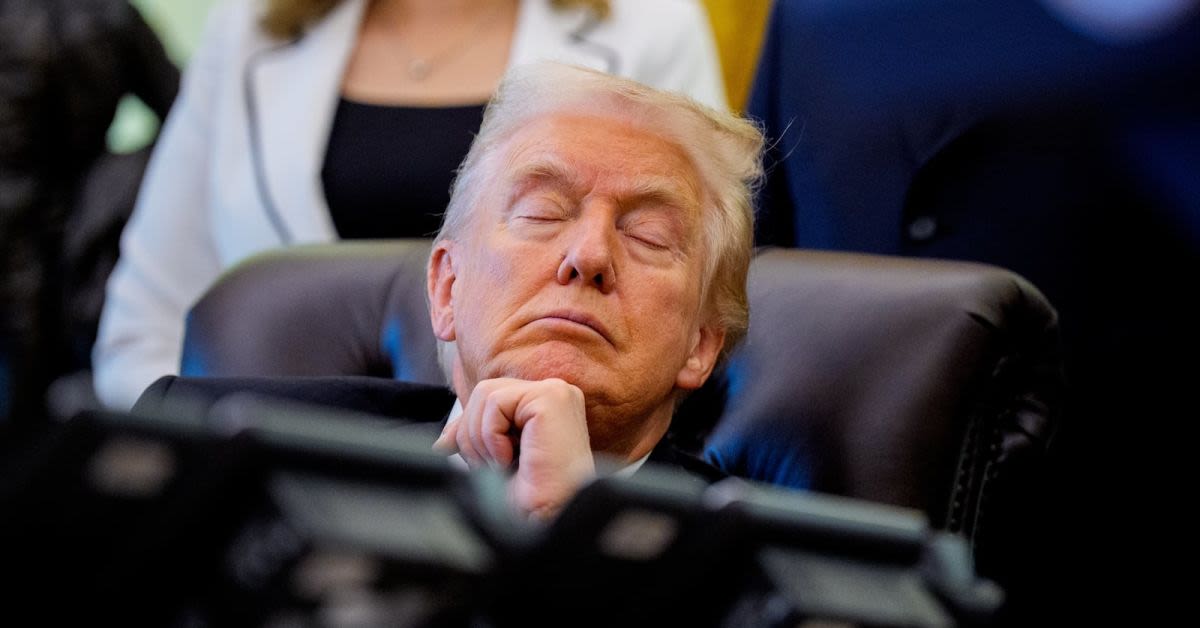
President Donald Trump has brushed aside renewed speculation about his health, explaining that he sometimes closes his eyes during marathon Cabinet meetings simply because they are "boring as hell.
".
In a wide-ranging interview with New York magazine, the former president described the often-lengthy sessions with nearly 30 senior officials, portraying them as exercises in endurance rather than any test of his physical or mental capacity. According to Newsmax, Trump recounted that these gatherings can stretch on for hours as each Cabinet member takes a turn speaking, leaving him largely in a passive role.
"It's boring as hell; I'm going around a room, and I've got 28 guys the last one was 3 1/2 hours," Trump said, offering a characteristically blunt assessment of the bureaucratic ritual. "I have to sit back and listen, and I move my hand so that people will know I'm listening."
He insisted that his habit of closing his eyes during such meetings is not a sign of fatigue or confusion, but rather a coping mechanism for tedium. "I'm hearing every word, and I can't wait to get out," he added, underscoring his claim that his attention remains sharp even when his eyes are shut.
The comments arrive amid a fresh round of media and political chatter over Trumps stamina and cognitive acuity, much of it driven by former staffers, liberal commentators, and long-time critics. The Hill has amplified claims that his occasional verbal stumbles or meandering remarks on the campaign trail reflect deeper health issues, a narrative Democrats have eagerly embraced as Trump seeks to return to the White House.
Some critics have seized on his appearance at Quantico, Virginia, in October, where several observers labeled his remarks "incoherent." Conservative commentator Megyn Kelly, who has often taken a skeptical line toward Trump, also claimed he appeared to be "rambling" on the campaign trail and experiencing what she termed "senior moments."
Trump and his allies have pushed back aggressively, arguing that such portrayals are politically motivated and divorced from his actual performance and schedule. They note that the same media outlets downplayed or excused visible signs of frailty and confusion in Democratic leaders, while magnifying any moment involving Trump that can be spun as evidence of decline.
Secretary of State Marco Rubio, speaking to New York magazine, offered a robust defense of Trumps condition and work ethic. "The guy is too healthy. He's too active," Rubio said, recalling how Trump once noticed that medallion samples were missing from chandeliers at the State Department and later surprised him by personally arranging for replacements.
That anecdote, Rubio suggested, illustrates a level of observational sharpness and follow-through inconsistent with the narrative of a man slipping mentally. For many conservatives, such stories reinforce their view that Trumps opponents are weaponizing health speculation as a substitute for debating policy, particularly on issues like border security, inflation, and foreign policy where the administrations critics believe he holds the stronger record.
Trump also addressed questions about medical imaging he underwent at Walter Reed National Military Medical Center, a subject that has fueled conspiracy theories and partisan speculation since his time in office. He said he regretted agreeing to the procedure, arguing that it handed his detractors a pretext to insinuate that something was wrong.
"It was the worst f***ing thing I ever did, and I blame them," Trump said, referring to his doctors and their recommendation that he undergo the test. "They wanted me to take it. And because I took it, people want to say, Oh, there must be something wrong."
White House medical official Col. James Jones, who was present during the interview, clarified the nature of the imaging in an effort to dispel lingering confusion. "It was a computerized tomography exam of his chest and his abdomen," Jones said, describing it as "MRI-like."
Jones emphasized that the CT scan was routine for a man of Trumps age and did not reveal any medical problems. His account undercuts the more sensational claims that have circulated in some media circles, where any mention of Walter Reed is often framed as evidence of a hidden crisis rather than standard preventive care.
For Trumps supporters, the episode is another example of a double standard in coverage, where ordinary medical precautions for a Republican leader are cast as ominous, while more serious or visible concerns involving Democrats are minimized or rationalized. They argue that the fixation on his posture in meetings, his off-the-cuff speaking style, or his decision to follow doctors advice says more about the medias political agenda than about his health.
As the 2026 political season intensifies, Trumps remarks suggest he is keenly aware that his opponents will continue to question his fitness, just as they did throughout his presidency. By openly mocking the idea that closed eyes in a "3 1/2 hours" Cabinet session signal weakness, and by highlighting routine medical tests that showed "no medical issues," he is betting that voters will see the health narrative as yet another partisan talking point rather than a serious concern.
Login