
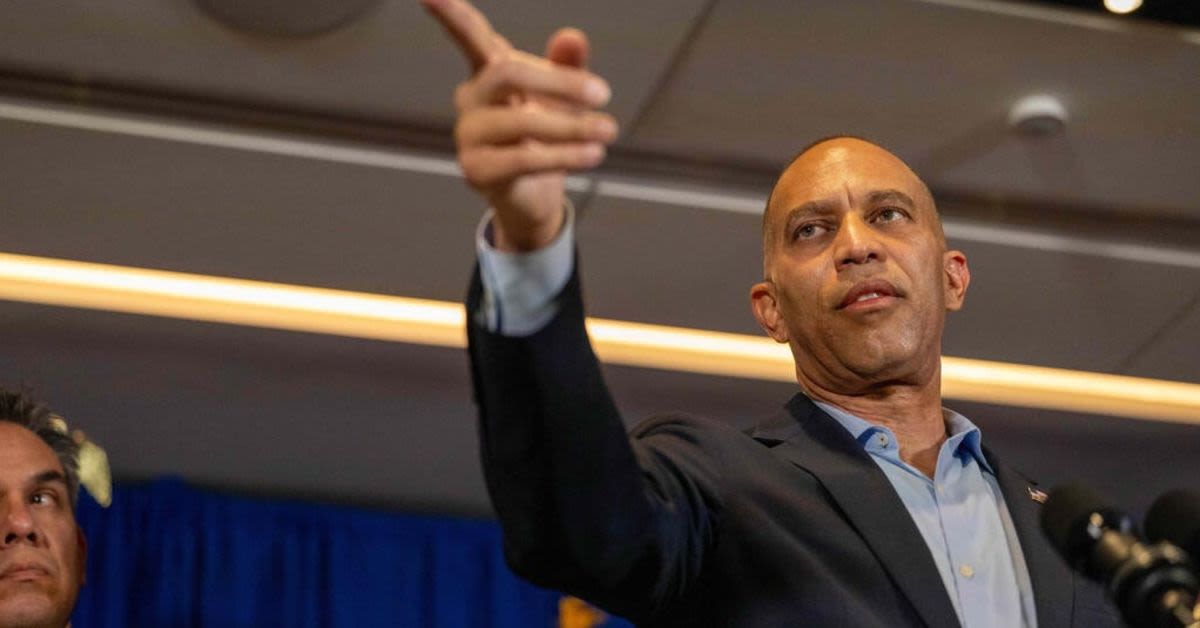
Hakeem Jeffries just cleared the last hurdle inside his own party on the road to the speaker's gavel, but not every Democrat went along.
House Democrats nominated Jeffries for speaker by a vote of 251 to 11 in a closed-door, secret-ballot caucus election, with two members not voting. No challenger ever put a name forward.
The win puts the New York Democrat on track to become the first Black speaker in American history after his party's sweeping midterm victory. The full House will formally choose its next speaker when the new Congress convenes in January.
With Democrats on track to hold more than 250 seats, Jeffries' path to the 218 votes he needs is all but secured. Still, those 11 "no" votes are more than a procedural footnote.
They reflect a growing fight over how far left Democrats plan to move now that they have retaken the House. According to Reuters, the party's left wing has pressed Jeffries for stronger commitments on the war in Iran, military aid to Israel, government-funded health care and campaign finance reform.
Among the dissenters are newly elected Democrats tied to the party's democratic socialist movement. They include Claire Valdez and Darializa Avila Chevalier of New York, both linked to New York City Mayor Zohran Mamdani's political operation.
Other incoming members who have voiced concerns about Jeffries include Adam Hamawy, Melat Kiros, Chris Rabb and Don Leonard. Members of the DSA-aligned bloc want to curb aid to Israel, expand government health care and take a more confrontational stance toward federal immigration enforcement.
Kiros, a Colorado Rep.-elect, told Reuters the dispute is fundamentally about direction. "What we're demanding is an agenda," she said. "It's about what kind of priorities, what kind of floor votes, what kind of plan do we have to actually fight for the bold change the American people sent us here to do."
Ohio Rep.-elect Don Leonard has been especially outspoken. According to Punchbowl News, he sought commitments on restricting aid to Israel and holding a vote on a constitutional amendment in exchange for his support.
Leonard also alleged that senior Democrats threatened retaliation if he refused to back Jeffries, including withholding committee assignments and campaign help. After the vote, seven of the 11 dissenters issued a joint statement explaining their opposition, NBC News reported.
The revolt reaches well beyond Capitol Hill. A Change.org petition calling for Jeffries and Senate Democratic Leader Chuck Schumer to be replaced reportedly gathered more than one million signatures, according to theGrio.
Democratic strategist Alvin Tillery, who advised Rabb's campaign, told theGrio the clash reflects a deep disconnect. "The Democratic voter base is farther to the left than the electeds and the donors," he said.
Tillery also took aim at establishment Democrats who have played up the historic nature of Jeffries' rise. "There's an old guard that thinks representation, them having their seats and then having a black speaker, is frankly worth as much, if not more, than actually delivering for the people," he said.
Michael Hardaway, a Democratic strategist and former Jeffries communications director, waved off the opposition. He called it "a fake grassroots movement authored by a small group of people who know how to drive a conversation online."
Jeffries chose to confront the dissent head-on. Some allies had pushed for a vote by acclamation, which produces no tally, but he requested a recorded count instead, pointing to the approach Democrats took when they returned to the majority in 2018. "Certainly seems to me it would be appropriate that we take exactly the same approach to give every single person the opportunity to weigh in one way or the other," Jeffries told reporters, CBS News reported.
The result showed the holdouts are a small slice of the caucus, as RedState noted. But with an energized activist base behind them, the fight over the party's direction has started before Democrats even take possession of the gavel.
Login