
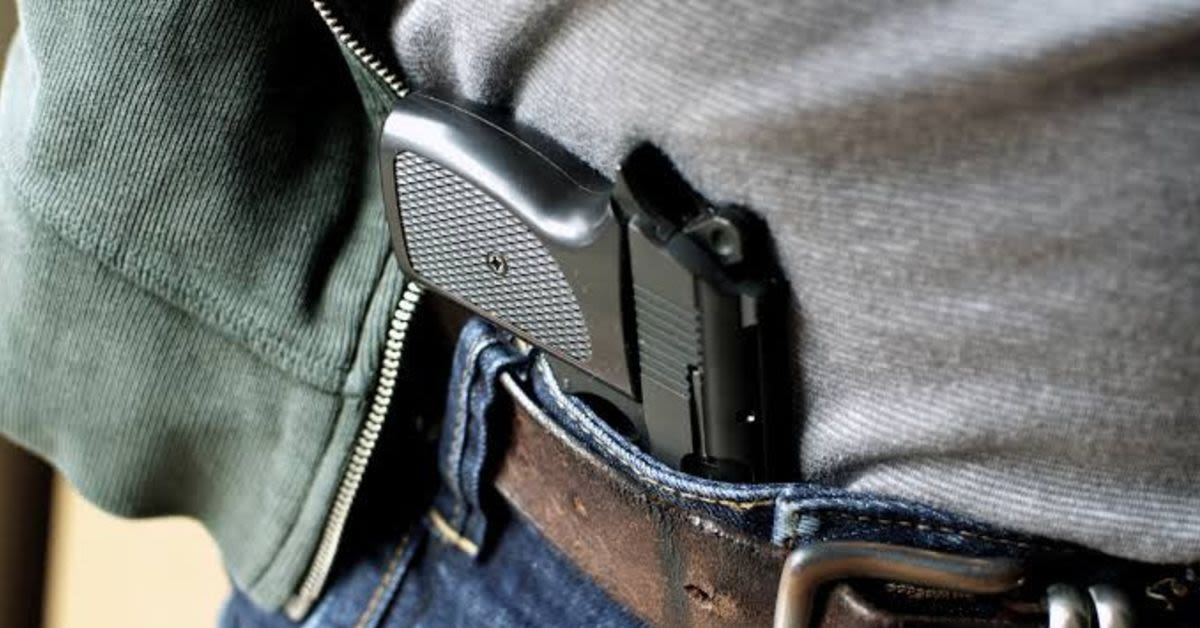
A Marine veteran who never considered himself a "gun guy" has built a following by chasing down the stories most newsrooms skip.
The influencer, who goes by Jake, runs goodguywithagun.online along with a Substack newsletter and accounts on X and Facebook. He told the Daily Caller News Foundation that the project began with an online argument he was determined to win.
"I got started on it because I basically am a loudmouth on social media sometimes and somebody told me that there was no way that we had, they told me that the good guy with a gun was a myth and I said, it's not a myth, it's just underdocumented," Jake said. "So I said, I will go and I'll find you examples."
The challenge quickly became a daily routine. "So I went out and found for about 100 days, every day I would come back with at least one, sometimes two or more examples of good guys with guns stopping a crime or defending someone or making sure that someone wasn't a victim and at about the end of 100 days or so, he cried uncle and said I had no idea," he continued.
The cases he highlights are rarely national news. In Rockdale County, Georgia, a man attacked a 30-year-old woman who was with her three children during a dispute while driving.
The woman retrieved a gun and wounded the man. He fled in the car, leaving the woman and children on the side of the road, and police later caught him.
In Columbia, Maryland, a man attacked and tried to strangle an elderly couple next door, both 85, because they could not give him a ride. The husband eventually retrieved a revolver and shot the assailant in the leg.
The attacker was later convicted of attempted murder and assault. He was sentenced to life with all but 60 years suspended.
Despite earning "Expert" marksmanship awards for both rifle and pistol in the Marine Corps, Jake said he had only ever seen a firearm as a tool. He said defensive gun uses are "under-reported," but he does not blame bias in mainstream or corporate outlets. Instead, he pointed to the way such stories are told.
"Consider the difference for a moment between what happens when a bad guy with a gun commits a crime and a good guy with a gun has a defensive gun use. A bad guy with a gun is very public, right?" Jake said.
"Mass shooter or a school shooter or something, a robbery, you see that person's face on TV, you see their name, they are associated with the gun, which is the instrument that they use to commit violent crime and you empathize with the victim," he continued. "So our empathy is with the victim, our antipathy is with the bad guy with the gun."
The defender, by contrast, usually remains anonymous. "When you have a defensive gun use, you'll hear about sometimes what that person's like, what the victim is like, I mean, it's still the victim, right? The person who used the gun in that case is the victim," Jake said.
"But you don't have a face. You can't associate a face and a name most of the time because their privacy is protected," he explained.
"You hear that, oh, well, there was a 34-year-old man who used a gun to stop a woman from getting abused on the street. Okay, great," he said.
"Well, I don't know his name. I don't know what it looks like. I don't have a feel for him," Jake added.
Jake said he did not get involved in Second Amendment issues until the Supreme Court's landmark Heller decision in 2008. He was stunned by how many people believed the ruling was wrong.
"The thing that made the difference to me was actually the Heller decision. That's the place where I looked around and said, I can't believe that so many people, so many people who are supposedly intelligent, so many people who are lawyers and theoretically understand what the Constitution means, I can't believe that so many people were about to let one of our core rights get infringed upon," Jake said.
For Jake, the ruling was a turning point. "So it was really Heller that made me say, guns are very important and even though I may not be part of gun culture, even though I live in the People's Republic of New York, I want to make sure that that right is protected," he added.
The numbers suggest he has no shortage of material. Experts told the outlet that the vast majority of defensive gun uses involve no shots fired at all.
"Estimates of defensive gun use vary depending on the questions asked, populations studied, timeframe, and other factors related to study design. The report Priorities for Research to Reduce the Threat of Firearm-Related Violence indicates a range of 500,000 to 2.5 million defensive gun uses each year," the Centers for Disease Control and Prevention website says.
What sets Jake apart from much of the online conversation is his sobriety about the subject. "I think some people are very much like, yeah, good job, those guys had it coming. There's a sort of amount of triumphalism and I understand where that's coming from," he said.
"I don't personally glorify death in any way," Jake said. "I think that if you have someone who was killed in the commission of a crime, it would have been better if they had been able to live and repent and be redeemed, you know what I mean? So I definitely cringe a little bit at that, but I know where it's coming from."
He also explained why he often features incidents from about two years earlier. "There's actually two reasons for that. One of them is that you do find occasionally instances of fraud," he said.
"You find cases where somebody was charged for murder or manslaughter and you want to see those work through the system and you want to see the acquittals," Jake continued. "You want to just be very careful with that stuff."
"So anything where I'm going to do the full write up and say, this is a full property for DGU, I want that to be ironclad as much as humanly possible. So that's the reason I give that a little bit of a gap there, let the legal system work," he added.
Ultimately, Jake said, his goal is less about promoting "gun culture" than about putting a human face on gun ownership. "I just think it's really critical to humanize the face of the gun owner," he said. He recalled a moment from jury selection that stuck with him.
"I remember one time I was in voir dire for a jury trial. I didn't get picked for the trial, but one of the things that I saw was the questioning of the other potential jurors about gun rights, pardon me, about guns," Jake said.
"You know, one of the people who said 'I have a gun' was a kind of a smallish, mousy little woman and thinking about her being the face of gun ownership is really kind of important to me," he said. For Jake, that is the whole point of the project.
Login