
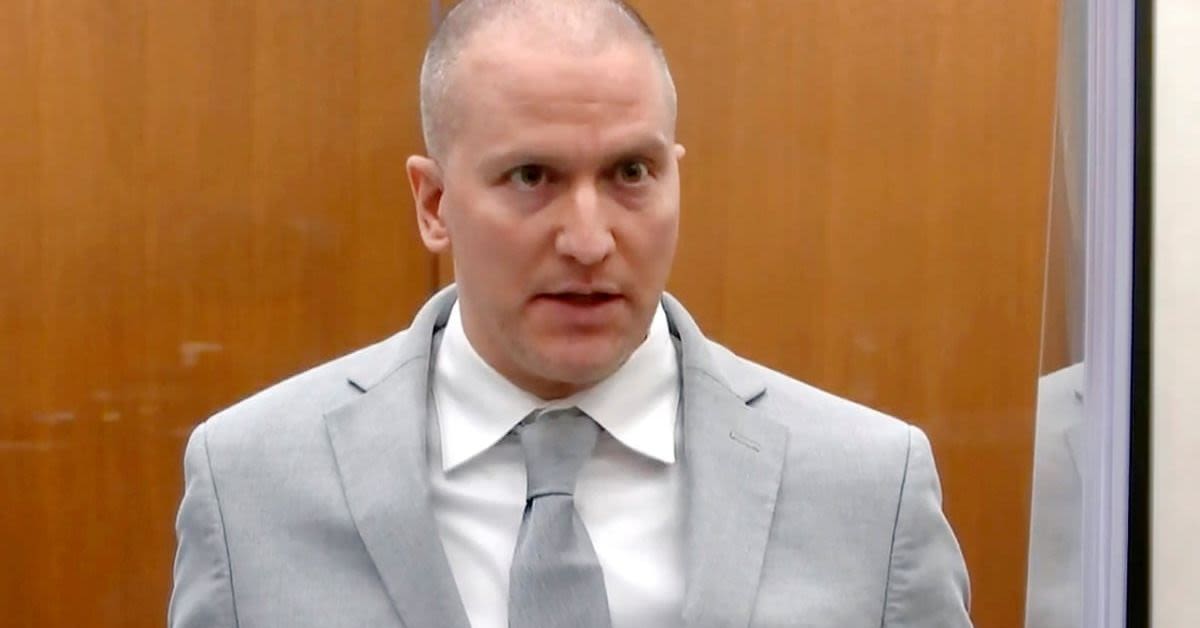
A former federal prosecutor is making a claim that few in public life have dared to voice about the death that set America on fire.
TJ Harker, a former assistant U.S. attorney, argues in his new book, "American Scapegoat," that Derek Chauvin did not kill George Floyd. The book, from Passage Press, is due out Dec. 1, and Harker laid out his case in granular detail in an interview with Blaze News.
Harker began with background that many Americans likely never heard amid the media frenzy. On May 25, 2020, Floyd left Cup Foods, where he had passed a fake $20 bill, and consumed drugs in a car with ex-girlfriend Shawanda Hill and drug dealer Morries Hall, according to the defense.
Store employees called the police, and officers arrived and requested an ambulance. Emergency medical services and the fire department, however, were unusually slow to arrive.
"The two more experienced officers, Chauvin and Officer Tou Thao, knew that EMS, the fire department, with their superior training, was only a half-mile away, due west on 38th Street," Harker said. "They should have arrived within two to three minutes of being dispatched."
"The problem was that they weren't dispatched for nine minutes after Thao made the Code 3 call," he continued. "Code 3 is the highest level."
"It means lights and sirens, get here right away. And he made that call about three minutes after George Floyd was on the ground," Harker explained.
"So the officers were expecting the ambulance to arrive and provide whatever medical treatment Floyd needed. They weren't equipped to provide it themselves," he said. Hennepin County and Minnesota's Emergency Communications Network did not respond to requests for comment.
At 6 feet 4 inches, Floyd towered over every responding officer. He struggled as officers tried to put him in the squad car, saying he could not breathe, so they brought him back out into the open.
As they restrained him while waiting for medical help, a hostile crowd formed, screaming at and later threatening the officers. Harker says that under the circumstances, the officers did their best to protect both Floyd and themselves.
"They handled it extraordinarily well," Harker said. "No matter how you evaluate the officers' conduct, what you come back with is that they did everything very, very well, despite being surrounded by a hostile audience."
"There were five officers on scene: Tou Thao, Thomas Lane, Alexander Kueng, Derek Chauvin, and a park police officer across the street, Peter Chang," he said. "All five believed the use of force was reasonable."
"They didn't use any strikes," he said. "No punches, no kicks. They didn't tackle the man."
"They didn't use pepper spray or mace, a Taser, or a baton. It's hard to imagine how officers could have used less force, short of letting George Floyd go and writing an apology letter," Harker added.
Floyd was eventually taken by ambulance to a second location, which Harker said is common when hostile crowds surround a scene. By the time treatment began, Floyd had no pulse.
National media quickly declared that Chauvin had killed Floyd by kneeling on his neck. A Hennepin County jury convicted Chauvin of second-degree murder, third-degree murder and second-degree manslaughter in April 2021, and he was sentenced to more than 22 years in prison.
Harker argues that the medical evidence told a different story. Hennepin County Medical Examiner Dr. Andrew Baker performed Floyd's autopsy.
"In a murder case, the medical examiner is both a fact witness and an expert witness," Harker said. "He's the only one who conducted the autopsy. And Dr. Baker is very experienced: more than 3,000 autopsies, the youngest-ever president of the National Association of Medical Examiners."
"From the very beginning within 24 hours of George Floyd's death he was telling prosecutors there was no evidence of asphyxiation," he said. "This is in prosecutors' memos to file, which are a red flag."
"There was no evidence of petechiae, no bruising to the neck muscles, no bruising to the back," Harker said. "No damage to the laryngeal structures. None."
Harker said prosecutors nonetheless made asphyxiation the bedrock of their case. "Prosecutors had to tie the death to Derek Chauvin's left knee," he explained.
"But crushing someone's windpipe leaves an incredible amount of physical evidence, and there wasn't any. So they went with what's called a blood choke: compressing the carotid artery, which takes a lot less pressure," Harker said.
That theory, he said, unraveled at trial under cross-examination of prosecution witness Donald Williams, an eyewitness and MMA specialist. "The fundamental problem is that George Floyd, like all homo sapiens, has two carotid arteries, not one," Harker said.
"By the end, they shifted to positional asphyxia the very theory they had ruled out back on May 26, 2020," he said. "They started the prosecution by saying George Floyd did not die from positional asphyxia and ended it in closing argument by saying the only thing he died from was positional asphyxia."
The Hennepin County Medical Examiner's Office told the outlet it stands behind its work. "The Medical Examiner's Office stands behind the findings of the original death investigation, including the manner and cause of death certified on Mr. Floyd's death certificate, and autopsy report which was made public by order of the Fourth District Court," a spokesperson said.
Harker also pointed to Floyd's history of drug abuse, which he says was swept aside because it did not fit the narrative. "In March 2020, George Floyd got pills containing an opiate and a stimulant, overdosed, and spent five days in the hospital, where doctors saved his life," Harker said.
"After that, he got clean. And the physiological literature is crystal clear: If you're an addict, you get clean and then start using again, your tolerance is gone," he continued.
Some of the most significant evidence, Harker said, sat untouched for months. Investigators impounded Floyd's SUV and the squad car, sealed them with evidence tape and left them until late 2020 and early 2021.
"In January 2021, just weeks before trial, Eric Nelson, Derek Chauvin's attorney, asked to search the squad car," he said. "And what they found is some of the most damning evidence in the case: partially dissolved speedballs containing methamphetamine and fentanyl with George Floyd's saliva and DNA."
According to Harker and the defense, that means Floyd likely consumed fentanyl twice, once in the car and again in the back of the squad car. "The body-cam footage is timestamped," Harker said.
"We know when he chewed the pills and spit out the residue on the backseat. It was about five minutes before he died and peak respiratory depression from fentanyl hits about five minutes after you take it," he said.
Harker also highlighted a moment captured on video. "There's a moment when George Floyd is on the ground, talking," he said. "And he says, 'I ate too many drugs.'"
According to Harker, Minnesota Bureau of Criminal Apprehension Senior Special Agent James Reyerson first testified that Floyd said those words. After a break, prosecutors recalled him, and his account changed.
"His new testimony was not 'I ate too many drugs,' but 'I ain't do no drugs.' Which was preposterous. Laughable," Harker said.
"I've listened to that audio hundreds of times," he added. "The syllable count matches 'I ate too many drugs.'"
The Minnesota Department of Public Safety directed reporters to the case file and court record, while the Bureau of Criminal Apprehension did not respond. The Minnesota Attorney General's Office also did not respond to a request for comment.
Asked why prosecutors would bother with such a trial, Harker pointed to history. "The Soviets could execute anyone they wanted, and they did," he said. "But they still held show trials because a trial carries an imprimatur of legitimacy."
"And Derek Chauvin has to be innocent for this political agenda to work," he said. "If he's guilty, people of regular moral conscience would say, 'The system malfunctioned; let's fix it.'"
"There's a reason the word 'scapegoat' is in the title," Harker said. "Other than Derek Chauvin, there's nobody for whom the logic of speaking the truth makes sense."
Chauvin also pleaded guilty to federal civil rights charges in 2021 and is held at FCI Big Spring in Texas. Another inmate stabbed him 22 times at FCI Tucson in 2023.
Harker offered little hope of a quick remedy. "So if the president were to pardon him, he would be pardoned only on the federal charges. The president can't pardon state charges," he said.
"His direct appeal rights are exhausted," Harker added. "Now his attorney, Greg Joseph, who's doing yeoman's work, has filed for post-conviction relief."
Joseph did not respond to a request for comment. Harker acknowledged the personal risk of defending one of the most reviled men in America but said it pales next to what others have sacrificed.
"Nobody's asking you to take a bullet at Normandy," he said. "They did ask other people to do that. So that's why I did it."
Login