
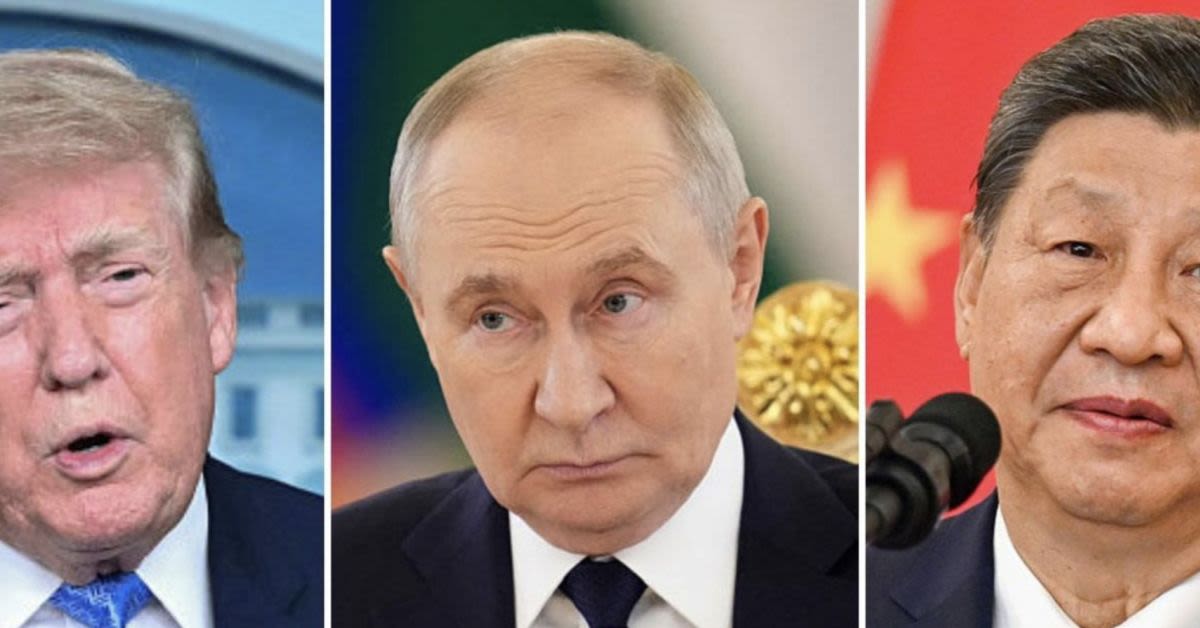
The leaders of the world's three largest nuclear powers are about to sit at the same table for the first time, and the White House has already said what will not be discussed.
President Donald Trump, Russian President Vladimir Putin and Chinese President Xi Jinping will hold the first-ever three-way meeting between the leaders of the United States, Russia and China next week, the White House announced Friday. The summit will take place in Shenzhen on the sidelines of the Asia-Pacific Economic Cooperation gathering in the southern Chinese city.
U.S. officials said President Trump wants Thursday's trilateral talks to focus on cutting nuclear arsenals, and he also plans to raise the war in Iran. Russia's war in Ukraine, however, is not expected to be on the agenda.
White House spokeswoman Olivia Wales confirmed the meeting to reporters. "The president has made it clear that, among other topics, he will discuss the reduction of nuclear weapons in the world. This proliferation, President Trump believes, is very dangerous," Wales said.
For a President who has long argued that the world's nuclear stockpiles pose an unacceptable risk, the setting offers a rare opportunity to press Moscow and Beijing together. Officials stressed, though, that only one of the two major conflicts dominating his second term will feature in the talks.
"I think the president does intend to talk about Iran in the trilateral meeting with Xi Jinping and Vladimir Putin," a senior U.S. official, speaking on condition of anonymity, told reporters on a call. Ukraine, by contrast, is being handled separately.
According to the official, Washington is running a "whole other track" of negotiations with Kyiv and Moscow aimed at ending the war. That track includes talks U.S. envoys have held in recent days with Putin and Ukrainian President Volodymyr Zelensky.
"China is not really a part of that track, so it doesn't seem appropriate to have the Ukraine discussion there," the official added. The approach keeps Beijing out of a negotiation in which it has no direct role.
Tesla and SpaceX chief Elon Musk will travel with President Trump to China, as reported by Breitbart. Officials said, however, that Musk will not take part in the meeting with Xi and Putin.
President Trump will also hold a bilateral working lunch and meeting with Xi on Thursday. It will be the fourth meeting between the two men since President Trump returned to the White House last year.
No separate one-on-one session with Putin is on the schedule. Instead, the two leaders are set to meet within the three-way format alongside Xi.
Some sensitive subjects are being kept off the table altogether. Officials said they do not expect the resignation of Nvidia chief executive Jensen Huang over an affair with an alleged Chinese spy to come up in President Trump's meetings with Xi.
"The situation with Nvidia should not really have any bearing on the trip," a second senior U.S. official said. That position signals the administration has no intention of letting the scandal shape its dealings with Beijing.
Nor will Washington put export controls on sensitive chip technology up for discussion, even though those controls sat at the heart of the Nvidia affair. The administration has framed them as matters of national security rather than bargaining chips.
"We do not negotiate American export controls. These are national security matters that we develop in the administration and we don't expect it to figure at all in any of our conversations with the Chinese while we're there," the second official said. The message to Beijing is that American security policy is not for sale.
The trip will begin in Southeast Asia before the President reaches China. He is set to leave Washington on Monday and arrive in the Philippines on Tuesday for the Association of Southeast Asian Nations (ASEAN) summit before traveling on to Shenzhen.
Whether the unprecedented meeting yields concrete progress on nuclear weapons remains to be seen. What is already clear is that the agenda reflects President Trump's priorities, with arms reduction and Iran in focus and Ukraine left to its own separate negotiating track.
Login