
The tears in my sons eyes told me more about the state of New York Citys public schools than a decades worth of glowing report cards ever did.
For years, my boys academic record suggested he was a standout in mathematics, a numbers whiz whose report cards were lined with As and the occasional B-plus. According to The New York Post, his grades at PS 221Q, the North Hills Elementary School, and later at MS 67Q Louis Pasteur Middle School in Little Neck, painted the picture of a student firmly on track for success, especially in math.
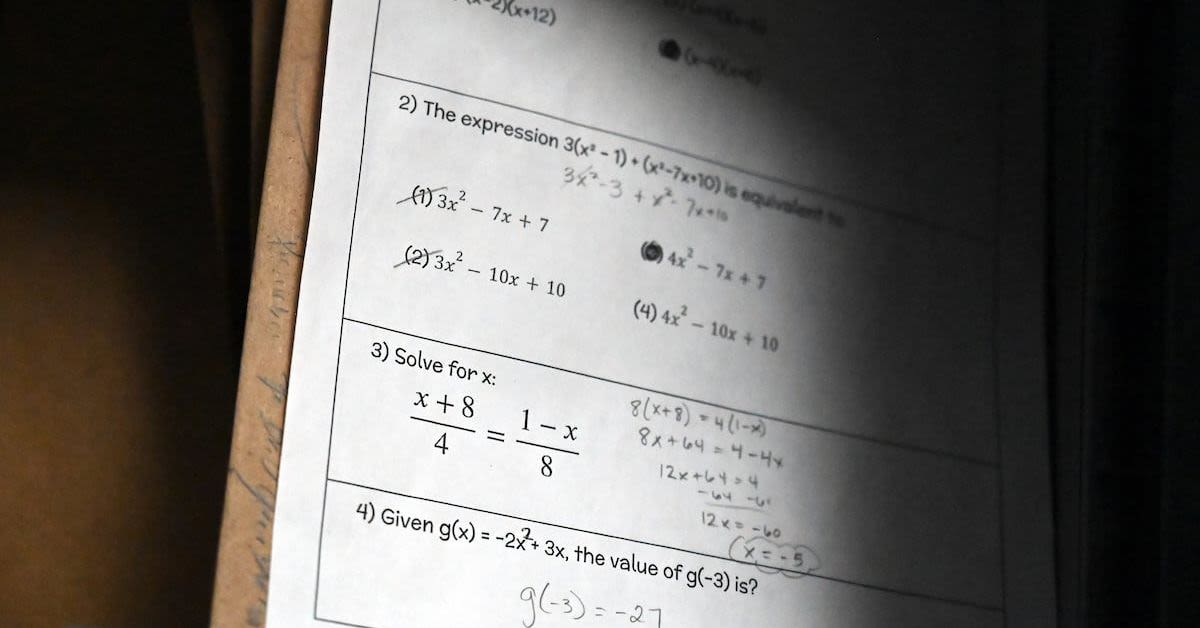
Yet when he entered one of the citys top high schools in Queens this fall and brought home a 78 on his first exam, I decided to sit down with him to prepare for the next test and discovered just how hollow those grades really were. I will never forget the moment I watched my son, a teenager who rarely shows emotion, stare at a math review worksheet and manage to answer only the first couple of questions before his composure cracked.
He could not solve basic algebra, could not handle geometry, and could not compute elementary-school fractions, even though his official record suggested he had mastered all of it. At PS 221Q, he had routinely received the highest marks in math, and at MS 67Q his lowest end-of-term math grade was an 89 in seventh grade, with a 92 in sixth and a 93 in eighth all solid As by any standard.
When he was admitted to his first-choice high school, one of New Yorks top-rated institutions, my husband and I had every reason to believe he would continue to excel. What I saw when I finally sat down with him to study did not just surprise me; it shook me to my core and exposed a system that prefers to protect its own image rather than tell parents the truth.
He stared blankly at the page, utterly confused by material that should have been well within his grasp after years of supposed high performance. Equations that contained fractions the kind of problems a competent middle-schooler should be able to tackle completely threw him off and left him feeling defeated.
My initial shock quickly gave way to heartbreak, and then to anger, as I realized that the confident narrative we had been fed about his progress was a fiction. My son is a mature, intelligent, hard-working young man who runs his own online apparel business and rarely lets others see when he is struggling.
As I watched tears fill his eyes, I told him plainly that this was not his fault, that the system failed him, and we would do whatever it takes to get him caught up. That night, I did not speak to anyone about what had happened, not even my husband, because I was still processing the magnitude of the betrayal.
When his teacher called after the test results came in, I already knew why she was on the line. She explained that he had answered correctly only two of ten multi-part questions and had scored a 10 out of 100, a devastating result for a child who had been led to believe he was excelling in math for years.
Now his high school is forced to provide him with the foundational math education he should have received in elementary and middle school, stretching its resources to remediate what the earlier grades failed to deliver. In desperation, I began buying math review books designed for first- through fourth-graders, just to determine how far back his gaps went and at what point the learning had effectively stopped.
My son now gives up his lunch period every Tuesday through Friday to attend tutoring sessions, and once baseball season ends, he will spend his Saturdays in additional tutoring as well, sacrificing his free time to make up for what the system never properly taught him. As the child of Colombian immigrants, I grew up in a home where education was treated as a sacred obligation, not a bureaucratic talking point.
My mother constantly reminded my sisters and me of the importance of school, stayed on top of our assignments, and drilled into us that a high school diploma was non-negotiable. That ethic of hard work and personal responsibility helped me become an NYPD police officer, and I have tried to pass those same values on to my own children.
When I married my husband, who is also an NYPD officer, in 2005, I insisted that we move to District 26 in Douglaston because it has long been considered one of the best school districts in New York City. We did what responsible parents are told to do: we chose a strong district, stayed engaged, and trusted the professionals.
Had my sons teachers simply told me he was struggling, we would have gotten him help early on; he would have done the work, and we would have supported him every step of the way. But we were never told that he was behind, and his report cards never gave us the slightest clue that anything was wrong.
Only later did I learn that teachers grade according to a rubric and that the Department of Education manipulates the numbers in ways that obscure reality. The NYC education system had betrayed my son to make itself look better, I realized, and that betrayal stung all the more because I had spent years working closely with the very people and institutions that failed him.
I am not a distant or disengaged parent; I am a longtime parent leader who has served as PTA president, Community Education Council president, and now sits on the Citywide Council on High Schools. I have built close relationships with teachers and administrators at every stage of my childrens education and became deeply involved precisely because I believed that the only way to be truly informed was to be present and engaged.
I thought I knew exactly how my son was doing in school. I was so wrong.
My son was not in advanced classes; he was in general education and did not take the Regents exams in middle school. I relied on his teachers to be honest with me about his progress and to alert me if he was falling behind.
I failed in my own way as well, because I did not scrutinize his work as closely as I should have or check his performance on state tests, assuming that strong report cards meant everything was fine. Only after I realized how far behind he truly was did I go back and examine his state test results.
That was when I discovered that he had been rated not proficient in math on a seventh-grade state exam, a glaring red flag that had never been communicated to us in any meaningful way. How, I asked myself, can he not be proficient in math but was receiving As?
Why did his middle school never provide additional resources or interventions when the state data clearly showed he was struggling? Why did no one pick up the phone, send an email, or schedule a meeting to discuss his deficiencies and work with us to address them?
I feel deceived, not just as a mother, but as a citizen who expects public institutions to be at least minimally honest. Looking back, the warning signs were there, but they were easy to miss in a culture that has normalized low expectations.
Teachers rarely assigned homework, and when they did, it was minimal and often perfunctory. My son was allowed to revise his answers on tests after they had been graded and receive a new grade, effectively erasing the consequences of poor performance and teaching him that mastery was optional.
Teachers also displayed a surprisingly relaxed attitude toward missed assignments, reinforcing the message that deadlines and accountability were flexible. In a city where so many working-class parents juggle multiple jobs and long commutes, countless families simply do not have the time to comb through every worksheet or cross-check every test score.
They rely on teachers and grading rubrics to be honest, and when those systems are corrupted by grade inflation and ideological agendas, children pay the price. The lack of rigor in city schools and the inflation of grades are dishonest, and this dishonesty is one of the reasons so many families are fleeing the public school system altogether.
The Department of Education, in its zeal to avoid uncomfortable truths and maintain the illusion of equity, enables failure in minority communities by constantly lowering their standards instead of grading our children accurately and failing to collaborate with families to address issues they may be having. They do not even enforce basic expectations like attendance; They dont even police chronic absenteeism. How can our kids get jobs if they cant read or do math, or are even taught the value of showing up?
As I began to speak with other parents, I quickly realized that my familys experience was far from unique. Shortly after my sons October test, I reached out to other parents at his high school to ask whether their children were also struggling in algebra, and the responses poured in.
Many reported similar problems and wanted to know what tutoring options were available, confirming that this was not an isolated case but a systemic failure. One mother of an eighth-grade girl in District 26 told me she was furious about her daughters math curriculum.
She explained that her daughter was receiving only one page of homework a day and that she was urgently trying to transfer her into a Catholic school, where expectations and standards remain higher and more traditional. That conversation crystallized for me that I had a responsibility, given my position in the public school system, to speak out on behalf of all the families who have been failed.
I decided to confront Schools Chancellor Kamar Samuels at a Citywide Council on High Schools town hall on Monday, Oct. 26. The DOE is in the process of ending the Regents requirement for graduation and replacing it with the Portrait of a Graduate model, which will grade students in a supposedly holistic manner that relies even more heavily on subjective teacher evaluations and less on objective measures of knowledge and skill.
All of the problems that harmed my son will only worsen as we abandon clear, rigorous standards in favor of vague, feel-good criteria that can be easily manipulated. I had already planned to question Samuels about this shift, but after seeing what had happened to my son, I knew I had to share our story publicly.
Sitting on the dais in the Art and Design High School auditorium, I spoke through tears. This school system is failing our children. . . . I equate this to the childhood game Kick the Can. My my son is the can. Where did he land? I tearfully said as I sat on the dais in the Art and Design High School Auditorium.
As I choked back tears, I made clear that the consequences of the systems failure would reverberate through my familys life for years to come, academically, financially, and emotionally. In high school, where they are expected to help him graduate with the necessary tools to succeed, will they continue to kick the can all the way to college, where I will be expected to pay for a remedial class that does not count toward a degree? I asked.
Then I pressed Samuels on the looming Portrait of a Graduate changes, asking how anyone could expect a different outcome for future students when grades would become even more dependent on the subjective judgments of biased teachers and principals. Samuels appeared caught off guard by my remarks, and his response left me disgusted.
He didnt even acknowledge my question. He didnt know what to do with himself. He was stammering and didnt know what to say. It just sounded like mumbo jumbo. As a parent and a longtime parent leader, I was entitled to a substantive answer, or at least a coherent one; I would have preferred a slick non-answer that politicians give, but he didnt even give me that.
After that exchange, I had to walk off the stage. Normally, after such events, I stay behind, chat with Department of Education officials, and pose for photographs, trying to maintain constructive relationships for the sake of the students I represent.
That night, I went straight home. I couldnt pose for pictures with Samuels. If he cant answer how were going to educate our children, who can?
That is the question every parent in New York City should be asking as the DOE doubles down on policies that obscure failure, erode standards, and sacrifice childrens futures on the altar of political fashion and bureaucratic convenience.
Login