
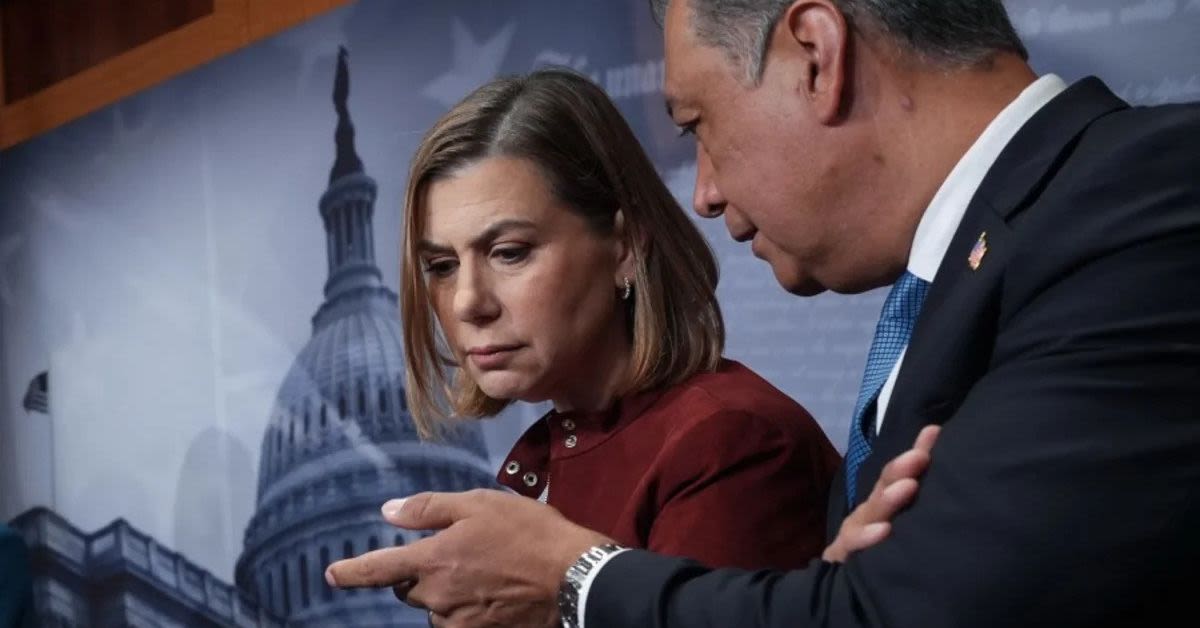
A Democratic senator from Michigan is facing mounting ethics complaints after openly suggesting that young Americans should fear working in a future Trump administration.
According to WND, U.S. Sen. Elissa Slotkin, a staunchly left-wing Democrat, is under fire for remarks that critics say weaponize congressional power to intimidate conservatives and potential Republican public servants. The controversy began when Slotkin appeared at an event at the University of Chicago and described what she called a deterrence strategy aimed at discouraging young professionals from joining a second Trump administration, prompting immediate backlash and formal complaints to the Senate Select Committee on Ethics.
The first complaint came from the Center to Advance Security in America (CASA), a watchdog group that urged Senate Ethics Committee Chairman James Lankford, R-Okla., and Vice Chairman Chris Coons, D-Del., to investigate whether Slotkins rhetoric crossed ethical lines. CASA chief James Fitzpatrick warned that Senator Slotkins recent statement that young professionals should be deterred from joining the Trump administration is extremely troubling and a potential violation of Senate Ethics rules. U.S. Senators must conduct themselves with proper ethics and morality at all times.
Now, University of Chicago student Michael Bicksel, who initially publicized Slotkins remarks, has filed his own complaint, further escalating the matter. A report reveals Bicksels filing is pending before the Senate Select Committee on Ethics, where he alleges that Slotkin is effectively threatening to use congressional investigations and possible prosecutions to frighten young people away from serving in a Republican administration.
Slotkins own words have become the centerpiece of the dispute, as critics argue they reveal an intent to chill lawful participation in a future conservative administration. I want young people coming out of school to say, Should I go work for the Trump administration? Like, that sounds fun, I might get an opportunity. I want them to be like, Lord, that might be buying myself a ton of problems that I dont want, and so let me avoid participating in that. I want that deterrence message sent, she said, in remarks widely circulated online and in conservative media.
After the uproar, Slotkin attempted to walk back her comments, insisting she was merely encouraging people not to engage in illegal conduct. She claimed her intent was to warn against unlawful behavior, but critics note she never identified any specific illegal acts and instead painted service in a Trump administration itself as a potential legal hazard.
Fox reported Slotkins comments were characterized by many as a threat, a description that has resonated strongly among conservatives who see a pattern of Democrats using legal and institutional power to target political opponents. Bicksel echoed that concern in his filing, stating, Recently at an event at my college, the University of Chicago, Senator Slotkin laid out a legislative-oversight agenda that involved using the legal process to terrorize members of the Trump administration in order to deter young people from going to work for it.
In his complaint, Bicksel asks the Ethics Committee to determine whether Slotkins remarks amount to improper conduct which may reflect upon the Senate. He writes, As a college student and a conservative, this was a shocking thing to hear. A prominent U.S. Senator came to my college and laid out a goal that I and my peers should be afraid to serve our country in the executive branch. This is well below the standard of conduct expected of a U.S. Senator and deserves investigation by the Senate Select Committee on Ethics and appropriate subsequent disciplinary action.
Slotkins critics argue this is not an isolated incident but part of a broader pattern of Democrats undermining constitutional norms when it suits their political aims. She was one of a small group of Democrats in Congress who previously released a video directed at U.S. military personnel, effectively urging them to question the chain of command under Trump as commander-in-chief.
The video told service members not to follow illegal orders from the Trump administration, yet never identified any such illegal orders, leaving the impression that ordinary presidential directives from a Republican commander-in-chief might be suspect. Several of the Democrats involved, after using the military as a prop in their political messaging, later refused to cooperate with any investigation into their conduct.
Trump himself blasted the six Democrats, accusing them of engaging in seditious behavior by telling troops, Our laws are clear. You can refuse illegal orders. You can refuse illegal orders. You must refuse illegal orders, again without specifying any actual unlawful commands. For conservatives, the Slotkin episode reinforces a troubling trend: prominent Democrats signaling that working for a Republican president, serving in the executive branch, or even following the lawful chain of command could invite legal peril, a message that threatens not only partisan opponents but the basic expectation that public service should not be criminalized for political reasons.
Login