
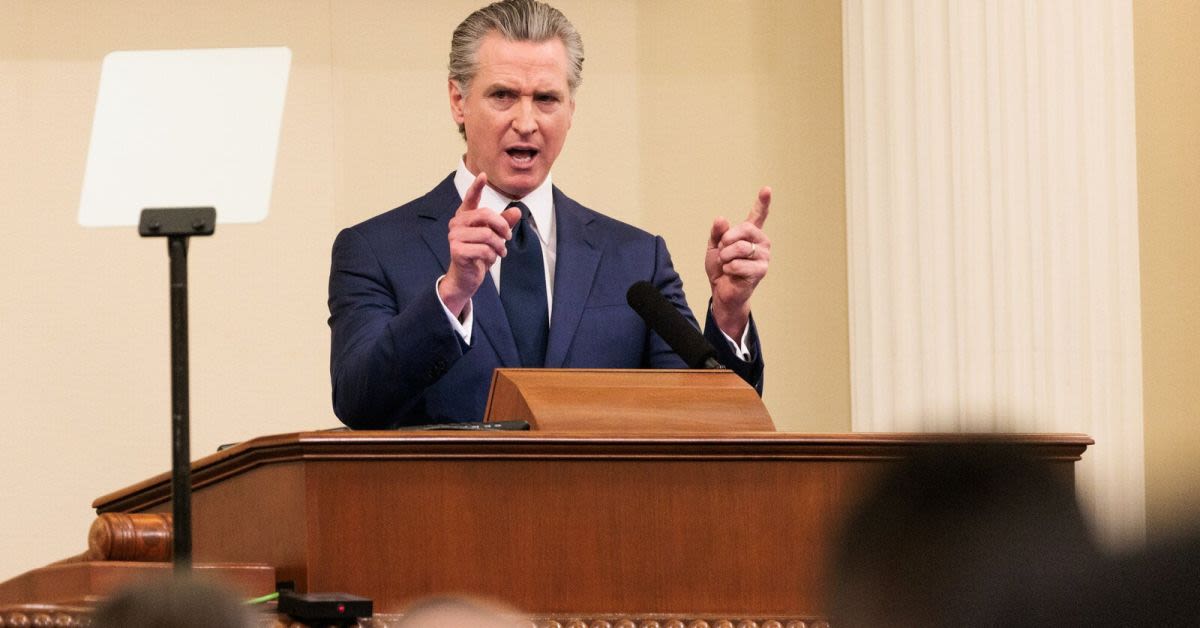
Californias law enforcement leaders are urging Gov. Gavin Newsom to abandon a sweeping plan to spare hundreds of death row inmates, warning that such a move would betray victims and jeopardize public safety.
Their appeal comes as the Democratic governor reportedly weighs commuting the sentences of 563 condemned prisoners, a move that would effectively dismantle the nations largest death row with the stroke of a pen. According to The New York Post, discussions inside Newsoms circle intensified after the botched execution of Tennessee inmate Christa Pike, in which two doses of the highly potent sedative Pentobarbital failed to kill her, an incident that has energized anti-death-penalty activists and added fresh pressure on governors nationwide.
Calling the potential mass commutation outrageous, the California Police Chiefs Association argued that Newsoms contemplated action would extend mercy to some of the states most notorious killers while sidelining the judgment of juries and the suffering of victims families. These are the worst of the worst individuals who committed horrific murders and were sentenced to death by juries after hearing the evidence, Tustin Police Chief Sean Thuilliez, who heads the association, said in a statement.
For many in law enforcement, the concern is not merely symbolic but deeply practical: they fear that once death sentences are erased, the legal machinery that has steadily expanded resentencing and early-release opportunities will eventually open the door for these offenders to return to the streets. The chiefs warned that such a step would override the careful deliberations of juries and judges, undermining the credibility of the criminal justice system and sending a dangerous message that even the most heinous crimes may not carry the ultimate consequence.
The association underscored that California has already created more legal avenues for resentencing, sentence review and commutation, including new regulations that could allow even inmates serving life without parole to seek clemency or sentence reductions. Against that backdrop, they argue, stripping away death sentences now is not a neutral administrative act but a radical policy shift that could, over time, erode what remains of meaningful punishment for the most violent offenders.
Thuilliez framed the governors deliberations as a direct affront to those who have waited decades for justice in some of the states most infamous cases. The governor is considering taking those sentences away and replacing them with a punishment that offers no guarantee these murderers will spend the rest of their lives in prison. That is outrageous, and it is an insult to the victims and families who have waited decades for justice, he said.
Even before the Pike execution debacle, activists and progressive allies had been pressing Newsom to convert all death sentences to life terms, a move that would require the California Supreme Courts approval for inmates with multiple felony convictions. A mass commutation in California alone could slash the nations death row population by more than a quarter, instantly transforming the landscape of capital punishment in the United States and cementing the states role as a vanguard of the lefts criminal-justice agenda.
The chiefs association contends that such a sweeping act by a term-limited governor would be a profound overreach, effectively nullifying years of work by prosecutors, juries, and judges who followed the law as written. A governor on his way out, they argue, should not unilaterally rewrite the moral and legal verdicts rendered in hundreds of murder cases, particularly when those decisions were made under statutes still on the books and supported by many Californians.
This is not his decision alone to make. The next Governor, the Legislature, victims families, and the people of California deserve to have their voices heard, Thuilliez said, insisting that any move of this magnitude should be subject to broader democratic debate rather than executive fiat. From a conservative standpoint, his argument reflects a deeper concern that progressive executives increasingly use their clemency powers to advance ideological goals that voters have never explicitly endorsed.
Among those who could benefit from a mass commutation are Richard Allen Davis, convicted in 1996 of kidnapping and murdering 12-year-old Polly Klaas, and serial killer Charles Ng, found guilty of 11 first-degree murders. Also on Californias death row is Cary Stayner, the handyman-turned-serial killer who murdered four women near Yosemite National Park in 1999, including two teenage girls aged 15 and 16, crimes that shocked the nation and helped cement public support for the death penalty in particularly brutal cases.
California has not executed anyone since 2006, even as it maintains the largest death row in the country, a reality driven in part by Newsoms 2019 executive order imposing a moratorium on executions. The governors office previously told The Post that Governor Newsom has been clear about his position on the death penalty since his first year in office, when he ordered a moratorium on executions, and he has denounced capital punishment as discriminatory and wasteful.
Yet Newsom has also publicly wrestled with the political and moral implications of wiping out hundreds of death sentences at once, especially in light of the victims whose lives were brutally taken. During an episode of his podcast, This is Gavin Newsom, he asked pro-racial justice attorney Bryan Stevenson, Do I commute the largest death row in the Western Hemisphere? before posing the question that haunts any such decision: What do I say to the victims?
Login