
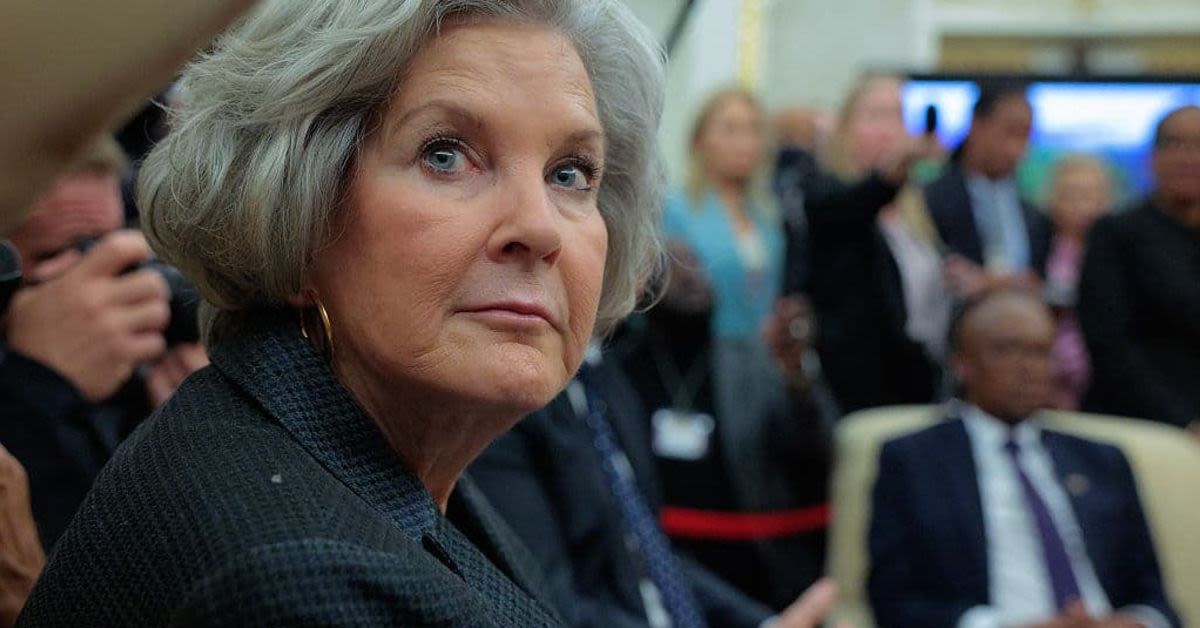
President Donald Trump notched another significant victory over the legacy media on when Politico backed down and corrected a story about White House Chief of Staff Susie Wiles after receiving a 48-hour ultimatum from the presidents legal team.
According to Western Journal, the dispute centered on Politicos reporting about who arranged a high-profile Fox News interview involving then-White House Press Secretary Katie Zacharia and host Sean Hannity. Politico had originally claimed that Wiles was responsible for coordinating the appearance, a detail that fit neatly into the outlets broader narrative of alleged turmoil inside the Trump White House but which the administration insisted was flatly untrue.
Under pressure, Politico issued a formal correction that significantly walked back its earlier claims about Wiles role. CORRECTION: An earlier version of this report, including its headline, mischaracterized the role White House chief of staff Susie Wiles played in then-press secretary Katie Zacharias interview with Sean Hannity on Fox News, the update read.
POLITICOs follow-up reporting indicates she did not play a direct role in setting up the interview. The original story had tied Wiles to the controversial media booking, which many in Washington viewed as the final blow to Zacharias historically brief tenure at the White House podium.
Zacharias interview with Hannity was widely seen as the last nail in the coffin that ended her historically short run behind the press podium. The episode became a convenient hook for critics eager to portray the Trump administration as chaotic, and Politicos now-corrected account had been used to implicate Wiles in that narrative.
Trumps counsel, William Scharf, challenged that storyline head-on in a sharply worded letter sent Monday to Politicos Global Editor-in-Chief Jonathan Greenberger. Between October 14-17, Politico published a series of demonstrably false and defamatory articles in an apparent effort to manufacture a narrative of dysfunction and infighting in the White House. These publications reflect far more than sloppy reporting or an unfortunate, inadvertent reliance on unreliable sources, he wrote.
They instead reveal a disturbing pattern of the publication of sensational falsehoods despite direct, on-the-record refutations from senior White House officials and even the President of the United States himself, as well as documentary evidence provided to Politico, all of which established clearly that claims central to Politicos planned reporting were false, Scharf continued. In other words, the White House is accusing Politico not merely of error, but of willful disregard for facts that contradicted its preferred storyline.
Put simply, your publication was told the truth and presented with corroborating evidence, and yet chose to publish fanciful fiction regardless. That line encapsulated the broader conservative critique of much of todays corporate media: that bias is not incidental but baked into editorial decisions, even when hard evidence points the other way.
Scharf argued that Politicos conduct raises serious questions about the outlets adherence to the most basic standards of ethics, journalistic integrity, and the standards of professionalism expected of serious news publications. For an administration long targeted by hostile coverage, the letter signaled a willingness not only to call out perceived bias but to demand concrete remedies.
The White House counsel accused Politico of knowingly disregarding the truth and hiding behind anonymous sources when confronted. That practice, common in Beltway reporting, has drawn increasing scrutiny from conservatives who see anonymous sourcing as a shield for partisan leaks and unverified claims.
I therefore demand that Politico retract these defamatory articles and issue corrections promptly, or face the consequences, he declared. Freedom of the press is not a professional exemption from accountability.
Those words underscored a core conservative principle: constitutional protections for the press do not absolve media organizations from responsibility when they defame public officials or mislead the public.
He ended the letter by demanding that Politico immediately correct or retract these publications, issue a prominent and public apology to the President of the United States and to Ms. Wiles, and remove the false reporting from your digital archives. The insistence on a prominent and public apology reflects a recognition that reputational damage spreads quickly in the digital age and cannot be undone by quiet edits.
Failure to do so or otherwise respond justifying Politicos publications within 48 hours will prompt an immediate review of Politicos relationship with the White House, and, of course, consideration of all other appropriate and available legal remedies, Scharf added. Politicos subsequent correction suggests the outlet took that deadline seriously, a notable concession from a major Beltway publication that often positions itself as an arbiter of political narratives.
The Trump administrations relationship with Politico has been turbulent as of late, to say the least. The clash over the Wiles story is only the latest skirmish in a broader struggle between a conservative White House determined to challenge media orthodoxy and institutions that have long leaned left in both tone and coverage.
Earlier this year, Politico was banned from the White House, along with CNN and MS NOW, but the outlets were granted temporary relief from a federal judge as the case makes its way through the courts. That legal fight highlights a tension between press access and the administrations right to set standards for conduct and accuracy among those granted the privilege of the briefing room.
This also isnt the first time Trump has scored a major victory against the mainstream media. Over the past several years, the president has repeatedly turned to the courts and the threat of litigation to hold powerful media and tech entities to account when they cross legal or ethical lines.
Last year, the president reached a settlement with CBS parent company Paramount for $16 million after the outlets deceptive editing of a Kamala Harris interview on 60 Minutes during the 2024 election cycle. That payout sent a clear message that selectively edited content designed to shape a political narrative can carry a steep price when it crosses into defamation or misrepresentation.
He received a $15 million payout from ABC News after suing the network and host George Stephanopoulos in 2024, after the anchor repeatedly stated that Trump had been found liable for rape. The settlement underscored that even high-profile anchors at legacy networks are not immune from consequences when they misstate the findings of a court.
Additionally, in January 2025, the commander in chief reached a settlement with Meta for roughly $25 million due to the suspension of his social media accounts. That agreement marked a rare instance of a major tech platform facing tangible repercussions for deplatforming a sitting president, a move many conservatives viewed as blatant political censorship.
Most of the money from these cases will go to fund Trumps future presidential library, with the remainder being used to cover legal fees. For supporters, the string of settlements and corrections is more than a series of legal wins; it is evidence that a conservative president willing to push back can force powerful media and tech institutions to answer for their actions, even in an environment where those institutions overwhelmingly lean to the left.
Login