
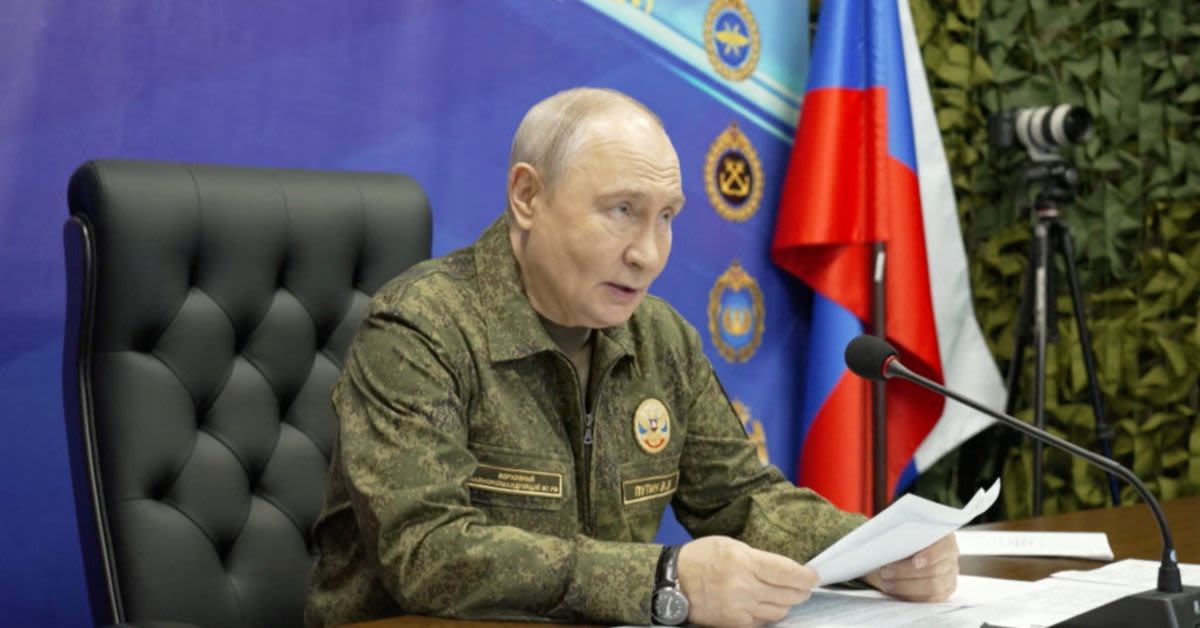
Russian President Vladimir Putin is pressing for a high-stakes three-way summit with President Donald Trump and Chinese President Xi Jinping next month to hammer out terms to end the four-year war in Ukraine.
The initiative, floated directly to Trump during an Oct. 9 phone call, would deliberately sideline Ukrainian President Volodymyr Zelenskyy and place the fate of his country in the hands of the worlds three dominant powers, according to The Wall Street Journal. As reported by The Wall Street Journal, a former Russian intelligence officer briefed on the conversation said Putin used the call not only to pitch the summit but also to secure an agreement for the United States to purchase Russian diesel fuel and help move it onto global markets.
The Kremlin has been careful to confirm the talks without appearing to overpromise, signaling both interest and strategic caution. Kremlin spokesman Dmitry Peskov acknowledged that discussions about a possible meeting are underway but stressed that nothing has been finalized, stating, "There is no clear understanding yet regarding the meeting itself or its potential agenda, although all three parties acknowledge the hypothetical possibility of such a meeting taking place."
For Trump, who has repeatedly vowed to end the war in Ukraine and restore a measure of stability to global energy markets, the proposal presents both an opportunity and a political minefield. A senior U.S. official said Trump has not yet agreed to attend but could be open to the idea as he continues to position himself as the only Western leader capable of brokering a deal with Moscow.
Moscows preferred venue underscores the geopolitical stakes and the optics Putin and Xi hope to cultivate. The Kremlin has suggested holding the summit on the sidelines of the Nov. 18-19 Asia-Pacific Economic Cooperation meeting in Shenzhen, China, according to people familiar with the discussions, a setting that would highlight Chinas growing clout and Americas need to engage.
Russian officials have already approached Beijing through diplomatic channels, seeking to lock in Xis participation and frame the gathering as a forum of equals among great powers. Chinese representatives have signaled they would not oppose the summit if Trump agrees to attend, the Journal reported, effectively placing the decision squarely in Washingtons hands.
For Xi, the proposed meeting offers a rare chance to cast China as an indispensable broker between two nuclear superpowers locked in a grinding proxy conflict. "China wants to be seen as the pivot of the great powers, and potentially as a mediator between the U.S. and Russia," Yun Sun, director of the China program at the D.C.-based Stimson Center, told the Journal, capturing Beijings ambition to supplant Western-led diplomacy.
The timing of the proposal coincides with a noticeable thaw in U.S.-Russia relations under Trump, who has prioritized pragmatic engagement over the punitive posture favored by many in Washingtons foreign-policy establishment. Earlier this month, Trump and Putin reached an agreement for the United States to purchase Russian diesel fuel, a move the White House framed as an effort to ease rising energy costs for American consumers and businesses already squeezed by inflation and global instability.
Trump followed that deal by waiving major sanctions against Russia that had been authorized under bipartisan legislation he himself signed in September, a step that infuriated hawks in both parties but delighted many in his populist base. The decision drew cheers from MAGA supporters who see sanctions as a failed tool of the globalist class and criticism from lawmakers in both parties who insist that sustained economic pressure on Moscow is essential to securing a favorable peace deal for Kyiv.
Inside the administration, officials have defended the presidents approach as a hard-nosed calculation rather than a concession to the Kremlin. A senior White House official told the Journal that Trump acted only after concluding there were few other viable ways to bring down fuel prices, which have become a central concern for working- and middle-class Americans.
Energy analysts, however, caution that the broader regional conflict remains the primary driver of diesel prices and that the Russian volumes covered by the agreement are too limited to dramatically shift global markets. They argue that while the deal may offer some marginal relief, it is unlikely to reverse the structural pressures created by war, supply disruptions, and years of underinvestment in traditional energy under green-first policies.
Trump, for his part, has framed his decisions on sanctions and energy as integral to a broader peace strategy rather than as isolated economic measures. Defending his move on Sunday, he warned that additional sanctions could sabotage delicate negotiations, writing on Truth Social, "I am in the process of negotiating Peace in the war between Russia and Ukraine, and don't want to do anything that will drive, foolishly, Russia away from the bargaining table."
The president also downplayed Moscows role in supporting Tehran, suggesting that keeping lines open with Putin could help limit Russias involvement in other destabilizing theaters. He argued that Moscow was providing relatively little assistance to Iran and that he wanted to preserve that restraint, a stance that contrasts sharply with the maximalist sanctions approach favored by many in the foreign-policy bureaucracy.
According to the Journal, this is not the first time Putin has floated the idea of a trilateral summit with Trump and Xi, but the latest proposal comes amid a more favorable climate between Moscow and Washington. The Kremlin appears to sense that Trumps willingness to break with bipartisan orthodoxy on sanctions and energy could open the door to a broader realignment, one that prioritizes American economic interests and strategic stability over ideological crusades.
The White House and the Chinese Embassy in Washington declined to respond to the Journals requests for comment, reflecting the sensitivity of the talks and the political risks for all sides. For Trump, agreeing to a summit that excludes Zelenskyy would invite fierce criticism from the foreign-policy establishment and the left, which have long opposed any settlement that does not fully align with Kyivs maximalist demands.
Yet the prospect of a three-way negotiation also highlights a reality that many in Washington prefer to ignore: great-power diplomacy often proceeds above the heads of smaller states, especially when Western taxpayers are footing the bill for open-ended conflicts. The proposed summit would give Trump a platform to test whether Putin and Xi are prepared to accept a settlement that reduces the burden on American resources while preserving core U.S. security interests.
No summit has been formally announced, and it remains uncertain whether Trump will accept Putins proposal as presented or insist that Ukraine be brought into at least part of the talks. What is clear is that, as the war drags into its fourth year with no decisive outcome, pressure is mounting on Western leaders to pursue a negotiated end rather than continue writing blank checks for a conflict with no clear exit strategy.
Login