
An explosion and massive fire at one of Canadas busiest military training bases has left multiple people dead, dozens more injured, and a nation demanding answers about what went wrong during a live-fire exercise on Canadian soil.
According to Conservative Daily News, the blast tore through Canadian Forces Base Wainwright in east-central Alberta, triggering a cascade of emergency responses as flames jumped the perimeter fence and overwhelmed local medical facilities. At least seven people were killed and dozens injured, Global News reported, citing multiple military sources, though Canadian officials have so far refused to release an official casualty count. Canadian Defence Minister David McGuinty acknowledged the loss of life and the scale of the injuries but has kept the public in the dark on precise numbers, a decision that will likely fuel further scrutiny of how the Carney government and senior military leadership are managing the crisis.
Im saddened to share that there have been both fatalities and injuries as a result of an incident on the base, McGuinty told reporters Saturday, according to The Associated Press. His brief remarks, while somber, offered little in the way of concrete information, underscoring a pattern of opacity that has become all too familiar in Ottawas handling of national security and public safety incidents.
The Canadian Armed Forces (CAF) confirmed that a fire ignited inside the bases training area at approximately 4 p.m. local time (6 p.m. EDT) before spreading beyond the installations boundaries. That rapid spread, combined with high winds and the presence of energy infrastructure and military fuel, has raised serious questions about whether adequate safeguards were in place before live ammunition was used.
Multiple military sources told Global News that a live-fire exercise struck a natural gas line or well, triggering the explosion and subsequent inferno. Canadian military authorities, however, have not publicly confirmed that account at the time of writing, leaving families, local residents, and observers to piece together the likely cause from unofficial reports and eyewitness testimony.
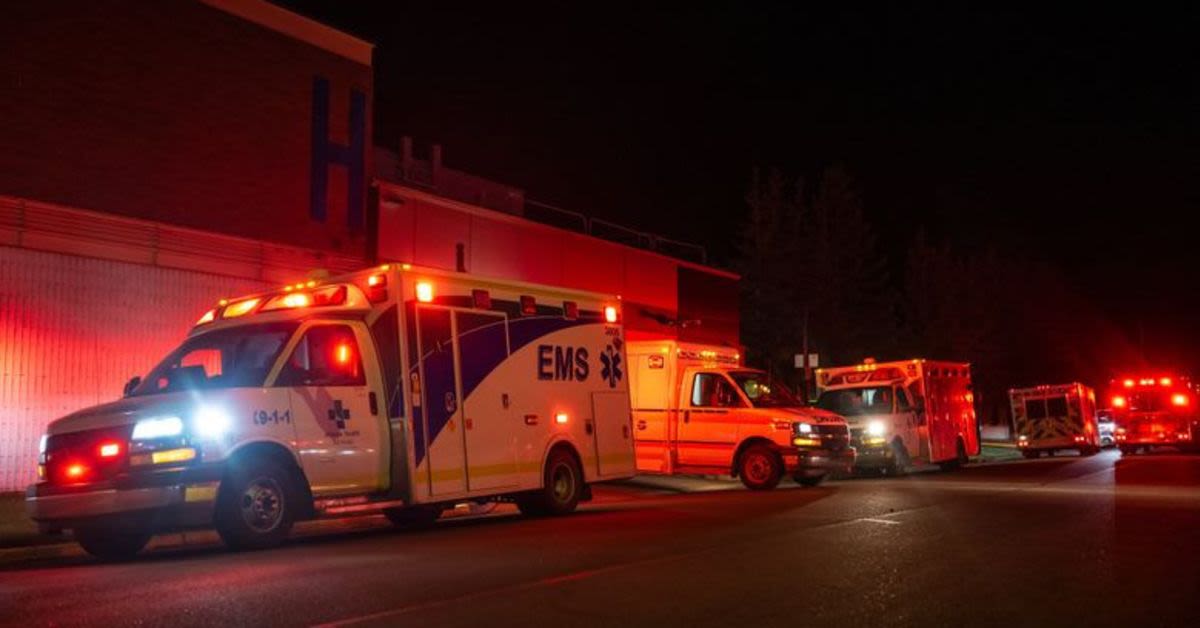
Hospitals in Edmonton were forced to activate Code Orange mass-casualty protocols as patients were rushed out of Wainwrights overwhelmed medical facilities, according to CBC News. The surge of casualties exposed the limits of regional capacity and highlighted how a single catastrophic incident on a major base can strain civilian health systems far beyond the immediate area.
This number of patients would overwhelm the city of Edmonton, Dr. Warren Thirsk, an emergency physician at Royal Alexandra Hospital, told the outlet. It is more patients than any of us want to count right now.
Ambulances converged on Wainwright High School, which local eyewitnesses said was being used as an emergency staging area as the scale of the disaster became clear. Authorities have not, at the time of writing, confirmed whether patients were treated inside the building, but the use of a public school underscores how the community was abruptly transformed into a front-line triage zone.
Acute Care Alberta confirmed that emergency medical services were providing both on-site care and transportation for the injured, while Shock Trauma Air Rescue Service (STARS) Air Ambulance dispatched crews from Edmonton and Saskatoon. The deployment of air ambulances from multiple cities suggests that the injuries were not only numerous but severe, requiring rapid evacuation to higher-level trauma centers.
Wind gusts reportedly reached 100 kilometers per hour (about 62.1 mph) as the flames crossed the bases perimeter fence, complicating firefighting efforts and driving the blaze in a single dominant direction. Firefighters from multiple jurisdictions were called in, a reminder that when federal installations fail to contain their own hazards, it is local communities and municipal resources that are forced to shoulder the burden.
The Canadian Armed Forces said its immediate priority was supporting those affected and notifying next of kin, adding that official casualty figures would not be released until that process was complete. While respect for families is paramount, the lack of transparency about the scale of the disaster risks eroding public trust, particularly when unofficial tallies and social media reports are already circulating widely.
Canadas Department of National Defence declined to confirm whether natural gas infrastructure or military fuel supplies were involved when contacted by the Daily Caller News Foundation (DCNF). That silence has only intensified speculation, especially given longstanding concerns about the coexistence of energy infrastructure and live-fire training on the same terrain.
We are aware of an incident in Wainwright, Alberta. The safety and security of our personnel, their families, and members of the surrounding community remain our highest priority, Suzanne Lalande, a representative of the departments media relations office, told the DCNF in an emailed statement. We are closely monitoring the situation and will provide additional information as it becomes available and can be confirmed.
The Canadian military and the Royal Canadian Mounted Police have launched a joint investigation into the incident, McGuinty told reporters in Ottawa, according to Reuters. That dual-track probe suggests officials are considering not only technical failures but also potential lapses in procedure or oversight that could carry legal or disciplinary consequences.
The reported explosion has sparked intense debate over whether natural gas infrastructure, oil wells, or military fuel supplies were involved, and whether live-fire training was conducted with sufficient regard for those risks. Before any official confirmation, social media users some claiming personal familiarity with the base and surrounding area began dissecting images, videos, and early reports in real time.
This could be one of the biggest Canadian mass casualty events, the @WogPogReal account said during a live X Space discussion the user hosted Saturday, predicting that the death toll could reach double digits. That grim assessment, while speculative, reflects the widespread fear that the public is not yet being told the full extent of the devastation.
The possibility of an oil or natural gas well explosion drew skepticism from some X Space participants, including user @CanadaPlus3, who argued that flames from a well fire would typically rise vertically rather than spread predominantly in one direction. The direction of the flames alone, however, does not establish the fires cause, and such technical debates underscore the need for a transparent, independent investigation rather than selective leaks and guarded statements.
The DCNF contacted Phoenix Gas to determine whether its natural gas infrastructure sustained damage in the blast or subsequent fire. A company representative acknowledged the inquiry and indicated that the firm would respond, suggesting that private-sector operators may soon be drawn more directly into the public discussion.
Another X Space participant, @jimmyjohn010, expressed the belief that military personnel were conducting a live-fire exercise when strong winds rapidly developed, potentially affecting operations on the firing range. If accurate, that scenario would raise serious questions about why training continued under such volatile weather conditions and whether commanders properly weighed the risks.
Potential court-martial proceedings over alleged safety violations were also raised by user @jimmyjohn010, although Canadian authorities have not, at the time of writing, announced any disciplinary action or determined whether military protocols were violated. The mere fact that such possibilities are being openly discussed reflects a broader concern that Canadas armed forces may be cutting corners on safety at a time when recruitment, readiness, and morale are already under strain.
A forward fuel point a location where military personnel store or distribute fuel during operations was another possible source of the explosion suggested by X Space participants who identified themselves as former service members. Authorities, at the time of writing, have not confirmed that any military fuel supply point was involved, but the presence of such facilities on a live-fire range inevitably magnifies the potential for catastrophic outcomes if something goes wrong.
The possibility that incendiary munitions, including napalm, contributed to the explosion was also raised by X user @SamSteeleT89C. If incendiary weapons were in use, that would further complicate firefighting efforts and heighten concerns about the type of ordnance being deployed so close to civilian communities and critical infrastructure.
I felt/heard the boom but it was a good distance from me, local resident Julie Verheul Tupling wrote on Facebook. Countless ambulances are staging at Wainwright High School from all over, Tupling added, describing the emergency response.
Ive done wireline work on that base.. theres lots of oil wells below ground level, out in the field, Rick Verheul, who identified himself as a former worker at the installation, wrote in a Facebook comment. Some wellheads were situated approximately 10 to 15 feet below ground level, while workers were required to complete safety training before entering the military range, according to Verheul.
We had to take a course before we went out on the rangewhat to do if we found a live round, Verheul wrote, recalling an instance in which workers encountered ammunition that was subsequently removed. The reported presence of oil and natural gas infrastructure at CFB Wainwright, however, does not establish whether those facilities were involved in Saturdays explosion, but it does highlight the complex and potentially hazardous mix of military and industrial activity on the site.
Canadian Prime Minister Mark Carney described the incident as serious, saying federal authorities were coordinating with provincial and municipal governments. Our thoughts are with all the brave women and men affected, Carney wrote on X.
The Canadian Armed Forces, the Department of National Defence, and federal public safety officials were coordinating with Alberta and municipal authorities to mobilize emergency resources, according to McGuinty. My thoughts are with the families and with everyone impacted by this tragic event, the minister said in an official statement which also thanked first responders and military personnel for their work.
This is a profoundly difficult moment for the entire Canadian Armed Forces, General Jennie Carignan, Canadas chief of the defense staff, added. Carignan said military officials were prioritizing support for affected personnel and their families as casualty identification and next-of-kin notifications continued.
Our soldiers, civilian personnel, and emergency responders are working closely with local authorities to respond to this situation, Lieutenant-General Michael Wright, commander of the Canadian Army, stated. Wright also expressed condolences to the families of those killed and pledged continued military assistance to those affected.
Alberta Premier Danielle Smith called the incident significant and tragic, while Conservative lawmaker Dane Lloyd reported hearing of significant casualties, underscoring the gravity of what unfolded at Wainwright. Their responses stand in contrast to the more guarded language from federal officials, reflecting a provincial leadership that has often been more forthright about crises affecting Albertans than the Liberal government in Ottawa.
CFB Wainwright is one of Canadas busiest military training installations, hosting exercises for Canadian Armed Forces personnel and allied units. It houses the Canadian Manoeuvre Training Centre and the 3rd Canadian Division Training Centre, making it a critical hub for preparing soldiers for combat operations and a place where safety failures can have especially devastating consequences.
The cause of the incident remains under investigation, but the questions are already clear: whether live-fire training was conducted responsibly in the presence of energy infrastructure and high winds, whether safety protocols were rigorously enforced, and whether political and military leaders will be transparent with the public about what went wrong. For a country that has long prided itself on professional armed forces and safe training environments, the Wainwright disaster is a stark reminder that readiness and realism in training must never come at the expense of basic prudence, accountability, and the protection of both service members and surrounding communities.
Login