
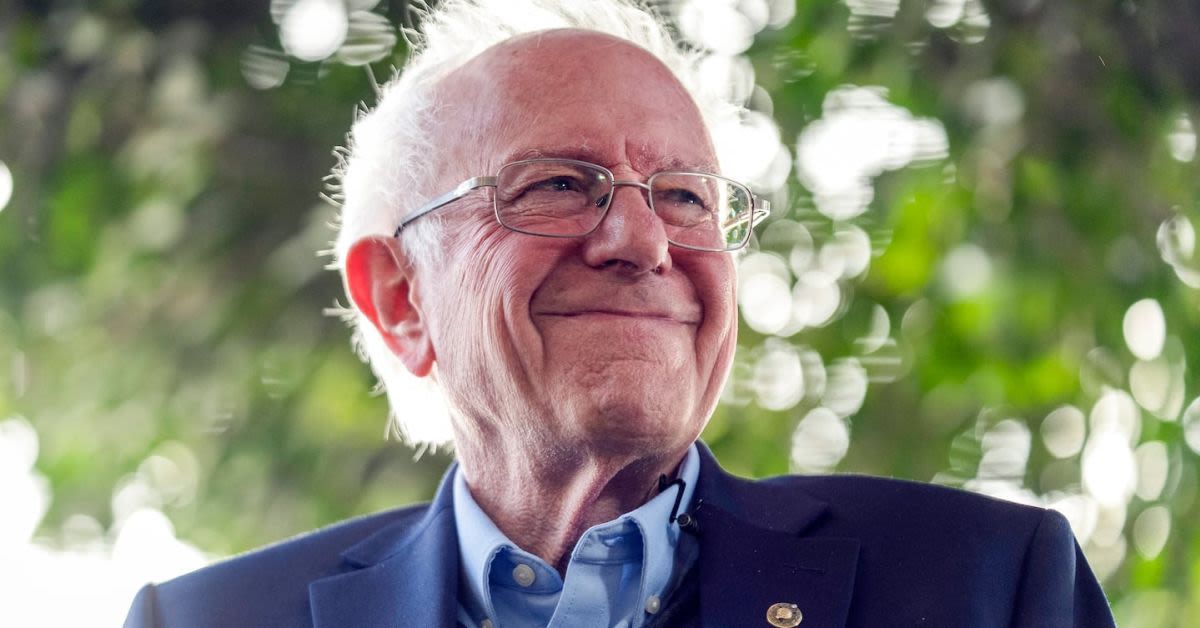
Two of Congress most outspoken progressives are preparing a sweeping new attempt to clamp down on artificial intelligence, unveiling legislation that would outlaw artificial superintelligence and erect a powerful new federal bureaucracy to police advanced AI systems.
According to The Associated Press, Sen. Bernie Sanders of Vermont and Rep. Greg Casar of Texas are set to introduce a bill that would not only ban the development of AI systems that surpass human cognitive abilities, but also temporarily halt work on the most advanced AI models until Washington writes and enforces new safety rules.
The proposal, which would establish a Cabinet-level Department of Artificial Intelligence, arrives as some of the very executives building these systems plead for government guardrails, even while the Trump administration and many Democrats continue to embrace expansive tech regulation as a political project.
The legislation, shared first with the AP, would impose a permanent prohibition on what it calls artificial superintelligence, defined as any system that exceeds human cognitive capacity or is capable of planning and carrying out the destruction or disempowerment of humanity.
In the interim, the bill would impose a moratorium on the development of the most powerful AI systems until the new department drafts and implements federal safety standards, effectively putting Washington bureaucrats in charge of deciding when and how innovation may proceed.
Under the SandersCasar framework, no advanced AI system could be deployed without explicit federal approval, turning the government into a gatekeeper for cutting-edge computing.
Violations of the law would carry severe penalties, including criminal sanctions of up to 20 years in prison in some circumstances, a level of punishment more commonly associated with violent crime than with software research.
Progressive advocates are touting support from a number of current employees at major AI firms and outside experts, who signed onto a statement backing the bill that was circulated to the AP.
Their endorsements underscore a growing split within the tech world, where some insiders now argue that the very tools they are building are too dangerous to be left to market forces and existing law, and instead require preemptive bans and centralized control.
Sanders, long a champion of expansive federal power over the private sector, framed the issue in stark, almost apocalyptic terms as he pressed for a slowdown.
"It doesn't take a genius to say, 'slow it down,'" Sanders, I-Vt., said in an interview with AP, adding, "Do we really want to develop a super intelligence that when it becomes smarter than human beings could act independently of human control? I don't think we do."
One of the bills backers, Juan Felipe Cern Uribe, a researcher in OpenAI's Safety Systems, argued that the stakes are nothing less than civilizational survival.
In a statement supporting the bill, he warned that "superintelligence could either go extremely right or extremely wrong" and that "we shouldn't be playing such games," language that progressives are using to justify aggressive preemptive regulation.
Another supporter, Swante Scholz, a software engineer at Google DeepMind who emphasized he was not speaking for his employer, painted an even darker picture of the current trajectory.
On the present path of development, Scholz said, the "most likely outcome is an existential catastrophe for humanity," and he added in a statement that "A ban on superintelligence development would be a positive change for the foreseeable future."
Despite the dire rhetoric, the measure faces steep political headwinds in the Republican-controlled Congress, where many lawmakers are wary of sweeping new federal agencies and blanket bans that could cripple American competitiveness.
Even among those open to some form of AI oversight, there has been little consensus around anything approaching the scope of the SandersCasar proposal, which would effectively nationalize the decision-making process around high-end AI research.
The bill also serves as a revealing marker of how the progressive wing of the Democratic Party intends to approach AI ahead of the November midterm elections and the 2028 presidential race, where technology policy is expected to loom large.
Casar, a Texas Democrat who chairs the Congressional Progressive Caucus, is positioning the legislation as a template for a more interventionist, government-first approach to emerging technologies, in sharp contrast to conservatives who emphasize innovation, competition, and national security.
Potential 2028 Democratic presidential hopefuls are already racing to show they are serious about AI, often by proposing more regulation, more oversight, and more state involvement.
Maryland Gov. Wes Moore rolled out a plan this week to regulate AI at the state level, while California Gov. Gavin Newsom just signed an executive order to speed up implementation of a California law that mandates independent oversight of AI companies, reinforcing the West Coasts reputation for heavy-handed tech rules.
Sanders, now 85 and a two-time presidential candidate, has made AI a personal crusade in recent months, using it to advance his broader agenda of wealth redistribution and centralized economic control.
In June, he introduced a separate proposal to create a sovereign wealth fund financed through a one-time tax on the stock of the largest AI companies, effectively seizing a slice of private enterprise to fund government-directed investments.
The Vermont senator has also been working to build a cross-ideological coalition around AI skepticism, even as his policy prescriptions remain firmly on the left.
Last week, he convened colleagues for a briefing with experts and attended a conference on AI that included Republicans such as former White House adviser Steve Bannon, highlighting how concerns about AI risk can blur traditional partisan lines even while the solutions diverge sharply.
Across the country, the debate over AI regulation is reshuffling political alliances and voter attitudes, with anxiety about the technology cutting across party boundaries.
Americans have become more worried about the environmental footprint of AI over the past year, a trend that progressives are using to justify further restrictions, while conservatives caution that such fears are being weaponized to throttle innovation and energy use.
A recent survey by The Associated Press-NORC Center for Public Affairs Research and the Energy Policy Institute at the University of Chicago found that about half of Americans now express deep concern about AIs environmental impact.
The poll reported that 53% of Americans are "extremely" or "very" concerned about artificial intelligence's environmental impacts, up from 41% last year, a jump driven largely by Democrats but also reflecting broader unease about the proliferation of massive data centers.
Those data centers, which power AI and cloud computing, have become a flashpoint in local communities where residents worry about land use, energy consumption, and infrastructure strain.
While some of these concerns are legitimate, conservatives warn that they are increasingly being folded into a broader regulatory push that treats technological progress itself as suspect, rather than seeking balanced solutions that protect both communities and economic growth.
Within the tech industry, a number of high-profile leaders have called for new safeguards, but they generally stop short of endorsing outright bans or criminal penalties for innovation.
President Donald Trump, by contrast, has resisted the latest wave of demands for expansive federal oversight, putting him at odds with executives such as Anthropic's Dario Amodei, OpenAI's Sam Altman, and xAI's Elon Musk, who have urged Congress to adopt some form of guardrails.
Trump has instead emphasized American leadership and competitiveness, warning that overregulation could hand strategic advantage to adversaries like China.
On Tuesday, he told the United Nations General Assembly that artificial intelligence will be renamed "super intelligence," a rhetorical flourish that drew criticism from Sanders but underscored Trumps instinct to frame the issue in terms of branding and national strength rather than technocratic control.
Sanders, for his part, dismissed Trumps stance as shallow and economically driven, accusing the president of failing to grasp the deeper risks.
"I think Trump has very little understanding of what this issue is about," Sanders said, adding, "I think he's mainly concerned about the economic implications of a slowdown."
Despite their differences, both Trump and Sanders acknowledge that AI safety will be a central topic in U.S.China relations, particularly as the two nations vie for dominance in advanced computing.
AI safety is expected to be a central part of talks between Trump and China's Xi Jinping at the White House this week, even as critics warn that any unilateral slowdown in American development, such as the one envisioned by the SandersCasar bill, could leave the United States dangerously exposed.
The prospect of Washington slamming the brakes on domestic AI research while Beijing presses ahead has become one of the main arguments against sweeping restrictions.
National security hawks and free-market conservatives alike argue that ceding the technological high ground to a communist regime would be reckless, especially in a domain that will shape future military, economic, and intelligence capabilities.
Sanders counters that the most dangerous forms of AI can only be avoided through international cooperation, drawing a parallel to Cold Warera arms control.
"Ronald Reagan, arch-conservative, was smart enough to understand that he had to sit down with Gorbachev, a communist, and work out a nuclear treaty that protected humanity," Sanders said, adding, "I think we can do that again now."
For conservatives, that comparison is revealing: Reagan negotiated from a position of strength, after rebuilding American military and economic power, not by preemptively disarming or shackling U.S. innovation.
The current debate over AI raises a similar question of sequencingwhether the United States should first ensure it leads in the technology and then seek prudent, verifiable limits, or whether it should embrace the progressive model of bans, moratoria, and new bureaucracies before the race is even decided.
As Sanders and Casar push their bill, the broader public conversation is only beginning to grapple with the trade-offs between safety, liberty, and national strength in the age of artificial intelligence.
Their proposal crystallizes a distinctly progressive vision: one that sees existential risk as justification for sweeping federal power, criminal penalties for innovators, and a permanent prohibition on certain lines of research, even as Americas rivals move full speed ahead.
Login