
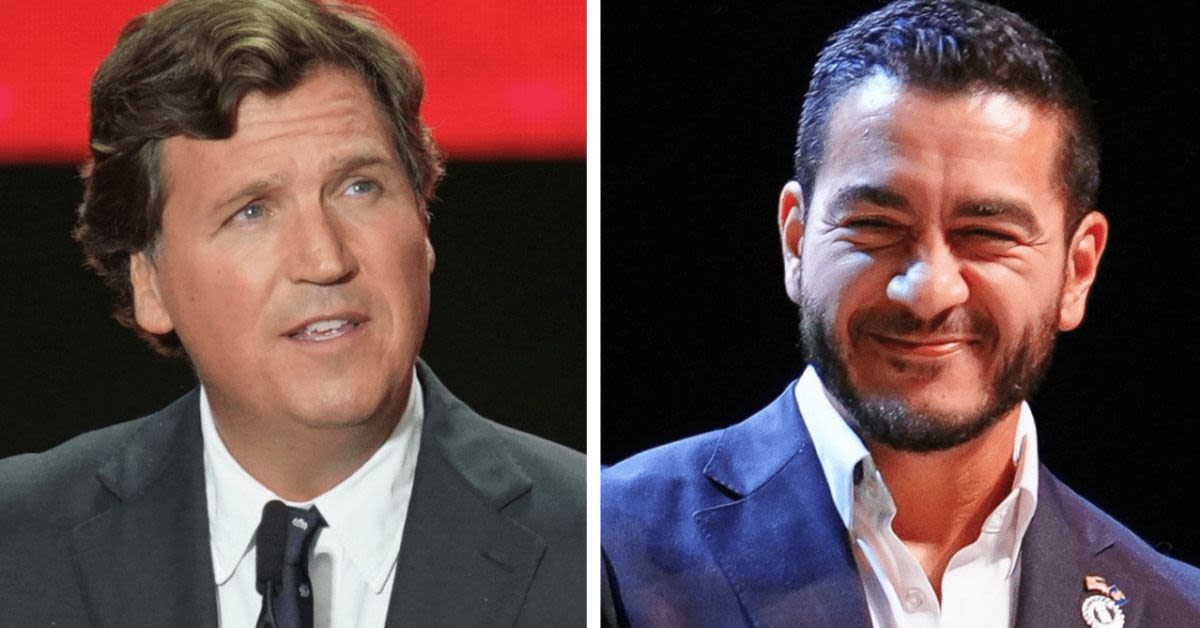
Politics has long produced unlikely alliances, but few are as jarring as the emerging rapport between former Fox News host Tucker Carlson and Michigan Democratic Senate nominee Abdul El-Sayed.
The two men, who sit on opposite ends of the traditional partisan spectrum, have found common cause in their disdain for former GOP Rep. Mike Rogers, as reported by Western Journal. Carlson, now a high-profile independent media figure, recently used his podcast to deliver a blistering assessment of the Republican Senate candidate, declaring, I wouldnt vote for Mike Rogers at gunpoint, according to Mediaite. That remark, effectively a political gift to El-Sayed, has now been reciprocated by the Democrat, who is seizing the opportunity to frame himself as the principled alternative to both Rogers and the Trump-aligned Republican establishment.
On Monday, El-Sayed appeared on CNN and offered his own broadside against the presidents movement, insisting that Donald Trump and his supporters are devouring themselves from within. He told host Erin Burnett that Donald Trump and MAGA is eating itself, a line clearly designed to portray the populist right as a self-destructive force rather than a durable political realignment. Look, Tucker and I dont agree on much, but we definitely agree on what he just said, El-Sayed told Burnett, signaling that he is more than willing to leverage Carlsons criticism of Rogers to his own advantage.
El-Sayed then expanded his critique, arguing that the turmoil on the right stems from a betrayal of the very principles that first animated Trumps rise. I think what youre seeing here is MAGA eating itself, because those who believed in the ideas the idea that we should have America first, that we shouldnt go to wars that we shouldnt be fighting, those who believe in just basic principles folks are turning on people like Mike Rogers because Mike Rogers was a neocon, and then he decried Donald Trump when Donald Trump came to power, he continued. In El-Sayeds telling, Rogers is emblematic of a Republican establishment that opposed Trump when it was fashionable, only to bend the knee once it became politically expedient. Now, hes willing to do whatever Donald Trump tells him to do, so long as Donald Trump is happy with him.
The Democrat also addressed Carlsons description of his campaign as literally Trumpian, a label that would normally be toxic in a Democratic primary but which El-Sayed tried to reframe as a commentary on his supposed consistency. He insisted that Carlsons remark was less about me. Its more about Mike Rogers, and its more about recognizing that I am going to be principled whatever it takes, he said, attempting to cast himself as the rare politician who will not bend under pressure.
El-Sayed went on to present his own political biography as proof of that claim, portraying himself as a candidate who has already withstood a massive financial onslaught. Im somebody who came through an 11-to-1 spend; $70 million spent against me because I dont take corporate money and stood up on my principles. And so I think thats what [Carlson] is speaking to right now. Ive never had a conversation with him, he said, suggesting that Carlsons praise is organic rather than coordinated. Hes not somebody whose endorsement I sought, but really, this is more of a non-endorsement for Mike Rogers, an anti-endorsement against Mike Rogers, than it is anything about me.
Beneath the surface, however, this budding alliance is not merely about a shared dislike of one Republican Senate candidate. It rests on two deeper areas of ideological overlap that should concern anyone who takes national security and Americas role in the world seriously. To put it bluntly, both men have downplayed the threat of Islamic terrorism and have taken positions hostile to the state of Israel, aligning themselves with a worldview that treats Western power as the primary villain and Islamist extremism as a largely understandable reaction.
This odd political courtship first drew wider attention when comments El-Sayed made in 2021 resurfaced, revealing a worldview that many Americans would find troubling in the post-9/11 era. Speaking on a podcast, El-Sayed said, 9/11 scarred our country in profound ways, but what we did after 9/11 scarred millions of other people. He added, When we talk about 9/11, we often fail to center them, a formulation that effectively shifts moral focus away from the nearly 3,000 Americans murdered on that day and toward those in the broader region where al-Qaida and its sympathizers operated.
In practical terms, El-Sayeds framing suggests that the true victims of 9/11 were not the office workers, firefighters, police officers, and airline passengers who were slaughtered, but the populations in countries where the United States later conducted military operations. When Rogers called these remarks disqualifying, Tucker Carlson rushed to El-Sayeds defense, using his newsletter to argue that the Democrat had been unfairly maligned. El-Sayed did not celebrate airplane hijackings or cheerlead Al-Qaeda; he simply said that the U.S. conducting terrorism of its own in response to 9/11 was not exactly an appropriate reaction. He is obviously right, Carlson said, endorsing the notion that Americas response to the worst terrorist attack in its history amounted to conducting terrorism of its own.
Carlson did not stop there, turning his fire squarely on Rogers and portraying him as the real danger in the Michigan Senate race. We are really not sure who Mike Rogers is, but if anyone in Michigans Senate race is unfit to serve in public office, it is him, he added, in a line that plays into his long-running habit of casting suspicion on certain Republicans as compromised or captured by foreign interests. For viewers familiar with Carlsons recent work, the phrase we are really not sure who Mike Rogers is carries a particular insinuation, one that often functions as a veiled reference to Israel or to alleged foreign entanglements that he rarely spells out but frequently implies.
Carlsons rhetorical style has become increasingly conspiratorial, often circling back to a familiar target in the Middle East. A typical monologue, as critics have noted, might begin with an apparently innocuous topic say, algebra and then spiral into a series of leading questions that nudge the audience toward suspicion of shadowy forces. The parody practically writes itself: Algebra: we need it, or so they say. But who said? And why are the numbers Arabic? Whod replace them with letters? Was someone setting up the Arabs? Who would do that? Hmm. My guest, a self-taught mathematician and the media wants to convince you such a thing doesnt exist, but they do has looked into this. The shocking things he found will have you asking questions about Israel.
If that send-up sounds exaggerated, it is actually more grounded than some of Carlsons real conversations, which have veered into territory that many would consider openly bigoted. In one discussion with a sculptor and pottery artist, the guest suggested that letters were inserted into algebraic equations just to [mess] with you, and the two men agreed that the subject was essentially designed for good little goy slaves. When a broadcasters real-life dialogue is more disturbing than parody, it raises serious questions about why any mainstream candidate would want to be associated with him, let alone embrace his criticism of a rival as a badge of honor.
Yet El-Sayed appears comfortable doing just that, even as he adopts a similar narrative about hidden forces aligned against him. When he talks about the 11-to-1 spend and the $70 million spent against me because I dont take corporate money and stood up on my principles, he is not merely complaining about campaign finance; he is implying that powerful, opaque interests are determined to stop him because of his stance on foreign policy and corporate influence. In reality, much of that opposition stemmed from concerns that he is a radical figure hostile to Israel and sympathetic to a worldview that treats Western democracies as aggressors and their enemies as victims.
From a conservative perspective, the convergence between Carlson and El-Sayed underscores a troubling trend on both the populist right and the progressive left: a willingness to minimize the threat of Islamist terrorism and to demonize Israel as a uniquely illegitimate state. When both a left-wing Democrat and a right-wing media star find themselves aligned in portraying Americas post-9/11 actions as terrorism and in casting suspicion on pro-Israel Republicans, it suggests that a certain brand of anti-Western, anti-Israel thinking has seeped into corners of the political spectrum that once would have rejected it outright. That this alliance is now being used to damage a Republican Senate candidate should give the GOP and its voters reason to pause and reassess who is actually advancing conservative interests.
The practical political questions now are straightforward, even if the ideological undercurrents are not. The first is when El-Sayed will inevitably appear on Carlsons podcast, given the mutual praise and shared enemies that now bind them. The second is whether he will bring along fellow leftist provocateur Hasan Piker, a favorite of the online far left; the betting here is that such a joint appearance is unlikely, though the mere plausibility of the scenario speaks volumes about the current state of American politics.
For voters in Michigan and beyond, the emerging CarlsonEl-Sayed axis highlights the importance of looking past partisan labels and examining what candidates and influencers actually believe about America, its enemies, and its allies. When a Democratic Senate hopeful and a former Fox News host can agree that Americas response to 9/11 was conducting terrorism of its own and converge in their hostility toward a pro-Israel Republican, it is a sign that some of the most basic post-9/11 moral certainties are being eroded. Whether this strange partnership remains a brief tactical alignment or evolves into a more durable ideological front, it reveals a deeper realignment in which skepticism of American power and contempt for Israel are becoming points of contact between extremes that otherwise claim to have nothing in common.
Login