
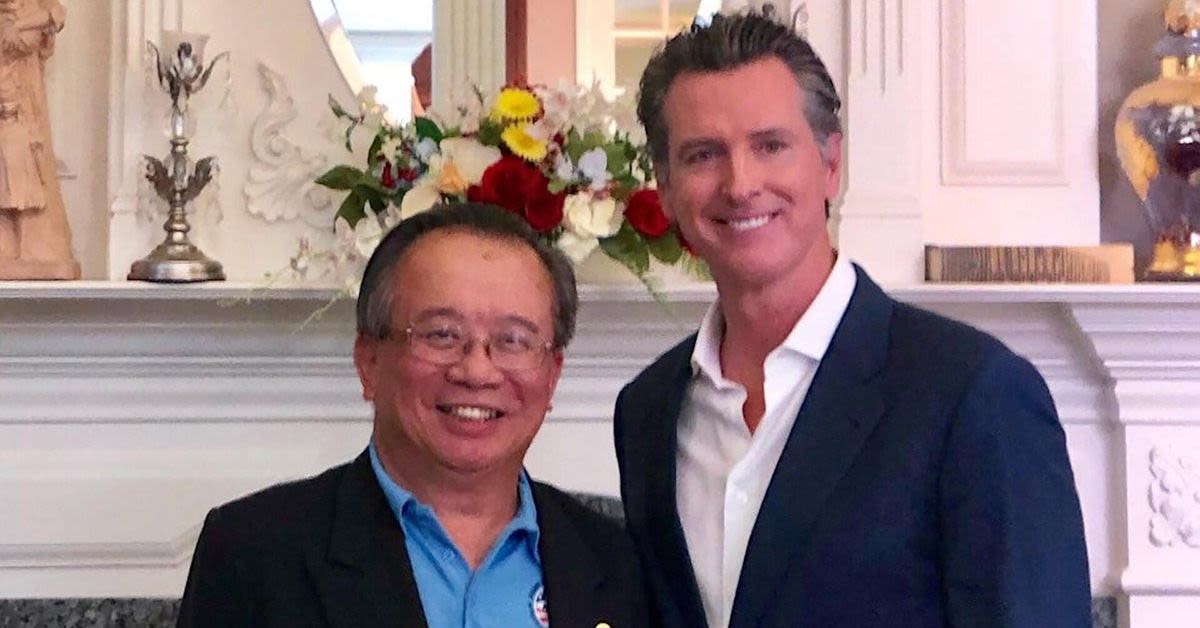
A powerful California family that amassed its wealth through McDonalds franchises has quietly become one of the Democratic Partys most generous benefactors, while sitting at the center of a web of China-linked political influence that should alarm anyone concerned about national security and foreign interference.
According to RedState, the Yin family, led by 89-year-old patriarch C.C. Yin, has poured more than $4.4 million into the campaigns and causes of Governor Gavin Newsom, Vice President Kamala Harris, and a host of other prominent Democrats. C.C. Yin, a Chinese immigrant who built a McDonalds franchise empire, also founded the Asian Pacific American Public Affairs (APAPA) association, a group that has become a key conduit between Asian-American activists and elected officials and, disturbingly, a reported access point for a suspected Chinese spy.
Newly released FBI files describe alleged Chinese intelligence operative Christine Fang better known as Fang Fang as a point of contact for APAPA and state that a top official in the organization directed her toward thenRep. Eric Swalwell. That official has been identified by sources as C.C. Yin, and Fang appeared with the Yin family at a 2013 APAPA event, underscoring how deeply she had embedded herself in Californias political ecosystem before abruptly fleeing to China in 2015.
Fang reportedly used an APAPA chapter as a pipeline into California politics, helping place interns and positioning herself as Swalwells primary liaison to the group. Her reach extended far beyond casual networking: Fang had a very well-documented sexual relationship with Swalwell, even managing at one point to get an intern placed in his Washington office, and, as the New York Post noted, The APAPA, according to a New York Post investigation earlier this month, is still placing interns with politicians across the US.
Nor was Swalwell her only target, as the Post further reported that she also seduced two other politicians she had met through the APAPA network, raising serious questions about how a foreign operative was able to exploit a U.S.-based nonprofit to gain intimate access to American lawmakers. While Democrats and their media allies have spent years obsessing over alleged Russian influence, the Fang case highlights a far more direct and personal penetration effort by the Chinese Communist Party (CCP) into the heart of Californias ruling class. Yet the political establishment has shown little appetite for a full accounting of how this was allowed to happen.
The Yin family, meanwhile, was not merely adjacent to this network; it was a central financial engine for the very Democrats now shaping U.S.-China policy. CBS News reported that C.C. Yins brother, Henry Yin, helped arrange Newsoms 2023 trip to China, where the governor met with CCP leader Xi Jinping a high-profile visit that played directly into Beijings soft-power strategy. Public records show the Yins gave about $364,817 to Newsoms campaigns, plus $80,000 to his 2019 inauguration committee and $50,000 to a nonprofit at his direction, while Harris received $214,300, alongside six-figure contributions to other California Democrats.
The same donor network also delivered $221,700 to Lt. Gov. Eleni Kounalakis between 2018 and 2025 and $115,680 to former state Treasurer John Chiang, illustrating how deeply the familys money is woven into Californias Democratic power structure. In parallel, Henry Yin emerged as a political gatekeeper and facilitator, reportedly advising Democrat Rep. Ro Khanna on trade, appearing with Newsom at a 2019 fundraiser, and being described in Chinese state media as an overseas contact for CaliforniaChina business and talent recruitment.
An organization press release states that Henry Yin has served as Senior Advisor to U.S. Representative Ro Khanna and served as President of APAPAs U.S.-China Trade Committee. Khanna, notably, is now the ranking Democrat on the House Select Committee on Strategic Competition between the United States and the Chinese Communist Party the very panel charged with policing CCP influence in American politics, business, and technology and he publicly named Henry Yin his senior adviser in 2019.
Yet as scrutiny intensified, Henry Yin appears to have tried to erase his public footprint. His LinkedIn profile, which as recently as early September listed him as a senior adviser to Khanna beginning in 2019, has reportedly been scrubbed of that role, even as Khannas office now seeks to distance itself from him. After the New York Post asked about the relationship, a Khanna spokeswoman insisted that Henry Yin lives in Fremont and is a respected community member, but has never held a formal role with the Congressman, a claim that sits uneasily beside the prior public descriptions and press releases.
Beyond domestic politics, Chinese state-linked outlets have amplified Henry Yins activities in China, portraying him as a bridge between Silicon Valley and the CCPs global ambitions. The Post reported that he traveled to China from 2013 to 2023 as head of a Silicon Valley Entrepreneurs Delegation, delivering remarks on perspectives as overseas Chinese in the U.S., with coverage boosted in party-controlled Sichuan media, while official overseas-Chinese affairs reports have labeled him an overseas Chinese leader in California and Silicon Valley.
These activities align closely with what U.S. authorities have long warned about the CCPs United Front operations. A 2018 U.S.-China Economic and Security Review Commission report describes United Front work as the CCPs effort to co-opt and neutralize sources of potential opposition to its policies and authority, including among overseas Chinese communities, a strategy that relies heavily on cultivating business elites, community leaders, and political donors who can shape narratives and open doors. The Yin family has not been accused of any wrongdoing, but the pattern of donations, access, and overlapping roles with groups exploited by a suspected Chinese spy raises hard questions that Democrats and their allies would rather ignore, especially as they continue to benefit from the familys largesse while presiding over a dangerously porous front in Americas strategic competition with Beijing.
Login