
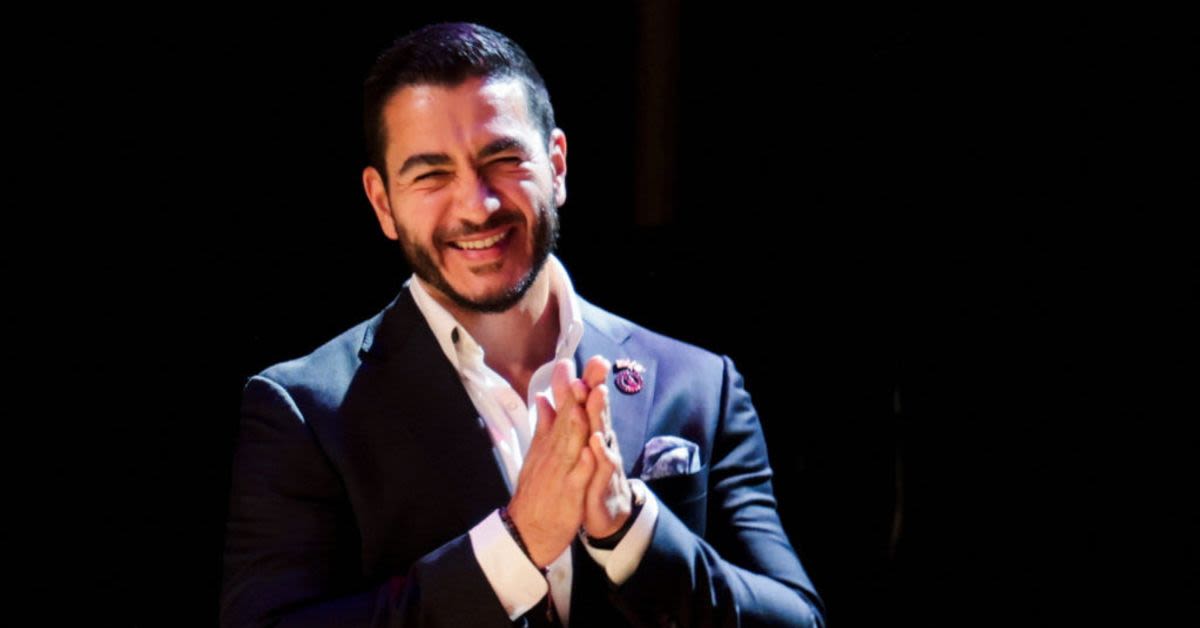
Abbott and Costello, Bert and Ernie, Abdul El-Sayed and Hasan Piker: three pairings that, in very different ways, make little sense without the other half.
In the first two cases, the duos are harmless fixtures of American entertainment; in the third, as reported by Western Journal, the partnership is far more troubling, tying a radical Michigan Senate nominee to one of the most inflammatory left-wing personalities on the internet.
El-Sayed, a progressive activist with a notably thin record in public office, owes much of his sudden rise in Michigan Democratic politics to the backing of Hasan Piker, the Twitch streamer infamous for declaring that America deserved 9/11.
Now, with the primary over and a general election looming, El-Sayed is scrambling to downplay that alliance, insisting that Piker is merely a streamer from California whose role in his campaign was incidental at best.
That narrative, however, is already collapsing under basic scrutiny.
Appearing on MS NOWs Morning Joe on Friday, El-Sayed attempted to maintain the fiction that Piker was a marginal figure in his political ascent, only to run into a rare moment of skepticism from host Joe Scarborough.
Scarborough, hardly a conservative firebrand, pressed El-Sayed on the obvious contradiction between his dismissive rhetoric and the reality that Piker was actively engaged in your primary campaign.
You have said, though, Oh, hes just a California streamer. He was a California streamer whos actively engaged in your primary campaign, Scarborough reminded him, cutting through the spin.
Scarborough then asked the question that any fair-minded voter should be asking.
Dont you think its disingenuous just to call him, like, a California streamer when you know the guy, you campaigned with the guy, he was a big part of your campaign? he continued, putting the issue squarely on the table.
El-Sayed, clearly uncomfortable, tried to minimize the relationship.
He wasnt a big part of my campaign. We had him to Michigan once, he replied, as though a single visit from a national leftist celebrity with a massive online following were a trivial footnote.
That statement is, at best, a half-truth.
Yes, Piker did a formal campaign stop with El-Sayed in Michigan once, but the connection did not end there, nor did its political significance.
On the eve of the primary, El-Sayed attended a pool party where Piker was the guest of honor, a gathering that may not have been officially hosted by the campaign but functioned as a de facto rally for the same young, hyper-progressive base that powered his victory.
To pretend that such events were inconsequential is to insult the intelligence of Michigan voters who watched this alliance unfold in real time.
Pressed further, El-Sayed shifted from denial to deflection, trying to reframe the controversy as a noble exercise in democratic outreach.
Im on your show, Joe, because I want to talk to the audience whos watching you right now, he said, pivoting away from Piker and toward a vague civics lecture.
And the problem in our democracy too often is we say who we cannot talk to, rather than asking, How do we bring these folks back into an electoral fold? There are some things [Hasan Piker] has said that I agree with, he added, as though the issue were merely about open dialogue rather than the normalization of extremist rhetoric.
That line of argument collapses the moment one recalls what, exactly, Piker has said.
This is not a case of a controversial but mainstream figure whose views fall within the normal bounds of political disagreement; this is a man who has proclaimed that America deserved 9/11, fantasized that the street should run red with the blood of landlords, and suggested that Donald Trump had an assassination coming.
These are not slips of the tongue from a tired broadcaster who has been on camera for eight hours; they are consistent expressions of a worldview that is openly hostile to the United States, to property rights, and to basic civic norms.
Even in short-form interviews, Piker comes across as a caricature of the radical left, gleefully pushing the envelope of what can be said about his own country and its leaders.
Given that record, El-Sayeds attempt to wave away the relationship as a minor footnote is not merely evasive; it is profoundly dishonest.
Scarborough, to his credit, seemed to recognize that something did not add up, and he even reached back to history to offer El-Sayed a lifeline.
He noted that Ronald Reagan, during his early political career in California, acknowledged that he had a Bircher problem, referring to the support he received from members of the ultra-conservative John Birch Society.
So I totally get that, Scarborough said, drawing a parallel between Reagans challenge and El-Sayeds current predicament.
Yet even as he extended that comparison, Scarborough underscored the core issue.
Im just saying, if you just call him a California streamer, that seems to minimize what he did in the primary. Thats the only thing Im asking you. Do you think that minimizes that? he asked, giving El-Sayed another chance to level with viewers.
Instead of answering directly, El-Sayed resorted to the oldest trick in the political playbook: change the subject to kitchen-table issues and blame Republicans.
Heres my issue at the end of the day, right? He is a streamer in California. And the issue that everybodys focused on is the price of gas and groceries in Michigan, he said, as though the character and judgment of a would-be U.S. senator were irrelevant.
From there, he launched into a familiar attack on his Republican opponent, Rep. Mike Rogers.
Meanwhile, youve got a guy like Mike Rogers who literally goes to Dallas instead of showing up to a debate in Detroit to campaign with Donald Trump, who not only says crazy stuff every day but does crazy stuff that costs you money the tariff war, the war in Iran, El-Sayed claimed, attempting to turn the conversation into a referendum on Trump-era policy.
And so its frustrating to me that I never hear about Hasan Piker on the doors. I never hear about him outside of conversations that are had like this, he added, implying that only media and Republicans care about his alliance with the radical streamer.
At that point, Scarborough largely reverted to form, softening his stance and suggesting that Republicans were exaggerating the Piker connection for political gain.
He even used the word bullsh*t to describe GOP efforts to tie El-Sayed to Piker, signaling to the MS NOW audience that, in his view, conservatives were weaponizing a minor association.
Yet by that stage of the interview, viewers had already seen enough to draw their own conclusions.
El-Sayed had been given multiple opportunities to forthrightly acknowledge Pikers role in his campaign and to repudiate his most extreme statements, and he chose instead to minimize, deflect, and change the subject.
To understand why this matters, one must look back at how El-Sayed secured the Democratic nomination in the first place.
The primary to replace outgoing Democratic Sen. Gary Peters was crowded, featuring several contenders, including state Sen. Mallory McMorrow, a more experienced progressive with a stronger legislative record.
El-Sayed, by contrast, had only a limited tenure as a Wayne County health official and some organizing success within Michigans sizable Muslim community, but little else in the way of substantive public service.
Polling reflected that reality, showing him lagging behind better-known and more accomplished rivals.
Then Hasan Piker entered the fray.
His involvement electrified a particular slice of the Democratic base: young, deeply online, and increasingly hostile to traditional American institutions and values.
Yes, Piker was a lightning rod, but in todays Democratic Party, being a lightning rod is often a feature, not a bug.
McMorrow eventually dropped out, and El-Sayed narrowly defeated U.S. Rep. Haley Stevens, who, while liberal, at least projected a semblance of mainstream sanity compared with the Piker-infused left.
Now El-Sayed faces a very different electorate.
The coalition that carried him through the primary young, progressive, and, in many cases, openly contemptuous of the United States is not representative of the broader Michigan voting public he must persuade in November.
He is attempting to perform a political sleight of hand: embrace Piker and his audience when it helps in a low-turnout, ideologically driven primary, then pretend that relationship was incidental once the general election demands moderation.
Meanwhile, Piker himself has effectively acknowledged the need for this distancing, reportedly suggesting that of course El-Sayed has to separate himself from a Twitch streamer in California for electoral reasons.
But Piker is not just a Twitch streamer in California; he is the voice of the very base that propelled El-Sayed to the nomination.
His rhetoric from America deserved 9/11 to fantasies of landlord blood in the streets is not some random sideshow; it is a distilled expression of the radical left-wing resentment that now animates a significant portion of the Democratic grassroots.
El-Sayed cannot credibly claim to be independent of that worldview while simultaneously benefiting from its energy, its money, and its votes.
Voters are entitled to ask whether a candidate who willingly aligned himself with such a figure in the primary will truly stand up to that same radicalism once in office.
The analogy that best captures El-Sayeds current strategy is not Abbott and Costello or Bert and Ernie, but Calvin and Hobbes.
During the primary, Piker was Hobbes made flesh a very real partner, a draw for crowds, a symbol of the campaigns ideological edge; now, in the general election, El-Sayed wants voters to believe that Piker is merely an imaginary friend, existing only in the ephemeral world of social media.
Michigan voters should not accept that convenient fiction, especially when the stakes involve a six-year term in the United States Senate.
Nor should the rest of the country ignore what it means when a major party elevates a candidate whose path to power ran straight through the most extreme corners of the progressive movement.
Login