
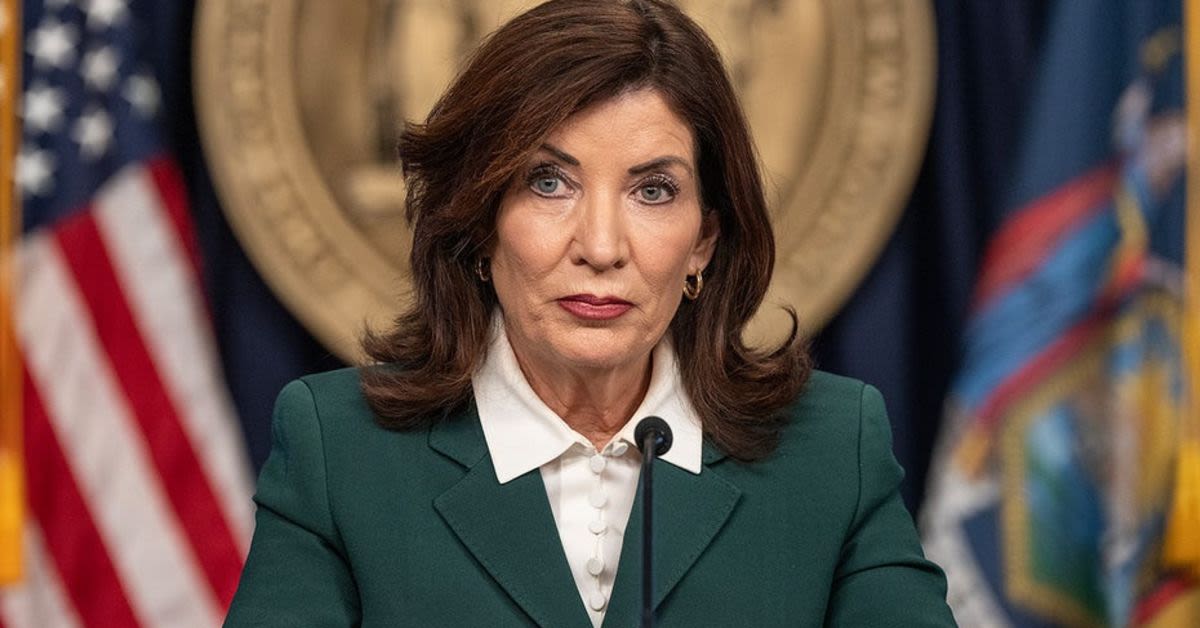
New Yorks Democratic governor, Kathy Hochul, is facing a growing revolt from the very unions and progressive activists who helped put her in office, all because she has dared to back a Trump-era tax credit designed to give parents more control over their childrens education.
According to Western Journal, Hochuls support for President Donald Trumps federal scholarship tax credit program a measure aimed at expanding school choice has triggered a sharp backlash from teachers unions, labor leaders, and fellow Democrats. Union officials and members of the broader labor movement joined with liberal lawmakers at a Wednesday rally, demanding that the governor reverse course and reject what they deride as a voucher plan, even though the proposal relies on voluntary donations and tax credits rather than direct cuts to public school budgets.
Hochul announced in May that she intended for New York to opt into the program, a necessary step before families in the state can access any of the benefits. Under the proposal, taxpayers would be eligible for a matching federal tax credit of up to $1,700 when they donate to approved nonprofit organizations that provide private scholarships to students.
The programs enrollment window runs through Jan. 1, 2027, giving states time to decide whether they stand with parents or with entrenched bureaucracies. Instead of embracing what many conservatives view as a common-sense reform that empowers families and introduces competition into a stagnant system, a coalition of unions, labor groups, and progressive lawmakers has chosen to attack the initiative, apparently more concerned about preserving their funding streams than improving educational outcomes.
More than 80 organizations reportedly turned out for the rally, all united in pressuring Hochul to abandon her support for the tax credit. Its a bad thing, United Federation of Teachers President Michael Mulgrew declared, denouncing the program in sweeping terms. Its a bad thing when it comes to all of the children in our state who go to public schools. It is a bad thing when we say were going to take taxpayer money and give it to folks with no accountability none.
Mulgrews invocation of accountability rings hollow to many parents and taxpayers who have watched public schools become increasingly ideological while academic performance stagnates or declines. The question naturally arises: Where is the accountability for teachers who use the classroom to push liberal political narratives, or for those who enjoy near-ironclad job protection despite presiding over chronically failing classrooms where students struggle with basic literacy?
For years, public-sector unions have treated taxpayer dollars as an entitlement, not a trust, and the current uproar underscores that mentality. The spectacle of powerful unions demanding their pound of taxpayer flesh while resisting even modest competition from private and religious schools highlights a glaring irony: the loudest defenders of public education often seem more invested in protecting their own power than in serving children.
Teachers unions have long functioned as a de facto arm of the Democratic Party, pouring money and manpower into campaigns and lobbying efforts that reliably advance progressive priorities. Their political clout is immense, and their messaging is carefully crafted, but their track record suggests that self-preservation, not student achievement, is their primary concern.
Dissenting teachers who question union orthodoxy or resist political activism in the classroom often find themselves marginalized or pressured into silence. Until the Supreme Courts 2018 Janus decision, unions in many states even collected mandatory agency fees from nonmembers, forcing educators to bankroll political operations they did not support.
Now, these same organizations are posturing as guardians of fiscal prudence and educational integrity, insisting that a voluntary tax credit program is a bridge too far. That claim is difficult to take seriously, particularly when the governors own office has emphasized that the Trump-backed plan is designed not only to expand private scholarships but also to bolster services such as tutoring and transportation for public school students.
Jonah Allon, a spokesman for Hochul, stressed that the governors priority is making sure every student receives an education that best meets their needs, which is why she wants the federal scholarship tax credit to benefit all New York students. His statement underscores a principle conservatives have championed for decades: education policy should focus on students and families, not on preserving the monopoly of any particular system or union.
Allon further explained that These credits have the potential to expand academic opportunity for public and private school students across our state without diverting resources from public schools or state and local budgets. That assurance directly undercuts the unions central talking point, which is that any form of school choice necessarily defunds public education, even when the mechanism is a federal tax credit tied to private donations.
Under the proposed guidelines, families earning up to 300 percent of their regions median income would be eligible for scholarship assistance, a threshold that reaches up to $309,000 in high-cost areas such as New York City. This design means that middle-class and even some upper-middle-class families many of whom are already paying steep taxes and, in some cases, private school tuition could finally receive some relief and flexibility in choosing the best educational environment for their children.
Parents who already shoulder the cost of private education but fall within the income limits would not be excluded, and there is no compelling reason they should be. Limiting school choice to only the poorest families, while politically convenient for unions, ignores the reality that many working and middle-class parents are desperate for alternatives to failing or politicized public schools.
Conservatives have long argued that competition is a powerful engine for improvement, and education is no exception. When public schools must compete with charter, private, and religious institutions for students, they face real pressure to raise standards, refocus on core academics, and respond to parental concerns instead of dismissing them.
Public school systems could seize this moment to innovate, streamline bureaucracy, and build more responsive, high-performing campuses that genuinely attract families. Yet such reforms would require confronting union work rules, tenure protections, and a culture that often treats a nine-month work year as sacrosanct, all of which are fiercely defended by the same groups now attacking the tax credit.
The broader failure of the public education system is not an accident; it is the predictable result of a structure that is heavily insulated from competition and deeply intertwined with the Democratic Party. Over time, this alliance has taken on an almost cult-like quality, in which any challenge to the status quo is treated as heresy, and any alternative especially faith-based or conservative-leaning schools is smeared as dangerous or illegitimate.
Public school teachers and their union leaders are routinely lionized as unassailable heroes, while charter schools, homeschooling, and religious academies are caricatured as extremist or substandard. This narrative persists despite mounting evidence that many alternative schools deliver stronger academic results and greater parental satisfaction, often with fewer resources and less bureaucracy.
Randi Weingarten, president of the American Federation of Teachers and one of the most influential figures in national education policy, attended the anti-voucher rally and warned darkly that public schools would be defunded by the Trump tax credit. For many parents who watched unions fight to keep schools closed during the pandemic and push ideological agendas in the classroom, the prospect of redirecting some resources away from that system is not a threat but a long-overdue correction.
Weingartens sudden alarm over funding contrasts sharply with her silence on issues that have outraged parents across the country. Where was this urgency when mothers and fathers objected to sexually explicit books in school libraries, or when teachers used social media to mock and disparage the very taxpayers who finance their salaries and benefits?
Serious questions also remain about transparency and academic rigor in New Yorks public schools, including why the state has reportedly shielded Advanced Placement (AP) exam results from public view. The most plausible explanation is that the scores are embarrassingly low, a reality that would undermine union narratives about the systems success and the supposed dangers of school choice.
When classrooms are dominated by lessons on DEI orthodoxy, LGBT activism, the evil nature of Trump, and sweeping claims of systemic racism, it is hardly surprising that basic skills suffer. Why invest the time and discipline required to teach critical thinking, rigorous reading, and math proficiency when it is easier to hang a pride flag, deliver a political sermon, and call it a day?
National Review recently highlighted data from the 2024 National Assessment of Educational Progress (NAEP), often referred to as the Nations Report Card, and the results for New York are deeply troubling. That year, 35 percent of the states eighth graders scored below the basic level in reading, a statistic that should alarm anyone who cares about the future workforce, civic literacy, and social stability.
Such outcomes represent more than just disappointing numbers on a chart; they constitute a profound betrayal of parental trust. Families send their children to school expecting them to learn foundational skills, not to be used as captive audiences for ideological indoctrination, and the persistent failure to deliver on that promise demands serious reform.
At its core, the battle over Trumps scholarship tax credit is a struggle over power and control. For decades, public school unions and their political allies have drawn billions from taxpayers while presiding over a system that too often produces mediocre results and increasingly politicized content.
When parents are given real leverage over curriculum, extracurricular activities, school board decisions, and most importantly where their children can enroll, the monopoly grip of the public sector begins to loosen. That shift terrifies unions and progressive activists, who understand that empowered families are less likely to accept one-size-fits-all mandates and more likely to question why they are being forced to fund institutions that do not reflect their values or meet their expectations.
Every family, regardless of income, is entitled to meaningful educational choice, especially in a state where taxpayers already pour vast sums into schools that are failing far too many students. As long as teachers are quietly encouraged to vote Democrat in exchange for job security, benefits, and ever-rising salaries, the incentive structure will favor political loyalty over academic excellence, and parents will continue to seek alternatives wherever they can find them.
Login