
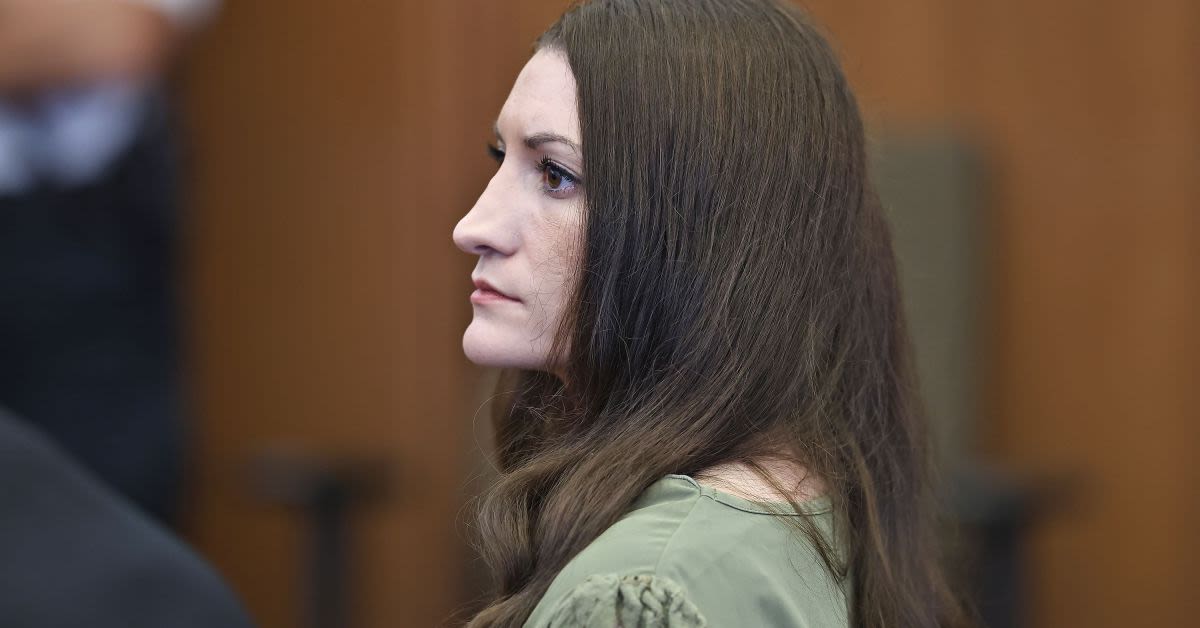
A young female juror in the Lindsay Clancy murder trial has acknowledged that she initially believed the Massachusetts mother was guilty and legally responsible for killing her three children, but ultimately voted to acquit her so that Clancy could receive the "help" she needed.
The juror, who requested anonymity, spoke to WBZ-TV reporter Kristina Rex after the high-profile trial ended in a mistrial, describing herself as one of the younger members of the panel and admitting she had not closely followed the case before being empaneled. According to The Post Millennial, her account has intensified debate over whether the jury faithfully applied the law or allowed emotion and policy preferences to override legal standards.
Clancy was charged with murdering her three children5-year-old Cora, 3-year-old Dawson, and 8-month-old Callanat the familys Duxbury home in January 2023 before attempting to take her own life. Her defense team argued that she suffered from severe mental illness and was therefore not criminally responsible for the killings under Massachusetts law.
Asked by Rex where she stood when deliberations began, the juror said she initially aligned with the prosecutions position that Clancy understood her actions and should be held accountable. "So, originally I felt as though she was guilty and she was criminally responsible for it," the juror said. "And maybe I still believe that in a certain way."
At the same time, she said she was persuaded that Clancy was in the grip of a profound psychological breakdown. "I think that this was a woman who, you know, she was not mentally healthy," she said. "She was someone that was in the throes of a significant mental health crisis."
The juror explained that her view shifted as deliberations progressed, in part because she felt the prosecution had not eliminated uncertainty about Clancys mental state and intent. "Because at the end of the day, there was so much doubt," she said. "You know, the prosecution didn't have a figurative, you know, smoking gun."
Yet she also offered a more troubling rationale from a rule-of-law perspective, suggesting that her vote for a verdict of not guilty by reason of insanity was driven by a desire to secure treatment for Clancy rather than to resolve the legal question before the jury. "Eventually I just felt like the only way to get justice work for Cora, Dawson, and Callen, and Patrick, and her parents, and everyone else that was closest was to get her the help that she desperately needed," the juror said. "And there's no way she's getting that help 100%."
Those remarks drew sharp criticism from conservative commentator Matt Walsh, who argued that the juror had openly admitted to disregarding her legal duty in favor of a subjective calculation about Clancys future. "The juror here says she went into deliberations thinking Clancy was guilty but switched to not guilty because it was 'the only way Lindsay would get the help she needs,'" Walsh wrote on X. "She's openly admitting she disregarded the law."
Walsh stressed that jurors are sworn to apply the law to the facts, not to engineer outcomes based on personal views about punishment, treatment, or social policy. "Jurors are not supposed to be making decisions based on those kinds of calculations," he continued. "They were there to judge whether Clancy was guilty or not. Period. Their job was not the ensure the Clancy 'gets the help she needs.' What a farce."
The juror, however, insisted that the constitutional standard of proof remained central to her decision and that she could not, in good conscience, vote to convict in the face of unresolved doubt. "Because at the end of the day, to not follow that reasonable doubt and to acknowledge that it's there, you morally and legally cannot convict somebody for that," she told Rex.
She said many jurors entered the deliberation room with firm, emotionally charged positions, and she rejected the notion that only one person was unwilling to entertain opposing arguments. "There were some big personalities in that room," she said.
The proceedings ultimately ended in a mistrial after the jury deadlocked 111, with one male juror refusing to join the others in finding Clancy not guilty by reason of insanity. Three female jurors later attacked the holdout, calling him "very arrogant" and claiming he "completely disregarded" information raised during deliberations.
The foreperson recounted that she became "so excited" and began filling out verdict forms when the holdout acknowledged having reasonable doubt, only to watch him maintain his refusal to vote for a verdict of not guilty by reason of insanity. Jurors described heated exchanges that grew loud enough for alternate jurors to hear, while also noting that the group shared "hugs," "laughter," and "a lot of self-care and group care."
The anonymous juror said she agreed with a note the panel sent to the judge accusing the holdout of misapplying the reasonable-doubt standard. She claimed he conceded that there were areas of reasonable doubt but still favored conviction and struggled to articulate a coherent legal basis for his stance.
She also spoke about the emotional impact of hearing the 911 call placed by Clancys husband, Patrick, who discovered the childrens bodies. "I will never be the same after the 911 call," she said.
Hearing Patricks anguish, she added, convinced her that online conspiracy theories suggesting he was involved in the childrens deaths were baseless. "All I could think was that if these people could have heard of that, like, visceral, like, hurling scream, I don't think I could name a single actor or actress that could have performed that, the way he did," she said. "It was horrifying," she added. "You know, just to imagine living through that and being the person to find their children in that scenario, like, it shakes you."
Her account underscores a growing tension in high-profile criminal cases between the emotional pull of mental-health narratives and the strict legal standards that are supposed to govern verdicts. While the juror repeatedly invoked reasonable doubt, her own words about wanting to ensure Clancy "gets the help she needs" will likely fuel concerns that some jurors are treating the courtroom as a venue for social work rather than justice, leaving grieving families and the broader public to question whether the law is being faithfully applied when the stakes are life, death, and accountability.
Login