
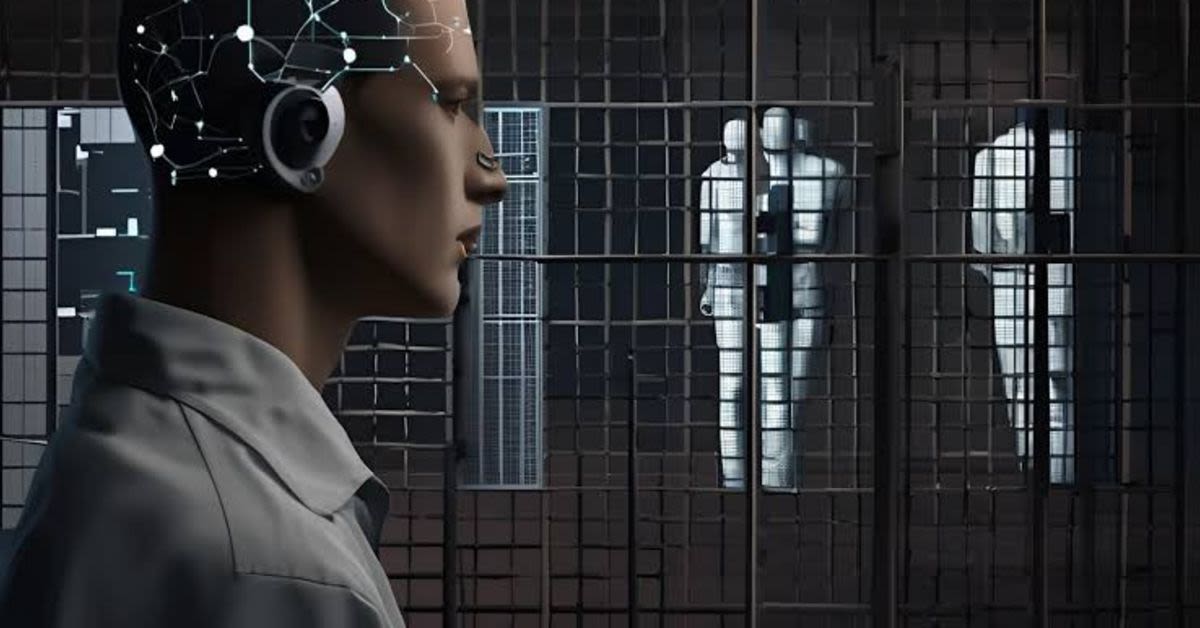
While legacy media outlets obsess over speculative doomsday scenarios involving artificial intelligence, a far more practical and largely unreported transformation is taking place within one of the most critical pillars of American public safety: the nations correctional institutions.
According to Western Journal, a technological shift is beginning to displace one of the most archaic and labor-intensive practices in modern government: the manual counting of inmates by correctional officers armed with paper clipboards. For decades, this ritual has consumed vast amounts of time, manpower, and taxpayer dollars, even as prisons and jails struggle with chronic understaffing, rising violence, and increasingly sophisticated criminal networks operating both inside and outside the walls.
That entrenched model is now being challenged by a new generation of conservative-aligned, efficiency-focused technology. Deep-tech enterprise LEO Technologies (LeoTech) has formally introduced Verus Vision AI, an agentic AI video intelligence platform designed to convert existing correctional camera systems into a continuous stream of real-time operational intelligence, rather than passive video archives that are rarely reviewed until after an incident occurs.
The rollout of Verus Vision AI coincides with the maturation of the broader Verus ecosystem, a fully integrated artificial intelligence platform built specifically for the corrections environment rather than retrofitted from consumer or corporate applications. The suite is structured to address multiple layers of prison operations: Verus Vision AI for real-time computer vision and video analytics; Verus AI for semantic intelligence across inmate voice, text, and email communications; Verus Voice AI for identity authentication through voice biometrics; and Verus ION as the enterprise orchestration layer that fuses data from disparate correctional systems into a single, unified operational picture for decision-makers.
Steve Harpe, LeoTechs Chief Product and Technology Officer, argues that the fundamental challenge in corrections has never been a shortage of data, but a chronic inability to convert that data into timely, actionable intelligence. When people see this, it blows them away, Harpe said. When you are leading a correctional facility, one thing you dont have is access to integrated data systems that provide actionable intelligence to make the right decisions.
Harpes perspective is informed by a career that bridges both the private sector and public service, a combination that often yields the kind of pragmatic, results-oriented thinking conservatives tend to favor. Before entering corrections, he managed enterprise technology infrastructure for American Airlines, EDS, CGI, and Capital One, gaining experience in large-scale systems integration and operational efficiency that government agencies typically struggle to achieve on their own.
He later served as Director of Corrections for the state of Oklahoma, where he began formulating the concepts that would eventually evolve into the latest components of the Verus platform. Verus Vision and ION are two groundbreaking pieces of technology that do not exist in the marketplace anywhere right now, he said, underscoring the claim that this is not merely an incremental upgrade but a structural rethinking of how prisons can operate in the 21st century.
At the core of Verus Vision is a simple but powerful proposition: use the cameras that are already installed in correctional facilities and apply computer vision and behavioral analytics to automate the most grueling and repetitive administrative task in any prisonthe inmate headcount. Under traditional protocols, a manual count requires a full lockdown, with officers physically verifying each inmates presence, a process that can be repeated up to 11 times a day in some institutions.
This ritual is not merely tedious; it is enormously expensive. It costs agencies millions of dollars a year, and in some cases its more than $200 million, Harpe said, highlighting the scale of waste embedded in the status quo. From a conservative standpoint, the idea that taxpayers are funding hundreds of millions of dollars in manual countingwhen technology can perform the same function more quickly and accuratelyillustrates the broader problem of government inefficiency that often goes unchallenged by bureaucracies and their political patrons.
Harpe is explicit that the goal is not to eliminate correctional jobs, but to redeploy human capital toward higher-value tasks that actually enhance safety and order. We are not talking about cutting headcount; we are talking about the rapid reallocation of tactical labor, he explained, framing the technology as a force multiplier rather than a replacement for officers.
The time reclaimed from endless headcounts can be redirected toward activities that directly confront criminality and disorder inside the walls. Those include more frequent contraband sweeps, dismantling illicit networks that operate within the facility, and strengthening perimeter security to prevent escapes and the smuggling of drugs, weapons, and other prohibited items.
Beyond automating counts, Verus Vision AI functions as a continuous diagnostic net, scanning live video feeds for indicators of trouble that human eyes might miss or notice too late. The system is designed to detect aggressive behavior, isolation that may signal self-harm risk, officer crowding that could precede a use-of-force incident, and man down medical emergencies such as strokes, heart attacks, or other acute distress events.
Everything we do is in real time. Its a matter of seconds, not minutes or hours later, Harpe said, emphasizing that the value of AI in this context lies in speed and precision, not in replacing human judgment. In an environment where seconds can mean the difference between life and death, or between a contained altercation and a full-scale riot, such capabilities can be decisive.
One of the most consequential applications of Verus Vision AI involves compliance with the Prison Rape Elimination Act (PREA), a federal framework that has often been criticized for being more reactive than preventive. Rather than relying solely on investigators to reconstruct events after an allegation is madeoften with incomplete or degraded evidencethe platform continuously analyzes live video for observable indicators such as unauthorized inmate proximity, multiple inmates entering restricted areas, or other patterns that may signal a developing sexual assault risk.
By preserving objective evidence and alerting correctional professionals in real time, the technology has the potential to shift PREA from a regime focused primarily on post-incident accountability to one that emphasizes prevention and early intervention. That shift aligns with a law-and-order philosophy that prioritizes protecting victims and maintaining institutional order, rather than merely documenting failures after the fact.
The Verus ecosystem extends beyond physical security into the realm of communications intelligence, where criminal networks increasingly operate through coded language, evolving slang, and deliberate misspellings designed to evade traditional keyword-based monitoring. Verus AI applies semantic and agentic AI to analyze inmate voice calls, text messages, and email communications, enabling investigators to detect patterns and meanings that would otherwise slip through the cracks.
Weve been very successful at detecting new slang and keeping law enforcement informed, Harpe said, noting that the system continuously learns and adapts as inmates attempt to innovate around monitoring. This kind of adaptive surveillance is particularly important as progressive prosecutors and activist groups push for looser oversight of inmate communications in the name of privacy, often at the expense of public safety and victim protection.
Over time, the platform builds long-term behavioral intelligence through Social Network Analysis, mapping inmate associations, recurring interactions, and evolving group dynamics. This allows correctional leaders to identify emerging gangs, shifting alliances, and potential organizational threats before they erupt into violence or spill over into the community through coordinated criminal activity.
A companion product, Verus Voice AI, uses voice biometrics and speaker authentication to combat PIN abuse, a common tactic in which inmates steal, trade, or purchase another prisoners phone profile to avoid investigative scrutiny. The biometric engine matches the acoustic fingerprint to the true speaker in real time, ensuring that the person using a given account is actually the authorized user.
The deployment of such sweeping surveillance capabilities inevitably raises questions about civil liberties and potential abuse, concerns that are often amplified by left-leaning advocacy groups and privacy activists. Harpe acknowledges that skepticism was intense when he first began presenting the concept to his peers. Three years ago, when I was the director of Oklahoma and sharing this vision with my peers in closed sessions, I got a lot of pushback, he admitted. But now that the products are built and were deploying once someone sees it, its a no-brainer.
To address concerns about overreach, Harpe said the platform is designed to operate within federal criminal intelligence standards, including 28 CFR Part 23, which governs the collection and use of criminal intelligence information. Human oversight remains central: operational decisions are made by correctional professionals, with AI serving as a recommendation engine rather than an autonomous decision-maker.
We want to make sure we are as non-biased as possible. But we do apply state law, policy, procedures, and federal law, for that matter, to everything we do with our AI, Harpe said, underscoring that the system is built to enforce democratically enacted rules, not to invent its own. That distinction is crucial in an era when many on the left warn of algorithmic bias while simultaneously pushing policies that weaken enforcement and undermine the rule of law.
The boundary between AI assistance and legal evidence is carefully maintained, particularly in the courtroom context. Rather than generating evidence itself, Verus Voice AI flags potentially incriminating communications so that investigators can obtain the original records directly from telecom providers, preserving the integrity of the chain of custody and the defendants due process rights.
We can detect calls where people are incriminating themselves or committing a crime, Harpe said. Theyre reviewed by our analysts and investigators, and if a case goes to court, prosecutors obtain the original evidence directly from the provider. This approach ensures that AI serves as an investigative aid, not as a substitute for traditional evidentiary standards that protect both the innocent and the integrity of prosecutions.
Verus ION, the orchestration layer of the ecosystem, integrates data across multiple correctional systemsranging from medical records to commissary purchases to housing assignmentsto deliver a unified operational picture. Harpe noted that this capability can quickly expose inefficiencies, such as prisons overpaying for medications across a statewide inmate population, enabling agencies to reduce waste and make more informed decisions about resource allocation.
Beyond the immediate corrections environment, the implications of this architecture are broader and more ambitious. The Verus platform effectively functions as the first true AI Global Search engine for correctional systems worldwide, capable of correlating and analyzing vast amounts of operational data that were previously siloed and underutilized.
For decades, the evolution of correctional technology has been largely limited to digitizing paperwork and automating basic administrative tasks, a modest step forward that left the underlying operational model largely unchanged. The next generation, exemplified by Verus, is about operational intelligence: systems that continuously observe, correlate, prioritize, and alert in real time, giving front-line professionals the tools they need to stay ahead of threats rather than merely reacting to them.
As staffing shortages worsen and correctional systems confront increasingly complex threatsfrom transnational gangs to contraband-fueled drug epidemicsthe safety of prisons and the communities they serve may depend less on how many officers are staring at monitors and more on whether the systems behind those monitors are intelligent enough to highlight what human beings alone cannot see. In that sense, the quiet AI revolution in corrections reflects a broader conservative insight: when technology is harnessed to strengthen law enforcement, reduce waste, and uphold order, it becomes not a menace to be feared, but a tool that can help restore competence and accountability to institutions that have too often been neglected by a political class more interested in rhetoric than results.
Login