
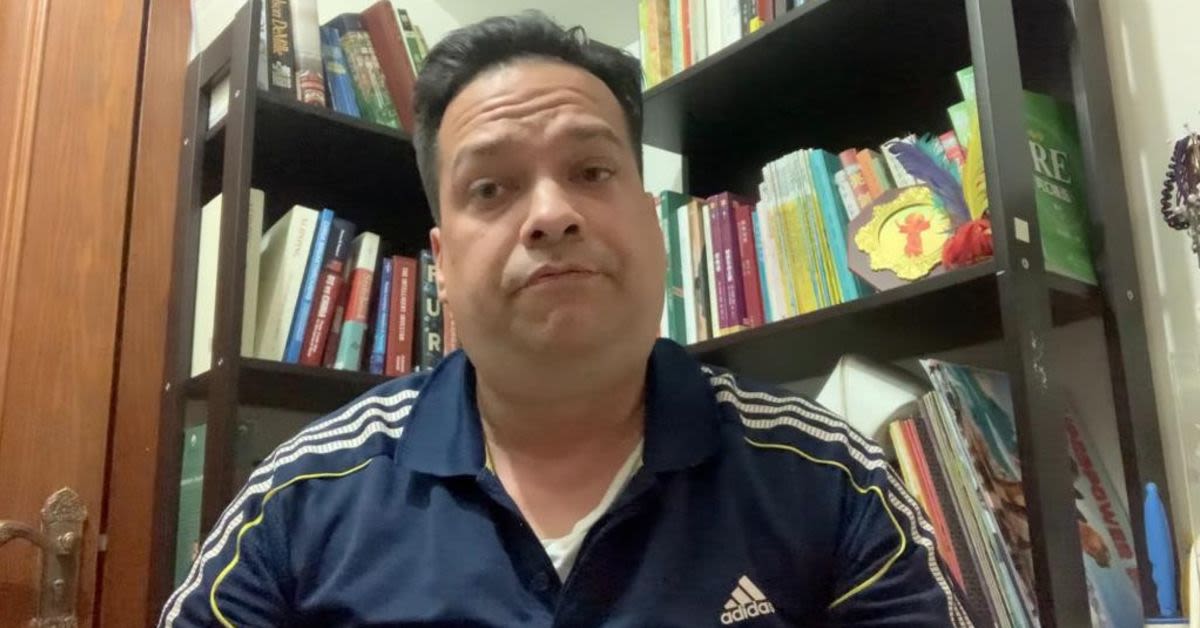
An American journalist who spent years working in Chinese state media has been sentenced to two years in federal prison for secretly serving the interests of Beijings intelligence apparatus inside the United States.
Thomas Weir Pauken II, 51, admitted in federal court that he acted as an unregistered agent of a foreign government and will face 36 months of supervised release after his prison term, during which he is prohibited from traveling abroad, according to a news release from the U.S. Department of Justice. The case has intensified long-standing concerns that the Chinese Communist Party is aggressively targeting Americans with access to political, governmental and technological circles, using money and influence to penetrate U.S. institutions that are supposed to safeguard national security.
As reported by Western Journal, federal prosecutors said Pauken operated at the direction of individuals he understood to be tied to the Chinese government from at least 2019 until his arrest in February 2026. One of his primary contacts was a figure identified in court filings only as Cathy, a handler who allegedly directed his activities on behalf of Beijings interests.
Prosecutors said Cathy tasked Pauken with meeting potential intelligence assets on American soil, equipping them with laptops and cellphones so they could communicate securely with her, and compiling reports containing information she requested. In return, Pauken received at least $100,000 from Cathy, who also financed multiple trips for him between China and the United States from 2019 through 2025, underscoring the scale and persistence of the relationship.
The most alarming allegations emerged when Pauken allegedly tried to build a bridge between his Chinese handler and an individual seeking a position in the Trump administration. According to court documents, Pauken provided that person with a SIM card and offered $10,000 in exchange for weekly reports intended for his Chinese contact, according to The Hill, raising the specter of foreign influence at the highest levels of the executive branch.
Pauken reportedly believed the information he was collecting would ultimately be funneled to Chinese President Xi Jinping, a detail that highlights how close to the core of the regime he believed his reporting would travel. Federal investigators said Pauken acknowledged that he believed the individual he was cultivating could potentially provide classified information to China if hired by the administration, although Pauken advised the person not to, the Associated Press reported.
His attorney, Charles Burnham, seized on that point in an effort to mitigate the damage, arguing that the absence of actual classified disclosures distinguished Paukens conduct from more traditional espionage cases. Mr. Pauken has accepted responsibility and respects the courts sentence, Burnham said, according to the AP, adding that the government had agreed Pauken did not provide classified information to China.
Even so, Paukens personal history makes the case particularly striking and politically sensitive. He moved to China in 2010 and worked for several Chinese media organizations, including China Central Television and Xinhua, Chinas state-run news agency, embedding himself in the propaganda arms of an authoritarian regime that routinely targets the United States.
He wrote under the name Tom McGregor to distance himself from his father with the same name, who was a former chairman of the Texas Republican Party in the 1990s and ran for governor more than a decade ago, according to The Hill. That detail underscores the irony of a man with deep family roots in American conservative politics choosing to work for a foreign power that is ideologically hostile to American constitutional principles and free-market democracy.
Federal prosecutors said Pauken also collaborated with two additional figures he met in China, known to him as Richard and William, whom he believed were likewise connected to the Chinese government. He further sold reports to a group of Chinese individuals from Wuhan who were seeking information about U.S. technology and the Department of Justice, a combination that points directly toward industrial theft and intelligence-gathering.
According to prosecutors, those Wuhan-based contacts wanted Pauken to locate an expert who could assist them with cyberespionage, a request that goes beyond mere information brokering and into the realm of enabling direct attacks on American digital infrastructure. The Justice Department therefore framed Paukens conduct not as a technical paperwork violation, but as a serious national security threat that could have facilitated hostile operations against the United States.
Pauken betrayed his country for money, Assistant Attorney General for National Security John A. Eisenberg said following the sentencing, capturing the governments view that financial greed lay at the heart of his cooperation with Beijing. First Assistant U.S. Attorney Theophani K. Stamos said Pauken had knowingly assisted a foreign adversary in attempting to undermine the U.S. government for financial gain, emphasizing that this was not a victimless or abstract offense.
This was not an isolated act, Stamos said, noting that Paukens conduct continued for seven years, a duration that suggests a sustained, deliberate partnership rather than a momentary lapse in judgment. For a country already grappling with Chinese theft of intellectual property, influence operations on college campuses, and aggressive cyber intrusions, such a long-running relationship only deepens public concern.
Pauken, however, offered a different narrative of his motives, casting himself less as a mercenary and more as a misguided would-be bridge-builder. At his sentencing, he acknowledged that he had done wrong, but disputed the governments characterization of his intentions, insisting that his actions were not meant to harm the United States.
I thought I was helping, but now I realize I could have caused more damage, Pauken said, according to The Washington Post, suggesting he believed he was somehow easing tensions rather than abetting a hostile power. He said he had hoped to improve relations between the United States and China and prevent a potential conflict between the two nations, a claim that sits uneasily alongside the concrete steps he took to facilitate Chinese intelligence-gathering.
U.S. District Judge Leonie M. Brinkema was not persuaded that his professed good intentions outweighed the gravity of his conduct. The judge noted that seven years was a substantial period to engage in conduct benefiting a foreign intelligence service and said the sentence was necessary in part to deter others from assisting foreign adversaries, especially those who might rationalize such cooperation as harmless diplomacy.
For Americans concerned about national sovereignty and the integrity of their institutions, the Pauken case serves as a stark reminder that foreign influence does not always arrive in the form of dramatic spy novels or stolen briefcases. It can come instead through journalists turned operatives, state media employees posing as neutral observers, and well-funded networks that quietly seek access to future policymakers, all while exploiting the freedoms and openness that define the United States and that its adversaries do not share.
Login