
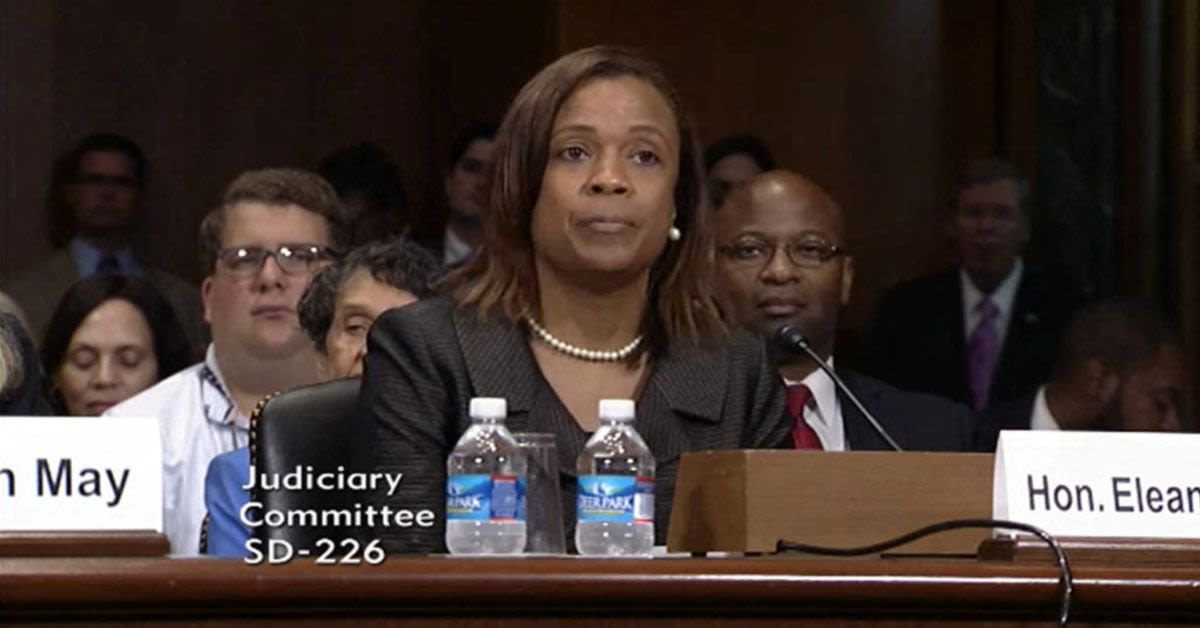
A federal judge who admitted to lying to investigators, engaging in sexual activity in her courthouse chambers during business hours, and attending a partisan political event received only a confidential reprimand, and House Republicans are now demanding to know why.
According to RedState, House Judiciary Committee Chairman Jim Jordan (R-Ohio), along with Reps. Darrell Issa (R-Calif.) and Clay Fuller (R-Ga.), sent a pointed letter to Eleventh Circuit Chief Judge William Pryor Jr. seeking a full accounting of how the federal judiciary handled misconduct allegations against U.S. District Judge Eleanor Ross. The lawmakers are pressing for documents and explanations surrounding the investigation, signaling that Congress is no longer willing to accept opaque, in-house discipline for serious ethical breaches by life-tenured judges.
The committees opening inquiry is direct and unsparing: "Why did the special committee choose to privately reprimand Judge Ross for severe offenses of misconduct?" They further ask why the panel did not recommend that Ross voluntarily retire, whether any member of the judiciary believed harsher sanctions were appropriate, and how a secret reprimand could possibly "restore public trust" in the courts.
Pryor has been given a deadline of 5 p.m. on September 15 to respond, putting the chief judge and the broader judicial discipline system squarely under congressional scrutiny. For Republicans who have long warned about an unaccountable, increasingly politicized judiciary, the Ross case is emerging as a test of whether federal judges will be held to the same standards they routinely impose on others.
The misconduct investigation began after Chief Judge Leigh Martin May alerted Pryor in September 2025, following a report from one of Ross law clerks. A special committee was quickly convened and ultimately concluded that Ross had committed three distinct acts of judicial misconduct.
Investigators determined that Ross carried on an extramarital relationship with a high-ranking police officer that included sexual encounters inside her chambers during working hours, within earshot of courthouse staff. The committee also found that she attended a partisan political celebration and then compounded the misconduct by making false statements to both Pryor and May while they were probing the allegations.
Ross initially denied everything, telling Pryor she had "never engaged in sexual intercourse in [her] office, nor anywhere else in the Courthouse." She likewise assured May she had no idea which officer the clerk might have been referencing, only to reverse herself less than two weeks later.
In a subsequent submission, Ross retracted those denials and admitted they were untrue, forcing the committee to confront not only the underlying behavior but also her lack of candor with supervising judges. The panels formal findings were unambiguous and unusually stark in their description of her conduct.
The report concluded that "[Judge Ross] engag[ed] in an extramarital affair with a high-ranking [police] officer and, in the course of that affair, hav[ing] sexual intercourse (and other intimate contact) in the judge's office, during business hours, and within hearing distance of staff; (2) [Judge Ross's] attendance at a partisan political event; and (3) [Judge Ross's] making false statements to Chief Judge Pryor and to the Chief District Judge that were material to the investigation of misconduct allegations and to the administration of the district court." Those findings, on their face, describe behavior that would end the career of most public officials, yet the judiciary opted for a private reprimand and internal restrictions rather than removal.
The partisan event at the center of the ethics concerns underscores why conservatives see this as part of a broader pattern of ideological bias within the federal courts. The committees report described it only as a district attorneys primary election victory party, but subsequent reporting identified it as Fulton County District Attorney Fani Willis Democratic primary celebration.
Willis, of course, is the prosecutor who brought charges against Donald Trump and his allies over the 2020 election, making Ross presence at her victory party especially troubling in light of her role as a federal judge. Ross, an Obama appointee, previously worked in the Fulton County District Attorneys Office before ascending to the bench, and she attended Willis celebration before returning to preside over federal proceedings the very next morning.
According to the Judiciary Committees letter, Ross later told her clerks that she had consumed "too many martinis" at the event, a confession that reportedly left two of them "mortified." For Republicans, that anecdote is emblematic of a culture in which some judges appear comfortable blurring the line between partisan politics and judicial duty, then treating the fallout as a mere embarrassment rather than a serious breach.
The conflict of interest soon moved from the realm of perception to a live issue in federal litigation. Ross was assigned to the Justice Departments lawsuit seeking unredacted voter rolls from Georgia Secretary of State Brad Raffensperger, a case with obvious political implications in a battleground state.
The Justice Department itself sought her removal from the case due to the appearance of partiality, and Ross ultimately recused, implicitly acknowledging that her attendance at Willis party had compromised her ability to sit on politically sensitive matters. That recusal, however, did not prevent the judiciary from later shielding her from public accountability through a confidential reprimand.
The special committees recommendation was limited to a private reprimand, coupled with several internal penalties that did not affect Ross lifetime appointment. She agreed to apologize to six former law clerks, permanently relinquish any opportunity to serve as chief judge, and remain barred from serving on Judicial Conference committees.
The Eleventh Circuit Judicial Council adopted those findings in February, and the U.S. Judicial Conferences Committee on Judicial Conduct and Disability affirmed them in May. None of those actions, however, were initially disclosed to the public, reinforcing the perception that the judiciary prefers to handle its own scandals behind closed doors.
Even the mandated apologies became a point of contention. Ross sent letters to the six clerks in May, but after they complained that the statements were vague and failed to demonstrate genuine accountability, Pryor ordered her to issue a second round of more substantive apologies.
For lawmakers already skeptical of judicial self-policing, that episode only deepened doubts about whether the system is capable of imposing meaningful discipline on its own members. The House Judiciary Republicans are now openly questioning whether the punishment bore any rational relationship to the gravity of the misconduct.
Jordan, Issa, and Fuller have made clear that Pryors answers will shape whether they pursue stronger remedies, stating they need the information to determine whether "additional action is warranted." That phrase, in the context of congressional oversight of a federal judge, points squarely toward the constitutional mechanism of impeachment.
Ross remains on the federal bench, her official reprimand kept secret until the underlying misconduct findings surfaced publicly. The judiciarys decision to resolve the matter internally, quietly, and on its own terms is precisely what House Republicans are now challenging as they weigh whether a judge who lied, engaged in courthouse sexual misconduct, and attended a partisan celebration for the prosecutor targeting a former Republican president should continue to wield lifetime judicial power.
Login