
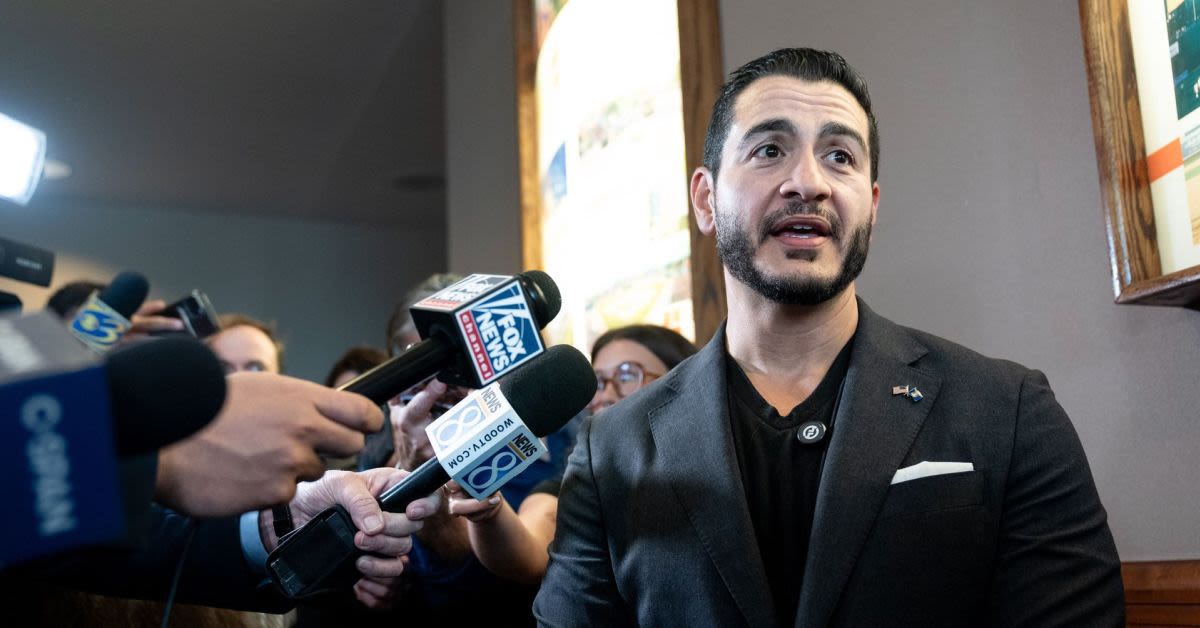
Democratic Michigan Senate nominee Abdul El-Sayed is set to share a stage this weekend with two figures who have promoted fringe 9/11 conspiracy theories, just days before the 25th anniversary of the deadliest terrorist attack on American soil.
El-Sayed is scheduled to headline the Islamic Society of North America's annual convention in Detroit on Saturday, where he will appear on a panel examining a "turmoiled America" alongside left-wing commentator Cenk Uygur and New Jersey-based cleric Zaid Shakir, according to The Washington Free Beacon. Both men have publicly questioned or rejected the official account of the Sept. 11, 2001, attacks, in which al Qaeda terrorists murdered 2,977 Americans, raising fresh concerns about the judgment and associations of a candidate seeking high federal office.
Uygur, host of the Young Turks YouTube show and a longtime progressive activist, has openly embraced 9/11 truther rhetoric in recent months. "I no longer believe [sic] official 9/11 story," Uygur declared in a February social media tirade, a statement that drew widespread criticism even from some on the left.
He has since amplified debunked and antisemitic claims about supposed Israeli involvement in the attacks, including the notorious "dancing Israelis" myth that alleges five Israeli spies filmed and celebrated the carnage. "I didn't know we arrested Israeli spies who were here to 'document the event,'" wrote Uygur, who is the uncle of Hasan Piker, a close El-Sayed ally who has said that "America deserved 9/11."
Uygurs comments were so extreme that one outlet said he was "going full 9/11 truther," a label that would once have been disqualifying in mainstream politics. Yet El-Sayed is not merely appearing at the same conference; he is headlining a panel with Uygur, signaling at minimum a troubling comfort with conspiracy rhetoric that dishonors the victims of Islamist terror.
Shakir, the other panelist, has likewise called for an "examination" of what he describes as "glaring weaknesses and inconsistencies" in the official 9/11 narrative. He has argued that the U.S. government used the attacks to "launch a war on Islam," and has directed followers to the writings of David Ray Griffin, a leading 9/11 conspiracy theorist who has claimed the United States itself orchestrated the attacks.
Beyond 9/11 revisionism, Shakir has a long record of radical political and religious agitation that would alarm most voters. In a 1992 treatise, he urged Muslims to embrace "extrasystemic political action," ranging from "noncooperation tactics to guerrilla war" to influence government policies or even eradicate the "system" altogether.
Shakir asserted that "every major Muslim political gain" in modern history was achieved through such action, citing the creation of the Islamic Republic of Iran and the "armed struggle" that led to Taliban control of Afghanistan as positive examples. A copy of his pamphlet was later discovered in the apartment of a suspect in the 1993 World Trade Center bombing, the New York Times reported in 2006, underscoring how his ideas have circulated in extremist circles.
Shakir, who describes himself as "extremely anti-American," has also blamed Israel and "Zionist forces" for that 1993 attack. "Considering the available information, it is the view of some observers that the WTC bombing was undertaken by the Zionist forces to give proof to their allegations concerning the magnitude of 'Islamic fundamentalist' terrorism, and as a pretext to intensify their anti-Islamic propaganda campaign in the U.S. media," Shakir wrote in the magazine Inquiry, adding, "This campaign has been so calculating that one immediately suspects it could not have risen accidentally. "
El-Sayeds decision to appear alongside such figures comes as his own record on 9/11 and the war on terror faces renewed scrutiny. Critics argue that instead of unequivocally condemning Islamist terrorism and its apologists, he has repeatedly sought to minimize the unique horror of 9/11 and to blur moral distinctions between the victims of that attack and casualties of subsequent U.S. military operations.
CBS News reported this week that El-Sayed deleted two COVID-era social media posts in which he compared the 9/11 death toll to COVID deaths and insisted the latter deserved the same level of outrage. On the 20th anniversary of 9/11, El-Sayed also drew an equivalence between the attacks and the ensuing war on terror, as previously reported by the Washington Free Beacon, a framing that many Americansespecially families of the victims and veteransview as deeply offensive.
El-Sayed has also been dogged by his close alliance with Hasan Piker, a popular left-wing influencer who has campaigned with him and who infamously declared that "America deserved 9/11." Rather than clearly and fully repudiating Pikers remarks, El-Sayed has repeatedly claimed they were "taken out of context" and portrayed Piker as a casualty of "cancel culture," a stance that raises questions about where he draws the line on anti-American rhetoric.
In his academic and media work, El-Sayed has tried to link post-9/11 "Islamophobia" to health problems among Muslims and Arabs, often casting Muslims primarily as victims. In a Sept. 11, 2012, essay for CNN that described Muslims as "another victim of 9/11," he cited a California study that found a dramatic increase in premature births for Muslim women after 9/11 compared with before the attacks, attributing the spike to "discrimination and marginalization" experienced by Muslim women.
Yet El-Sayed omitted from that essay the findings of his own Michigan-based study on birth outcomes for Muslim women before and after 9/11. That research found no difference in premature births for Muslim women after the attacks and concluded that Arab and Muslim women were at "significantly" lower risk for premature births than white, black, and Asian mothers, as the Free Beacon reported, raising concerns about selective use of data to support a preferred narrative of victimhood.
The Islamic Society of North America convention itself has already drawn attention, not only because El-Sayed is headlining but also because of the organizations controversial history and speaker lineup. The group, for which El-Sayed's father-in-law serves as a founding committee member, has extensive ties to the Muslim Brotherhood and was named an unindicted co-conspirator in a 2008 Hamas fundraising case, while this years convention will also feature Texas-based cleric Yasir Qadhi, who has called the Holocaust a "hoax."
Another scheduled speaker, Pakistani cleric Tariq Masood, was quietly dropped from the program after the Free Beacon reported that he admitted to forcing his 13-year-old niece into marriage in accordance with Islamic law and had been accused of "pedophilic rhetoric." That such figures were invited in the first place, and that El-Sayed continues to lend his name and credibility to the event, underscores the broader pattern of his comfort with extremist-adjacent networks and ideologues.
For a candidate seeking to represent Michigan in the U.S. Senate, these associations and omissions are not minor footnotes but central to evaluating his judgment, values, and respect for American victims of terrorism. El-Sayed's campaign did not respond to a request for comment, leaving voters to weigh his silence, his alliances with 9/11 revisionists and anti-American agitators, and his selective use of data against the solemn memory of nearly 3,000 Americans murdered on a clear September morning and the enduring need for moral clarity in the face of Islamist extremism.
Login