
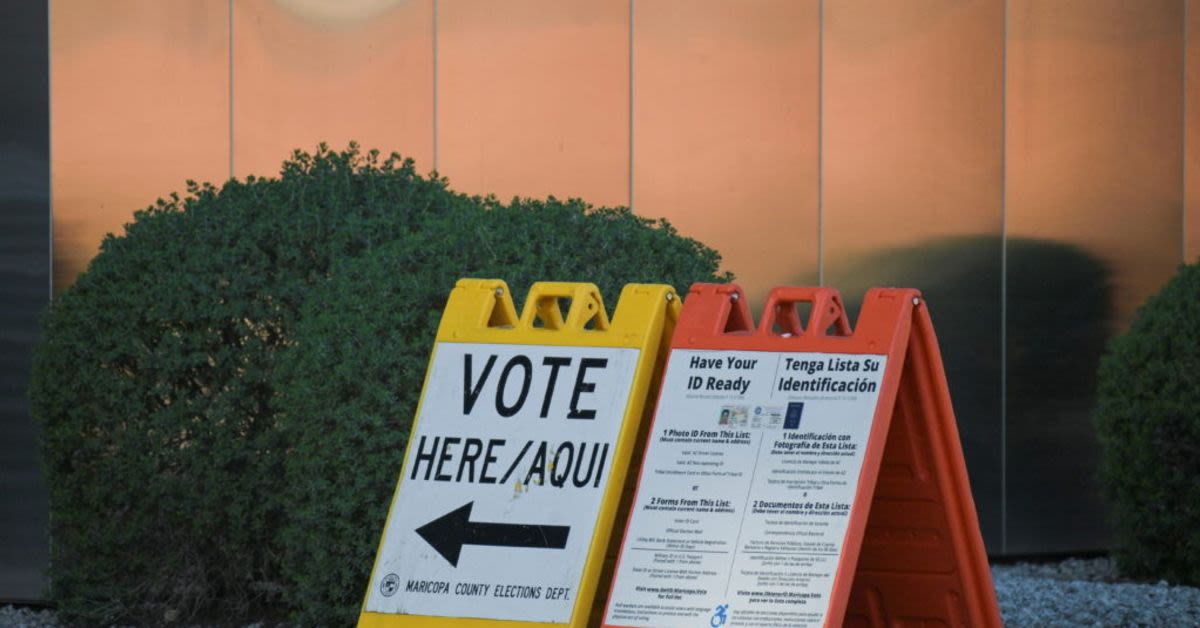
One of the most consequential election-integrity clashes in the United States is now formally on a collision course with the Supreme Court, where justices will be asked to decide whether states may insist that would-be voters prove they are American citizens before being added to the rolls.
According to RedState, the Republican National Committee has chosen Arizonas proof-of-citizenship regime as the vehicle for that showdown, elevating what many conservatives view as a common-sense safeguard into a potential landmark case. At the heart of the dispute lies a question that, outside the rarified world of progressive election lawyers, sounds almost self-evident: Can a state require people registering to vote to prove they are American citizens? For RNC Chairman Joe Gruters and many on the right, the answer is not only yes, but that it is astonishing this is even in doubt.
Gruters announced that the RNC will present Arizonas case before the Supreme Court this fall, framing the litigation as a test of whether basic qualifications for voting can be meaningfully enforced. At stake is a principle so basic that most Americans would be shocked it is even being debated: Can states verify citizenship before someone is added to their voter rolls? Gruters wrote. The answer should be obvious.
From a legal standpoint, the principle is already embedded in federal law, which makes it a crime for noncitizens to cast ballots in federal elections. Arizonas position is that if citizenship is a statutory prerequisite to voting, then election officials must be permitted to verify that status before granting access to the franchise. To conservatives, that is not voter suppression; it is the bare minimum for preserving the integrity of self-government in a constitutional republic.
The controversy, however, has been simmering for more than twenty years, reflecting the broader national divide between those who prioritize ballot security and those who treat virtually any verification measure as an affront to voting rights. In 2004, Arizona voters approved Proposition 200, a ballot initiative requiring applicants to provide documentary proof of citizenship when registering to vote, with roughly 56 percent of voters backing the measure. That democratic mandate, delivered at the ballot box, immediately drew the ire of progressive groups and set the stage for a long-running legal war.
The Supreme Courts 2013 decision in a case involving the National Voter Registration Act (NVRA) complicated Arizonas efforts to enforce its voter-citizenship rules. The Court held that the NVRAs federal registration form preempted Arizonas requirement that applicants using that form provide documentary proof of citizenship. In practical terms, that ruling forced Arizona into an awkward and confusing two-track registration system that has been a flashpoint ever since.
Under that bifurcated regime, individuals who meet Arizonas proof-of-citizenship standard are registered as full-ballot voters, eligible to participate in all races. By contrast, applicants who register using the federal form without providing documentary proof of citizenship can be listed as federal-only voters, allowed to vote in federal contests but not in state or local elections. For election-integrity advocates, the system is a patchwork compromise that leaves glaring vulnerabilities and invites abuse.
Seeking to close those gaps, Arizona Republicans advanced H.B. 2492 in 2022, legislation designed to reinforce and clarify the states citizenship-verification requirements. That law triggered yet another wave of litigation, as national Democrats and allied advocacy organizations rushed to court to block its implementation. The Democratic National Committee and various voting-rights groups targeted key provisions, including the documentary proof-of-citizenship rules and procedures for handling registrants whose citizenship could not be confirmed.
These activist organizations have argued, with a straight face, that asking voters to demonstrate they are legally entitled to vote amounts to voter suppression. From a conservative perspective, that claim is revealing: it suggests that the lefts definition of access includes preserving loopholes that make it easier for ineligible individuals to slip onto the rolls. They may be right that it is a form of suppressionbut what is being suppressed is the opportunity for noncitizens and other ineligible registrants to dilute the votes of lawful American citizens.
The RNC is now urging the Supreme Court to resolve a central piece of this dispute and, in doing so, to clarify the balance of power between states and Washington over election qualifications. The Supreme Court must now decide whether states have the authority to enforce one of the most fundamental qualifications for voting: American citizenship, Gruters wrote. The RNC is leading the legal battle to defend Arizonas proof-of-citizenship requirement after Democrats went to court to block the law and prevent the state from removing noncitizens from its voter rolls.
The stakes extend far beyond Arizonas borders. If the Court affirms that states may robustly verify citizenship at the point of registration, it could set a nationwide benchmark for election-integrity laws at a time when public confidence in elections is fragile and citizenship verification has become a central concern. Conversely, if the Court sides with the Democratic Party and its allies, states could find themselves hamstrung in their efforts to ensure that only Americans decide American elections.
This Arizona case arrives amid a broader series of legal battles over election rules, many of which are already reaching the Supreme Court. As RedStates Susie Moore reported, the Court just last week delivered another significant victory for the Trump administrations election-integrity agenda in a separate case. There, the justices stayed a lower-court injunction that had blocked portions of President Trumps election-integrity executive order from being enforced against 23 states and the District of Columbia ahead of the 2026 midterms.
Trumps order, among other provisions, directed the Department of Homeland Security to share citizenship information on voting-age residents with state election officials. It also instructed the Department of Justice to prioritize enforcement of existing federal election laws and required the U.S. Postal Service to develop new procedures for handling mail-in ballots. These measures, far from radical, were aimed at giving states the tools and data necessary to maintain accurate voter rolls and to guard against fraud in an era of expanding mail voting.
The Supreme Courts decision in that case did not resolve the ultimate legality of Trumps policies. Instead, the majority held that the states lawsuit was premature because their alleged injuries depended on a chain of speculative future events. As the Court explained, Article III prohibits federal courts from stacking hypothetical on hypothetical to speculate that harm will eventually materialize.
The three liberal justices dissented, signaling their continued willingness to entertain aggressive challenges to conservative election reforms even at early stages. Yet the legal maneuvering did not stop with the Supreme Courts stay. As RedStates Teri Christoph reported, U.S. District Judge Indira Talwani, an Obama appointee, soon issued a 14-day temporary restraining order blocking portions of the Postal Services newly finalized mail-ballot rule.
That move produced a kind of legal whiplash. The Supreme Court had essentially said the earlier challenge was not ripe because USPS had not yet finalized its rule; once the rule was finalized, Democrat-led states promptly returned to court to attack the policy itself. The pattern is familiar: when conservatives attempt to tighten election procedures, progressive litigants race to find a friendly judge to halt those efforts, even as the underlying merits remain unresolved.
All of this is unfolding with the midterm elections only months away, compressing the timeline for courts to provide clarity and for states to adjust their systems. Against that backdrop, the Arizona case raises a question even more fundamental than how mail ballots are processed: Who is legally entitled to participate in American elections in the first place? For conservatives, the answer is straightforwardonly citizensand the law should reflect that with clear, enforceable standards.
Congressional Republicans have advanced the SAVE America Act, designed to strengthen citizenship verification and related safeguards, while the Trump administration has sought to make federal citizenship data more accessible to state election officials. The RNC, for its part, reports that it is now involved in more than 170 election-integrity lawsuits nationwide, underscoring the breadth of the legal battlefield. As the SAVE Act languishes on Senate Majority Leader John Thunes desk, the Arizona litigation could become the flagship case in the broader campaign to restore confidence in the ballot box.
The Arizona fight is also part of a wider clash over basic voter-verification rules in multiple states. As previously noted at RedState, the U.S. Court of Appeals for the Fifth Circuit recently reinstated several provisions of Texass election law, including identification requirements for mail-in ballots. A unanimous panel concluded that the challengers lacked standing to contest several of the provisions and observed that mail-ballot rejection rates had actually declined after the new ID rules took effectan outcome that undercuts the lefts narrative that such measures inevitably disenfranchise voters.
Minnesota, by contrast, has come under scrutiny for what critics describe as dangerously lax election practices. Training materials for election judges in that state explicitly instruct workers not to request identification from registered voters, even though voter ID is standard practice in much of the developed world. Minnesota also permits a registered voter to vouch for the residence of up to eight individuals registering on Election Day, a system that, according to credible reports, has been exploited repeatedly by radical activists.
These examples go to the core of the Arizona dispute. Election-integrity advocates are not demanding some baroque, unworkable bureaucracy; they are calling for straightforward standards that mirror those in nearly 200 countries around the globe. They want voter IDs, accurate and regularly maintained voter rolls, paper ballots, timely counting, and a single, clearly defined Election Day rather than a weeks-long free-for-all. As critics of the current patchwork often quip, Its not rocket surgery.
Requiring proof of citizenship to vote in a national election is, from this vantage point, one of the most basic protections a sovereign nation can adopt. The Supreme Court now has an opportunity to affirm that principle by upholding the legitimacy of voter ID and citizenship-verification laws grounded not only in federal statute but also in the sovereign authority of states. Arizonas law, which the Democratic Party is fighting tooth and nail to stop, has become a symbol of the broader struggle between those who want secure elections and those who treat virtually any safeguard as suspect.
Gruters, in articulating the RNCs position, distilled the issue to its essence. States should not be forced to ignore evidence that registrants may be ineligible, he wrote. Election officials should not be prevented from verifying citizenship. For conservatives, anything less invites chaos, undermines faith in outcomes, and erodes the very notion of citizenship as a meaningful legal and civic status.
With the midterms fast approaching and election law already generating one Supreme Court confrontation after another, Arizonas case is poised to be far more than a technical dispute over registration forms. It could define how far states may go to answer the most elementary question in any American election: Are you a citizen?
Login