
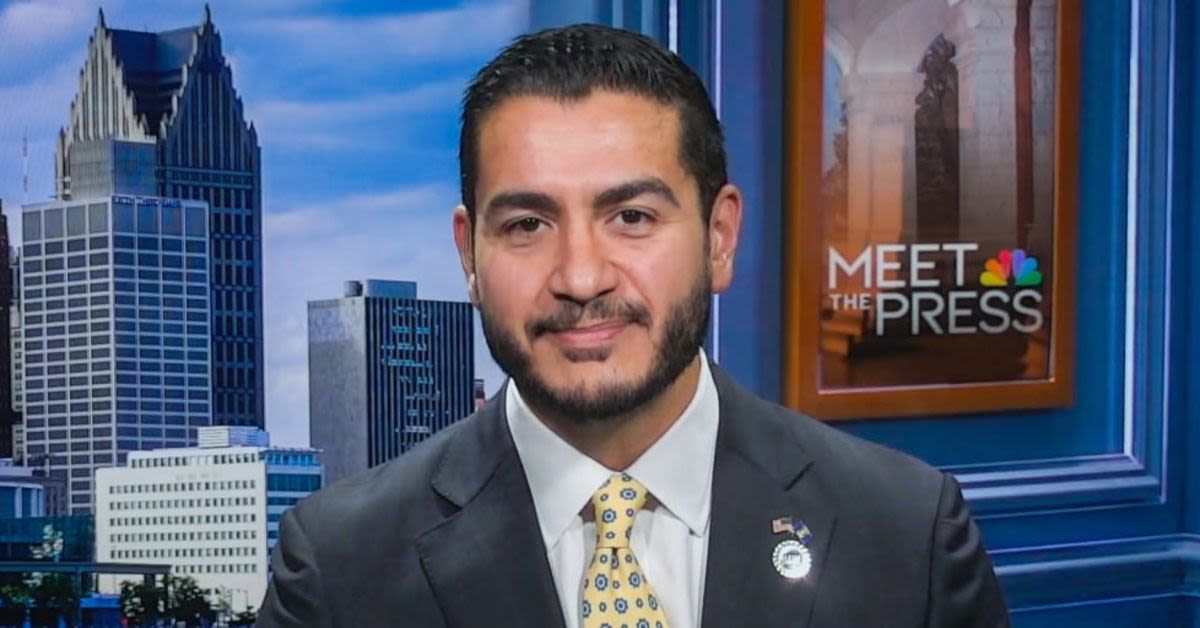
Two weeks after Michigan Democrats narrowly settled their Senate primary, the party is already grappling with the liabilities of its nominee, DSA-backed former Wayne County health director Abdul El-Sayed.
According to RedState, El-Sayed eked out a razor-thin victory over Rep. Haley Stevens (MI-11), winning by fewer than 5,000 votes out of more than 1.5 million cast, despite polling that had suggested a double-digit blowout in his favor. That polling failure is now under scrutiny, but one clear takeaway from the primary is that the openly anti-America, anti-Israel Democrat is struggling with key constituencies Democrats typically rely on, including Jewish voters and black voters.
Republican nominee Mike Rogers, a former congressman backed by Donald Trump, has wasted no time moving to exploit those weaknesses. Rogers has already launched an outreach effort aimed at attracting disaffected Democrats in November, a classic center-right strategy of building a broader coalition rather than slicing the electorate into grievance-based subgroups.
El-Sayed, by contrast, appears to be leaning into identity politics in an attempt to repair the damage, particularly with black voters who largely backed Stevens in the primary. During a recent campaign stop, he tried to forge a connection by declaring that he, too, is a proud African because his parents are from Egypt, a line that came in response to a question about older black voters.
"I am Arab," he said, while adding, "I'm also African." The moment, captured on video and shared widely online, was quickly framed as a clumsy attempt to claim a shared identity with a demographic that had just rejected him at the ballot box.
Michigan Democrat Abdul El-Sayed desperately attempts to appeal to black voters who overwhelmingly voted for his opponent in the primary: Im also African." pic.twitter.com/cgnJH6VNve The reaction among many observers on the right was immediate disbelief, especially from those who remember how Democrats bristled whenever Elon Musk pointed out that, having been born in South Africa, he is technically African-American.
That history underscores why El-Sayeds remark was always going to land awkwardly with some Democrats, both black and white, who resent what they see as opportunistic identity claims. Yet a longer version of the clip, filmed from another angle, added another layer to the story and raised fresh questions about the authenticity of the exchange.
In that extended footage, a black man in the crowddescribed as a hecklercan be heard repeatedly shouting that El-Sayed is Arab and dont care about black folks, while being blocked by individuals who appeared to be campaign staff or handlers. Hes an Arab, he dont care about Black folks, a heckler shouts at Abdul El-Sayed at a press conference in Detroit. State Sen. Stephanie Chang, D-Detroit, speaking at the podium, says, hate has no place here. pic.twitter.com/bKM7cx0SbH
Moments later, El-Sayed delivered his carefully modulated response, pivoting to his now-viral African line and offering what sounded like a pre-packaged reflection on divisions in society. I am Arab, Im also African, El-Sayed says in response to heckler. Id love the opportunity to sit down with that gentleman, El-Sayed says. pic.twitter.com/wrfeX8KPJE
The timing was, at minimum, remarkably convenient, with the hecklers accusation setting up El-Sayed for a polished, camera-ready answer that just happened to hit all the right rhetorical notes. For skeptics, it is difficult to ignore how neatly the exchange served his narrative, even if there is no definitive proof it was orchestrated.
Scripted or not, the episode was politically painful for El-Sayed on several fronts, not least because his attempt to claim an African identity came across as contrived rather than authentic. More striking still was his complaint about those who divide us by sorting people into groups and pitting them against one another, a charge that rings hollow given that such identity-based segmentation was central to his own primary campaign and is a hallmark of modern Democratic politics.
For voters in Michigan, the contrast heading into November could not be clearer: a Republican candidate focused on outreach and broad-based appeal versus a Democratic socialist nominee mired in the very racial and ethnic gamesmanship he now pretends to deplore. As Democrats struggle to hold together a fracturing coalition, El-Sayeds missteps with black and Jewish voters may prove decisive in a state where margins are thin and patience with progressive identity theatrics is wearing out.
Login