
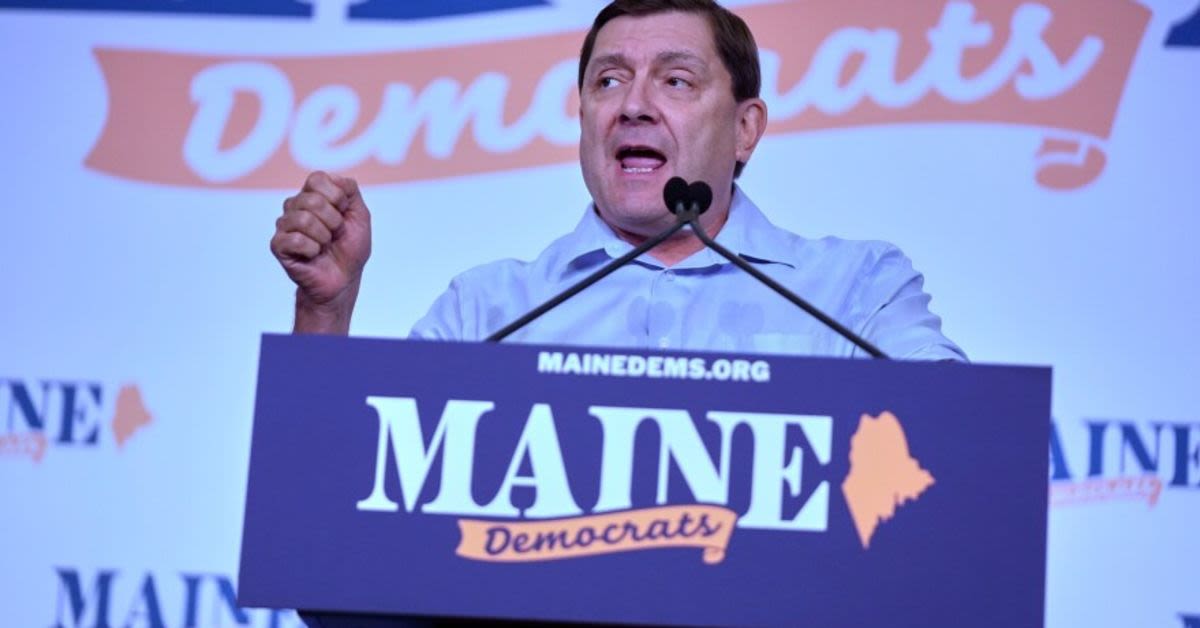
Troy Jackson has built his U.S. Senate campaign on fiery denunciations of greedy corporations and high-priced lobbyists, even as the political machine he helped lead in Augusta quietly banked hundreds of thousands of dollars from corporate PACs and lobbying firms over the past several election cycles
According to the Washington Free Beacons review of state records, the Maine Senate Democratic Campaign Committee (SDCC) for which Jackson was listed as principal officer pulled in nearly $54,000 from corporate political action committees between 2018 and 2024, the period during which Jackson rose to and served as president of the Maine Senate. Those donors included pharmaceutical heavyweight Cigna, financial giant Bank of America, and energy conglomerate Avangrid, the parent company of Maines dominant electric utility.
The same disclosures show that the SDCC accepted more than $130,000 from firms registered to lobby the Maine Legislature and over $22,000 from individual lobbyists during Jacksons tenure. Together, those contributions total in excess of $207,000, forming a financial backbone for the Democratic majority that kept Jackson in the top leadership post.
That fundraising record sits uneasily beside Jacksons populist rhetoric as he challenges Republican incumbent Sen. Susan Collins. Jackson, who casts himself as a fifth-generation logger and working-class voice, has repeatedly claimed that Collins sold out to lobbyists and special interests while he fought for working Mainers.
On the stump and online, Jackson has framed his campaign as a crusade against a rigged system that favors the wealthy and well-connected. He has declared that his bid for higher office is guided by one goal: fixing our broken system so Maine's working families stop getting squeezed while the rich get richer, and insists he is running because the status quo isn't working due to high-priced lobbyists and corporate greed.
Jackson has reserved some of his harshest language for the pharmaceutical industry and for Central Maine Power, the states largest electric utility and a subsidiary of Avangrid. As recently as May, when he was still pursuing the governors mansion, an issues page on his campaign website proclaimed that Maine patients shouldn't be at the mercy of greedy pharmaceutical companies and accused Central Maine Power of shifting money to Wall Street investors while reaping egregious utility profits.
Yet during the years Jackson presided over the Senate and oversaw the SDCC, pharmaceutical and energy interests were writing checks to the very committee that underwrote Democratic campaigns. Cigna Healthcare alone donated nearly $9,000 to the SDCC between 2022 and 2024, according to the filings. Mylan contributed $5,000 in 2018, and after its merger with Upjohn to form Viatris, the new entity added another $1,375 in 2023 and 2024.
Avangrid, the corporate parent of Central Maine Power, also became a reliable benefactor of the Democratic campaign arm. The company gave $15,500 to the SDCC between 2022 and 2024, while Central Maine Power itself chipped in $1,000 in 2018. Those contributions flowed even as Jackson publicly lambasted the utilitys profits and corporate structure.
Sometime after May 16, that earlier issues page disappeared from Jacksons campaign site, internet archives show. In its place, the campaign posted a more generic priorities page that calls to lower the cost of prescription drugs and make sure greedy corporations pay their fair share, but omits the previous, more pointed attacks on Big Pharma and Central Maine Power.
Pressed on the apparent contradiction, Jacksons campaign doubled down on its anti-establishment message rather than addressing the SDCCs donor base. The campaign told the Free Beacon that Susan Collins has sold out to special interests while Troy Jackson has fought for working Mainers to fix our broken system so Maines working families stop getting squeezed while the rich get richer.
Jackson has also made high-priced lobbyists a favorite foil, accusing them of thwarting reforms that would benefit ordinary citizens. He has blamed them for killing good bills that would help lower prescription drug costs, protect workers, stop the spraying of harmful chemicals and so much more, casting himself as the champion of those thwarted efforts.
The SDCCs fundraising history, however, shows that the committee eagerly accepted $131,625 from a roster of prominent lobbying firms while Jackson held the gavel. Among them was Pierce Atwood, which has represented pharmaceutical interests such as Merck & Co. and the powerful trade group PhRMA, and Preti Flaherty, which has represented gas companies including Global Partners and NRG Energy and which employed Jacksons son, Chace Jackson, as a lobbyist during his fathers presidency of the Senate.
Chace Jackson spent years lobbying the very legislature his father led, raising obvious conflict-of-interest concerns that Democrats in Augusta largely brushed aside. At Preti Flaherty, he represented Global Partners as it fought a 2019 bill targeting the company for emissions violations, a measure that ultimately died in the Jackson-led Senate, the Free Beacon previously reported.
In 2022, Chace Jackson moved to the Resurgam Group, a full service lobbying shop founded by Jacksons former chief of staff, B.J. McCollister. Before joining Jacksons official office, McCollister had served as executive director of the Maine SDCC and now advises Jacksons Senate campaign, further intertwining the political and lobbying operations around the Senate president.
By 2024, Jacksons final year in the Maine Senate, Resurgam had become a lucrative player in Augustas influence industry. The firm received nearly $200,000 in lobbying compensation from nine of Chace Jacksons clients, including multinational liquor giant Diageo and the Maine Gun Safety Coalition, the states leading gun control organization, the Free Beacon reported.
Jackson, long marketed as a proSecond Amendment Democrat and repeatedly endorsed by the National Rifle Association, nonetheless voted for two gun control bills backed by the Maine Gun Safety Coalition while his son was lobbying for the group. Those votes have fueled conservative criticism that Jacksons populist persona masks a willingness to accommodate progressive priorities and special interests when it suits his political ambitions.
Throughout this period, the SDCCs mission was to preserve the Democrats majority in the upper chamber and, by extension, Jacksons hold on the presidency. The committees X account frequently promoted Jackson personally, boasting in April 2020 that Troy Jackson fights for patients. Every day. In Maine, Senate Dems fight for #patientfirst healthcare.
The committee declined to respond to questions about its fundraising practices and Jacksons role in courting corporate and lobbying dollars. That silence has left Republicans ample room to define the narrative, especially as national Democrats attempt to portray Jackson as a blue-collar outsider taking on entrenched power.
GOP-aligned groups have already seized on the overlap between Jacksons family, his political operation, and Augustas lobbying class. A new ad from the conservative Senate Leadership Fund brands Jackson just another dirty politician, highlighting his sons status as one of the highest-paid lobbyists in town as evidence that the candidates anti-lobbyist rhetoric is little more than campaign-season theater.
For voters in Maine, the contrast between Jacksons carefully crafted image and the financial and familial ties surrounding his rise in state politics raises fundamental questions about authenticity and accountability. As he seeks to unseat Susan Collins by railing against greedy corporations and high-priced lobbyists, the record of who funded his political machine and who profited from his leadership will likely remain at the center of the debate.
Login