
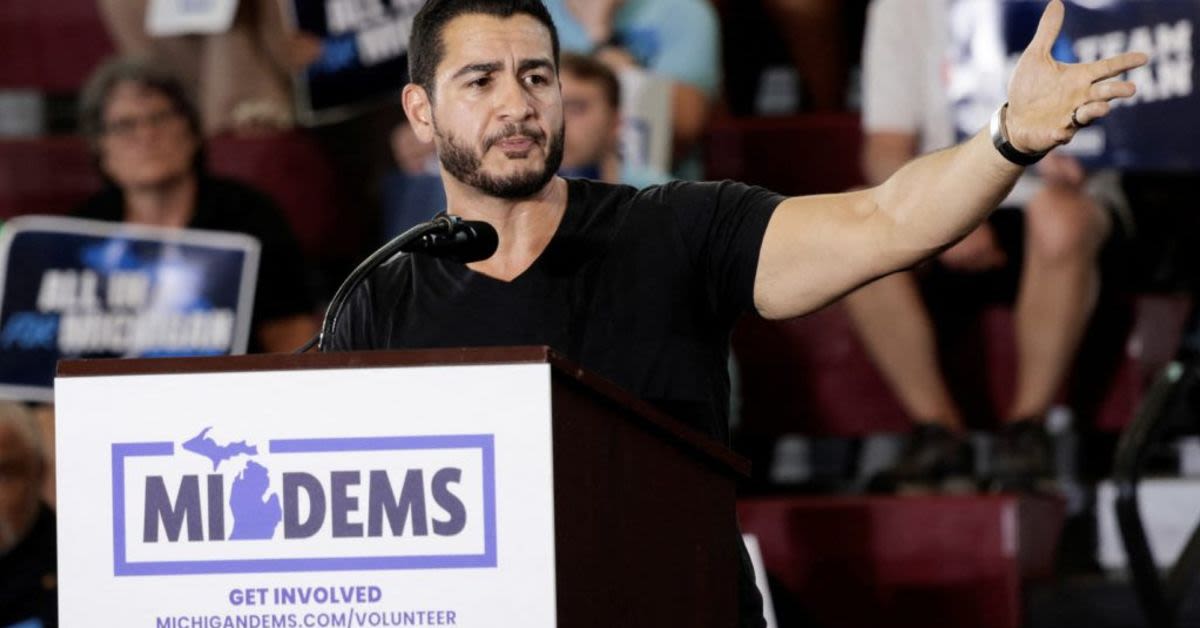
Michigan Democratic Senate hopeful Abdul El-Sayed is campaigning as a champion of fair taxation on the wealthy even as his own finances appear structured to minimize the very payroll taxes he insists the rich should pay more of.
According to the Washington Free Beacon, El-Sayedwho has pledged to build a tax system that's fair for working people and makes billionaires pay their fair shareis personally benefiting from a controversial tax strategy long criticized by Democrats when used by their political opponents.
El-Sayeds most recent financial disclosure, covering all of 2025 and the first seven months of 2026, shows he paid himself a salary of $64,000 through AME Higher LLC, a company he created to receive consulting and speaking income.
That same disclosure shows he took an additional $103,000 as a member draw, meaning profits distributed to him as the owner of the business rather than as wages.
Accountants say this split between salary and profit is a classic method for reducing exposure to Social Security and Medicare payroll taxes, particularly when an LLC is taxed as an S-corporation.
If El-Sayed had simply paid himself a straight $167,000 salary, he would owe the full 15.3 percent self-employment payroll tax on that amount12.4 percent for Social Security and 2.9 percent for Medicarerather than shielding a large portion of his income from those levies.
Under federal tax rules, an LLC that elects to be treated as an S-corporation must pay its owner a reasonable salary that reflects a legitimate market rate for the work performed, and that salary is subject to payroll taxes.
However, profits distributed above that salary are not subject to the same payroll taxes, allowing high earners to save thousands of dollars while still technically complying with the law.
The split between the compensation and the distribution may have been done with an eye towards tax havens, Robert Willens, a tax and accounting adviser to Wall Street hedge funds, told the Free Beacon.
This is a loophole actually that was attempted to be closed several times. Obama first tried to close the loophole and was unsuccessful.
Still a very viable strategy, Willens said.
A second accountant, who requested anonymity out of fear of reprisal, said the way El-Sayed reported his income strongly suggests that his LLC is being taxed as an S-corporation.
If you elect, as an LLC, to be an S-corp, then you could take out a salary, the accountant said. So if it's an LLC, and he checked the box that says you're going to operate as an S-corp, that's probably the only thing that would make sense.
The accountant added that if AME Higher LLC were not taxed as an S-corporation, El-Sayed wouldn't take the income out in the manner reflected on his disclosure.
El-Sayeds campaign declined to respond to questions about the structure of his business or the apparent inconsistency between his rhetoric and his personal tax strategy.
He would hardly be the first politician to condemn tax advantages for the wealthy while quietly using those same provisions to reduce his own tax bill.
During the 2004 presidential race, thenDemocratic vice presidential nominee John Edwards was criticized by the New York Times for using what it described as a tax shelter, a so-called S Corporation, to reduce taxes on income from his lucrative trial-lawyer practice.
The Times noted that Edwards attacked President Bush as favoring the wealthy with his tax policies and blamed tax shelters as undermining the Medicare program.
At the time, an Edwards campaign spokesman defended the arrangement by saying Edwards believes that no individual should pay more than they owe in taxes, but he also believes that we should make sure our tax code reflects our values. The law should make sure everybody is paying their sharenot one penny more and not one penny less.
Years later, in 2012, former House speaker Newt Gingrich faced similar scrutiny when his presidential bid revealed he had used an S-corporation structure to separate salary from profit.
Gingrichs tax returns showed he received $444,327 in salary from two firms and $2.4 million in profit distributions, a setup that USA Today described as a popular tax strategy involving a so-called S Corporation, an entity that has increasingly been used by attorneys, entrepreneurs, contractors and self-employed professionals to avoid business taxes.
Unlike El-Sayed and Edwards, however, Gingrich openly campaigned on a flat national tax rate and on reforms to partially privatize Social Security and Medicare, aligning his personal tax planning with a broader pro-market, limited-government philosophy.
The S-corporation maneuver has since become widely known as the Gingrich-Edwards tax loophole, a label popularized by CNBC in 2014.
Then-president Barack Obama sought to eliminate the strategy in his 2015 budget proposal but failed, and his vice president, Joe Biden, later used a similar structure to route book and speech income through S corporations substantially lowering his tax bill, the Wall Street Journal reported.
Biden used a traditional corporation rather than an LLC, but tax experts note that LLCs, like El-Sayeds, can elect to be treated as S-corporations and achieve the same effect.
Democrats in the Senate have repeatedly attacked this very approach, particularly when they can frame it as a tool of the rich and of large financial firms.
In 2023, Sen. Sheldon Whitehouse (D., R.I.) introduced the Medicare and Social Security Fair Share Act, aimed at the owners of pass-through businesses who, he claimed, can avoid Medicare taxes by disguising earned income as distributed business profits.
The bill, which Whitehouse reintroduced in 2025, would impose an additional tax on pass-through business income for individuals earning more than $400,000 a year.
Sen. Ron Wyden (D., Ore.) likewise proposed a 2025 measure targeting pass-through entities that avoid paying their fair share of taxes, continuing a pattern in which Democrats publicly denounce the very structures some of their own leaders quietly exploit.
Right now, wealthy owners of pass-through businesses like hedge funds and private equity firms can avoid paying Medicare taxes entirely, Whitehouse said in a March 2026 Senate Budget Committee statement.
My bill would close that loophole.
Whitehouses office did not respond to a request for comment on El-Sayeds apparent use of the same mechanism.
Whether El-Sayeds consulting firm is formally taxed as an S-corporation cannot be definitively confirmed without access to his complete tax filings, which he has refused to release.
Instead, on July 15 he provided only two pages of his 2025 federal return, omitting Schedule 1 and Schedule Eforms that would disclose S-corporation income and other pass-through activity.
Even that limited disclosure, however, offers clues that align closely with the S-corporation strategy described by the accountants.
The partial return lists $130,749 in W-2 wages, a figure that roughly matches the $146,749 in salary income he reported on his financial disclosure.
Of that W-2 income, $82,749 came from Wayne County, Michigan, where El-Sayed served as health director until April 2025.
The remaining $64,000 in W-2 wages came from his consulting firm, AME Higher LLC, mirroring the salary figure he reported from that entity.
Additional income listed on his financial disclosuresuch as speaking fees, consulting fees, book royalties, and revenue from three rental propertieswould not typically appear as W-2 wages, further underscoring the distinction between salary and profit distributions.
A third accountant told the Free Beacon that this W-2 pattern is significant because it is consistent with an LLC that has elected S-corporation status.
The owner of an LLC taxed as an S-corporation can pay himself a W-2 salary, the accountant explained, whereas the owner of a traditionally taxed LLC generally cannot.
Assuming El-Sayeds disclosure is accurate, the accountant said, it strongly indicates that he has indeed classified his LLC as an S-corporation and is therefore able to treat a substantial portion of his income as profit distributions not subject to payroll taxes.
That arrangement stands in sharp contrast to the populist, soak-the-rich rhetoric that has defined El-Sayeds Senate campaign.
The left-wing Democrat has repeatedly insisted that the wealthy should pay their fair share, while vowing to crack down on tax breaks and loopholes that benefit high earners and corporations.
He has also declared that he oppose[s] corporate tax breaks and has attacked President Donald Trumps tax reforms, saying, I believe in right-sizing our tax code to take on the outsized power of excess wealth in our economy and democracy.
On his campaign website, El-Sayed goes further, proclaiming, The ultrawealthy should no longer be able to hide behind loopholes that leave them paying lower tax rates than the rest of us.
Toward that end, I support taxing capital gains over $1 million at the same rate as ordinary income and closing the stepped-up basis loophole. I'll also fight to close the Social Security payroll tax cap to make sure the rich pay their fair share so that Social Security stays solvent well into the future.
While his 2025 tax return does not show capital gains over $1 million, El-Sayeds total income for that year exceeded $686,000, placing him firmly in the top 1 percent of Michigan earners even as he presents himself as a tribune of the working class.
El-Sayed has built that wealth rapidly since his failed 2018 gubernatorial bid, even as he has continued to rail against excess wealth and demand higher burdens on top earners.
His partial 2025 return shows $686,069 in total income, a level that would put him among the very taxpayers he insists should be paying more.
Some of that money came from his wife, psychiatrist Sarah Jukaku, whose private practice does not accept Medicareeven though El-Sayed is a vocal proponent of Medicare for All, a government-run system that would further expand Washingtons control over health care.
In addition to his consulting and speaking income, El-Sayed owns three rental properties, including two overseas holdings that underscore his financial comfort: one in Bangalore, India, and another in Dubai, apparently located in a resort-style luxury development.
For a candidate who castigates the ultrawealthy and calls for closing loopholes that allow high earners to hide behind favorable tax treatment, the picture that emerges is one of a politician eager to impose new burdens on others while preserving every legal advantage for himself.
His use of an S-corporation-style structureif fully confirmed by the returns he has so far declined to releasewould place him squarely in the tradition of Democrats who publicly condemn tax planning strategies as immoral when used by conservatives, only to quietly adopt them when it benefits their own bottom line.
Login