
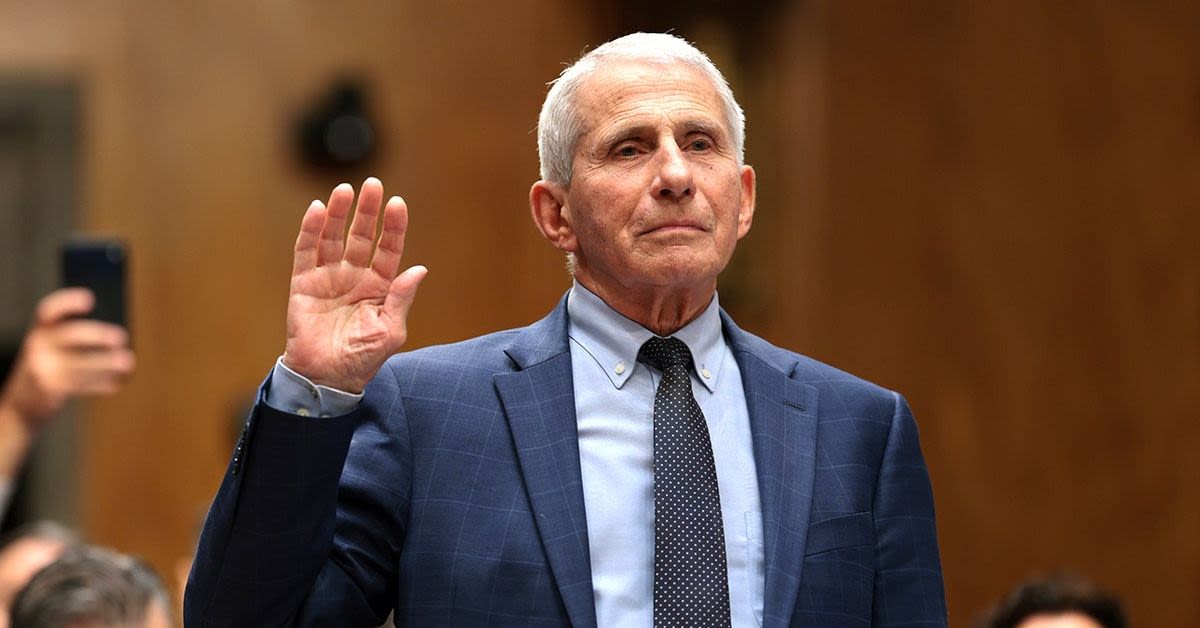
Two Republican senators say newly released correspondence from Dr. Anthony Faucis government email account shows that senior federal health officials privately raised concerns about COVID-19 vaccine injuries even as the Biden administration pressed ahead with its aggressive vaccination campaign.
According to Just The News, Sens. Ron Johnson of Wisconsin and Rand Paul of Kentucky on Sunday unveiled an internal May 27, 2021 email from thenacting Food and Drug Administration Commissioner Dr. Janet Woodcock to Fauci and thenNational Institutes of Health Director Dr. Francis Collins, in which she relayed troubling reports of post-vaccination harm. Woodcock wrote that she had received accounts directly from individuals, including healthcare professionals, describing adverse events after COVID-19 shots that did not fit any clear diagnostic pattern.
The symptoms do not fit together into a distinctive syndrome and most are not easily quantifiable or evaluated with standard laboratory testing," Woodcock told Fauci and Collins, adding that These problems are not the sort that a system like VAERS [the Vaccine Adverse Event Reporting System] would be able to detect."
In the same message, Woodcock suggested that even more advanced federal monitoring tools might miss what she was seeing. She appeared to acknowledge that "even a more sophisticated" system like the Centers for Disease Control and Preventions surveillance platform or the FDA's own safety system would likely fail to capture these atypical cases, underscoring a potential blind spot in the governments vaccine safety apparatus.
Woodcock went further, warning that federal health officials needed to proactively investigate the issue rather than rely on passive reporting. She wrote that she believed authorities should conduct a study, though she doubted the pharmaceutical industry would support such work "for obvious reasons," and cautioned, "But my experience is, that if you let a problem fester, then it will come back to bite you later, and you are not prepared."
At the time, Collins was serving as director of the National Institutes of Health, while Fauci was a central figure on the White House Coronavirus Task Force and the longtime head of the National Institute of Allergy and Infectious Diseases. Johnson now chairs the Senate Permanent Subcommittee on Investigations, and Paul leads the Senate Homeland Security and Governmental Affairs Committee, giving both Republicans broad authority to probe federal COVID-19 decision-making.
The day after receiving Woodcocks warning, Fauci forwarded her email to Collins, underscoring that the concerns could not simply be brushed aside. Fauci wrote that Woodcock "asks what we think of this? We cannot ignore her. We should probably bring in CDC and see what" thenCDC Director Rochelle Walensky thinks, according to the document produced by the Department of Health and Human Services.
Johnson and Paul say that, based on the records they have reviewed so far, it remains unclear whether Walensky was ever consulted or whether the CDC took any concrete action in response. Their public release notes that by the end of May 2021, when Woodcock sent her email, there were already 440,025 worldwide adverse events and 8,650 deaths associated with the COVID injection reported to VAERS, with 3,350 (39%) of those deaths occurring within two days of injection."
The senators highlight that the CDC relied on a major federal contractor, General Dynamics Information Technology (GDIT), to input VAERS reports, and that the volume of cases quickly exceeded what planners had anticipated. The 440,025 adverse events logged by late May 2021 surpassed GDITs December 2020 worst-case scenario of 1,000 reports per day by a factor of approximately 2.6, raising questions about whether the system was overwhelmed and whether serious signals were being properly analyzed.
Johnsons April 29, 2026 report, cited in the release, points to earlier internal warnings inside the FDA about the agencys analytical tools. Three months before Woodcocks May 27 email, on March 1, 2021, Dr. Peter Marks, director of the FDAs Center for Biologics Evaluation and Research, was alerted by FDA safety expert Dr. Ana Szarfman that the algorithm the agency was using to evaluate VAERS data was masking/hiding safety signals.
According to the senators, "The email we are releasing coincides with monthly data runs by Dr. Szarfman using a new algorithm showing dozens of safety signals including sudden cardiac death, pulmonary infarction (which Dr. Fauci suffered in June 2021), cerebral artery occlusion, basal ganglia stroke, agonal rhythm, and Bells palsy." They assert that Unfortunately, FDA officials ignored Dr. Szarfman and the safety signals, told her to cease and desist, and continued to use the algorithm they knew was masking safety signals."
The release further notes that, beginning in March 2021, NIH neurologist Dr. Avindra Nath was leading a team of physicians and researchers who were diagnosing and treating individuals severely injured by the COVID injections. The injuries and symptoms Naths team was seeing, the senators say, resembled those being described directly to Woodcock by patients and clinicians, suggesting that multiple arms of the federal health bureaucracy were encountering similar red flags.
Johnson and Paul pose a series of pointed questions about what Woodcock knew and when she knew it, and whether the public was misled by omission. Was Acting Commissioner Woodcock aware of Dr. Naths diagnosing and treatment of COVID injection injuries at NIH and/or what senior FDA officials had been told and shown about safety signals when she wrote her May 27, 2021 email? If so, why did she hide that knowledge from the public? If not, why was she kept in the dark?" they ask.
They also return to Woodcocks own admission that she believed a formal study was needed but doubted industry backing. Dr. Woodcock wrote that she thought health officials should conduct a study that she nevertheless 'doubt[ed] the industry would support, for obvious reasons. What are those obvious reasons?" the release Sunday asks in closing, implying that financial or reputational interests may have outweighed transparent risk assessment.
The senators underscore that Faucis reaction to Woodcocks email is revealing in its own right. The day after receiving Woodcocks email, Fauci forwarded the email to Collins that in part read: she 'asks what we think of this? We cannot ignore her, they note, adding that That is an odd statement as it appears to suggest they sure would like to ignore her and the reports of injection injuries."
For conservatives who long argued that Washingtons COVID-19 response was driven more by political imperatives and deference to Big Pharma than by candid science, the correspondence bolsters suspicions that serious safety concerns were downplayed or buried. Johnson and Paul are now using their committee gavels to demand answers about why internal warnings from Woodcock, Szarfman, and Nath did not translate into forthright public disclosure, and why the same government that insisted the shots were safe and effective appears to have been privately wrestling with evidence that its own surveillance tools were failing to capture the full picture.
Login