
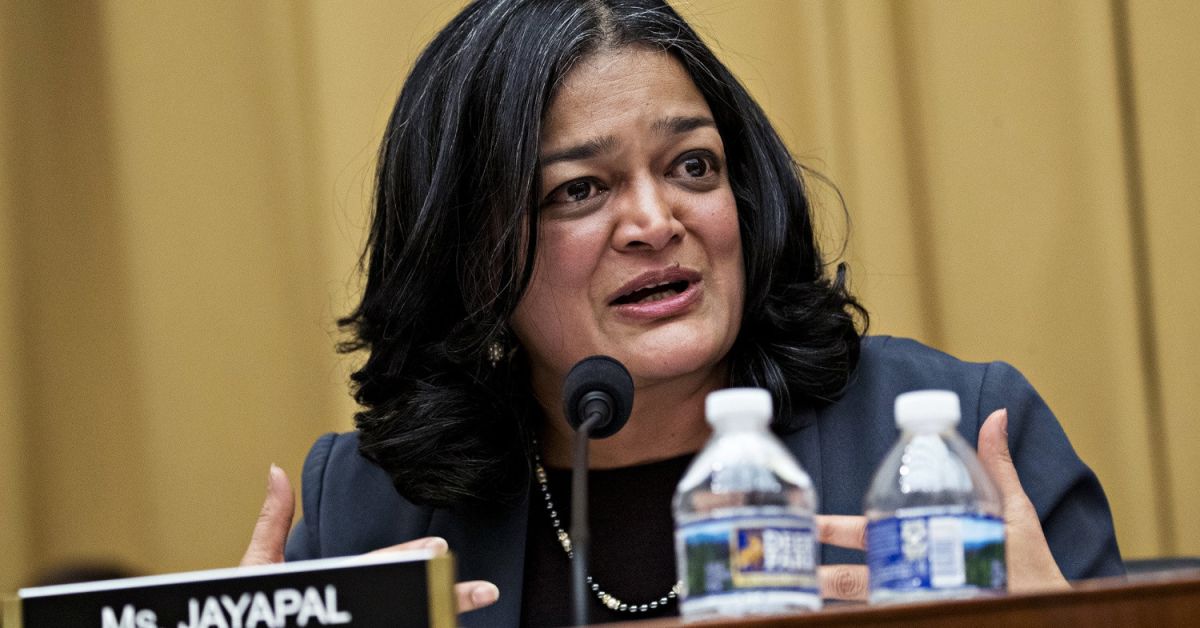
Rep.
Pramila Jayapal (D-WA) has acknowledged that she is personally pressuring the University of Washington (UW) to reverse course after administrators canceled a planned campus appearance by far-left online personality Hasan Piker, while simultaneously urging student groups to work around the decision and bring him to campus through alternative channels.
The controversy centers on UWs abrupt decision to scrap An Evening with Hasan Piker, a university-hosted event that had been scheduled for January 2027 as part of its official Speaker Series. According to The Post Millennial, Jayapal, who chairs the Congressional Progressive Caucus and is herself a UW alumna, has now stepped in on Pikers behalf, publicly defending his right to appear and confirming that she has raised the matter directly with university officials.
Jayapal framed her intervention as a defense of constitutional liberties, casting herself as a guardian of the First Amendment in a statement posted to X. As a Member of the Judiciary Committee, I have been absolutely clear that free speech is a Constitutional right that we must all stand up and protect, she wrote, signaling that she views the cancellation as a free-speech issue rather than a question of institutional judgment or academic standards.
She went on to reveal that she has been in direct contact with UW leadership about the decision and that administrators have responded by promising an internal review. I have been communicating my concerns about the cancellation of the Hasan Piker event directly to the University, and they have informed me that they are doing an internal review to ensure this never happens again, Jayapal added, suggesting she expects procedural changes that would prevent similar cancellations in the future.
At the same time, Jayapal pointed Pikers supporters toward a different path for getting him on campus, one that has long been used by conservative speakers who face resistance from university bureaucracies. I encourage student groups who want to hear from Mr. Piker to work with the University to ensure that they can proceed, she wrote, effectively advising activists to use student organizations as sponsors rather than relying on the universitys official lecture apparatus.
That reference to student groups is not incidental, because Piker himself has tried to frame his situation as equivalent to the treatment of conservative figures who have been protested or blocked from speaking on campus. If this had happened to Charlie Kirk, or if this had happened to Ben Shapiro, this would be the number one news story on Fox News for a month, Piker complained after UW canceled his appearance, attempting to cast himself as a victim of the same kind of censorship conservatives have long decried.
Yet there is a key difference that Pikers comparison glosses over, one that goes to the heart of how universities typically handle controversial speakers. Kirk and Shapiro are usually invited by independent student organizationsoften conservative or libertarian clubsrather than being selected as official, university-hosted speakers by academic departments or central lecture offices, which gives administrators more distance and allows students to bear responsibility for the invitation.
Pikers event, by contrast, was not a student-led initiative but a university-sponsored production organized through UWs Office of Public Lectures. It was backed by the Henry M. Jackson School of International Studies and the Graduate School, meaning that the institution itselfnot just a student groupwas effectively endorsing him as a featured voice in its formal Speaker Series.
Jayapals push for student groups to take the lead therefore appears to be a tacit acknowledgment that the model used for Pikers original invitation was politically and administratively fraught. Her suggestion mirrors the longstanding practice by which controversial conservative speakers have managed to appear on campus despite hostile faculties and activist pressure: by relying on student organizations, often with outside legal or financial support, rather than on official university sponsorship.
UWs administration, for its part, has tried to frame the cancellation as a procedural matter rather than a political one, insisting that the institution remains committed to robust debate. The University of Washington is dedicated to the free exchange of ideas, including on controversial topics and involving provocative speakers, the university said in a statement, attempting to reassure critics that it is not abandoning free speech.
However, the university also disclosed that an internal review had found serious flaws in how the Piker event was arranged under the auspices of the Speaker Series. The review concluded that the process for organizing this event did not meet the necessary level of rigor for University-hosted events in the Speaker Series, and UW has pledged to update its procedures, though it has not publicly detailed what, specifically, went wrong in the approval chain.
The uproar has prompted a broader question that many taxpayers and alumni are now asking: why was Hasan Piker, of all people, selected as a university-hosted speaker in the first place. Piker himself has said that the invitation came directly from a faculty member, explaining, Daniel Bessner invited me to UW. I was like, sure, Ill do it, indicating that the initiative originated within a particular academic unit rather than from a neutral, campus-wide vetting process.
Bessner is the Anne H.H. and Kenneth B. Pyle Associate Professor in American Foreign Policy at the Jackson School, one of the units sponsoring the event, and he is not a politically neutral figure. He previously served as a foreign policy adviser to Sen. Bernie Sanders presidential campaign, underscoring that the decision to elevate Piker was rooted in a particular ideological milieu rather than in a broad-based academic consensus.
Sources familiar with internal dynamics at the Jackson School describe a faculty faction that has grown increasingly hostile to university leadership as administrators have tried to rein in years of disruptive activism. These activist professors, the sources say, have accused UWs central administration of selling out or caving as it has attempted to restore order and enforce basic standards following violent protests and encampments.
Within that context, inviting Piker was reportedly seen by some of these faculty activists as part of a broader effort to push UW back toward a more confrontational, left-wing political posture. According to those familiar with the situation, some faculty cast themselves as part of the resistance to university leadership, using high-profile events and speakers to challenge administrative authority and reassert radical politics on campus.
Questions have also been raised about the logistics of the planned event, particularly the decision to use an expensive off-campus venue despite UWs having large lecture halls and event spaces of its own. Sources have suggested that this choice may have been an attempt to sidestep additional scrutiny from senior administrators, who might have been more likely to intervene had the event been scheduled in a prominent on-campus facility.
UW previously told The Ari Hoffman Show that the Office of Public Lectures selects its speakers independently and that top university executives do not provide input into those choices. The university also emphasized that Piker was slated to receive only a nominal honorarium and travel reimbursement funded by Office of Public Lectures endowments rather than by state appropriations, but that assurance has done little to quell concerns about the use of public resources and institutional prestige to elevate a deeply polarizing figure.
For many critics, the core issue is not the size of Pikers honorarium but his record of inflammatory and often hateful rhetoric, which makes him an odd champion for those suddenly invoking free-speech absolutism. Piker became notorious after declaring that America deserved 9/11, later describing the terrorist attacks as backlash for U.S. foreign policy, comments that many Americansespecially conservatives and veteransview as morally repugnant and anti-American.
His statements about Israel and Jews have been similarly extreme, raising serious questions about why a public university would choose to platform him as an official speaker. He has called Hamas the lesser of two evils compared to Israel, claimed the terrorist group is 1,000 times better than Israel, and referred to Orthodox Jews as inbred, rhetoric that Jewish organizations and many observers have characterized as antisemitic and supportive of extremism.
Pikers contempt is not limited to foreign policy or religious minorities; he has also smeared his domestic political opponents in sweeping, incendiary terms. He has labeled the Republican Party the biggest domestic terrorist organization and the biggest terrorist internationally, language that further underscores why many conservatives see his elevation by a taxpayer-funded institution as a stark example of ideological bias and double standards.
Jayapals vigorous defense of Pikers right to appear at UW stands in sharp contrast to her own prior statements about speech she deems hateful or dangerous. In an earlier social media post, she insisted, Hate speech is not free speech. It is harmful and threatening, and she argued that Facebook has the power to take down hateful groups and should, endorsing corporate censorship of content she finds objectionable.
Now, however, Jayapal is invoking free-speech principles on behalf of a speaker who has called Orthodox Jews inbred, praised Hamas relative to Israel, and repeatedly issued inflammatory statements about Israel, Jews, and his political adversaries. The shift highlights a familiar pattern on the left: expansive free-speech rhetoric when it protects ideological allies, and aggressive calls for deplatforming when the target is conservative or religious speech.
Following UWs cancellation, Piker responded not with introspection but with accusations, blaming pro-Israel and Jewish organizations for allegedly orchestrating political pressure behind the scenes. He claimed the university had received a barrage of botted emails and probably got a boss call, implying that outside forces had bullied administrators into backing down.
He went further, charging that Democrats themselves were complicit in silencing him at the behest of foreign interests. Piker alleged that Democrats were engaging in censorship once again at the behest and the direction of Israel, a claim that fits squarely within his broader narrative about outsized Israeli and pro-Israel influence over Western institutions.
These are not new themes for Piker, who has repeatedly suggested that Israel and its advocates wield disproportionate control over democratic governments. After claiming that British authorities had barred him from entering the United Kingdom, he asserted, Israel advocacy organizations have unbelievable amounts of power over what even the United Kingdom has to say and do, again portraying Jewish and pro-Israel groups as puppet-masters behind sovereign states.
British Jewish organizations had indeed urged their government to deny Piker entry, citing his comments about Hamas, Hezbollah, Zionism, and Orthodox Jews as evidence of antisemitism and sympathy for extremist movements. Piker, for his part, has denied being antisemitic, but his record of statements has made that denial difficult for many observers to accept, particularly in light of rising antisemitism across Western campuses and cities.
The dispute over his canceled UW appearance is unfolding against a broader backdrop of anti-Israel activism and federal scrutiny at the university. UW is among the institutions that came under investigation by the Trump administrations Department of Education Office for Civil Rights over allegations of antisemitic harassment and discrimination, as well as potential violations of Title VI of the Civil Rights Act, which protects students from discrimination based on shared ancestry or ethnic characteristics.
In recent years, UW has also been rocked by escalating campus unrest tied to pro-Hamas and far-left activism, raising concerns about safety, order, and the rule of law. In 2024, pro-Hamas activists established a violent Gaza encampment on campus, and in May 2025, pro-Hamas and Antifa radicals organized a takeover of the universitys Interdisciplinary Engineering Building, causing more than $1 million in damage before the occupation ended.
Despite the severity of that destruction, the university later lifted emergency suspensions imposed on students accused of participating in the takeover, a move that critics say exemplifies the administrations reluctance to impose meaningful consequences on radical activists. Against this history of leniency toward left-wing disruption and hostility toward Israel, the decision to initially elevate Hasan Piker as an official speakerand Jayapals subsequent pressure campaign to reinstate himraises pressing questions about UWs priorities, its commitment to genuine viewpoint diversity, and the standards it applies when deciding which voices deserve the imprimatur of a public university.
Login