
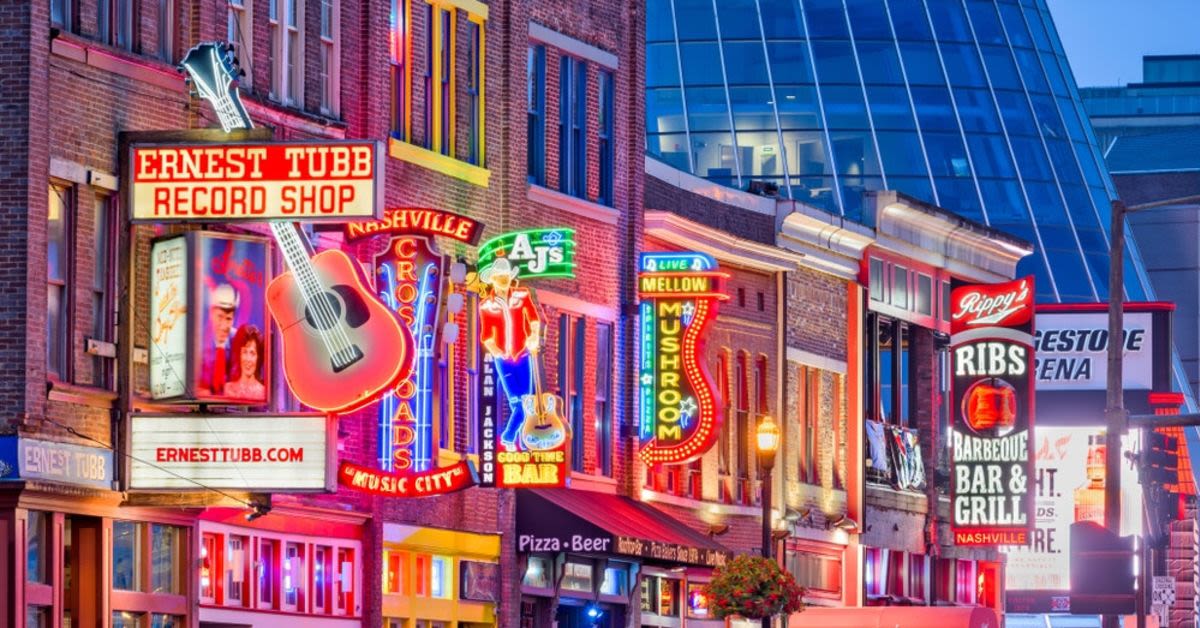
Country music star John Rich is sounding the alarm that Nashvilles famed Lower Broadway the beating heart of Music City is being pushed toward darkness by an aggressive property tax regime that he says is crushing the very honky-tonks and live music venues that made the city world-famous.
According to Fox News, Rich, the 52-year-old Big & Rich singer and owner of Redneck Riviera Bar & BBQ on Lower Broadway, has gone public with a stark warning that the citys tax and appraisal policies are driving iconic establishments to the brink. In a video he posted to Facebook, Rich declared that "the lights are going out on Broadway" as businesses struggle to keep up with soaring tax bills that he believes are the product of deliberate political choices, not economic inevitability.
Speaking to Fox News Digital, Rich argued that a combination of sharply higher property assessments and subsequent tax hikes has delivered a devastating blow to the districts bars, restaurants and music halls, threatening not only individual businesses but the live music culture that earned Nashville its "Music City" nickname. He contended that the tax burden is now so heavy that even veteran operators with decades of experience cannot make the numbers work, despite the areas continued popularity with tourists and locals.
"It was a one-two punch," Rich said, describing the sequence of events that he believes set the crisis in motion. "So the first thing he did was they reappraised everybody's property in the county, in the city, and as soon as they got that done, which was an extremely inflated appraisal rate, then they come in and raise the taxes aggressively on top of these extremely inflated appraisals."
"And with those two things, what you've done is you've now put a death nail in a vast majority of the businesses," he continued, arguing that the combined effect of reassessment and tax hikes is unsustainable. "It's only a matter of time before you're going to see large percentages of the businesses downtown turning out the lights."
"We've already had three in the past two weeks have to shut down. I'm talking major, major, major places that have been there for decades," Rich added, underscoring that the closures are not limited to marginal or struggling operations but include long-standing anchors of the Broadway scene. Though Rich has placed much of the blame on Nashvilles Democratic Mayor Freddie OConnell, the citys regularly scheduled four-year reappraisal, conducted in 2025, was carried out by the independently elected Davidson County assessor of property.
The 2025 reappraisal produced a staggering 45% median increase in property values across Davidson County, reflecting years of rapid growth and development in Nashville. Under Tennessee law, such reappraisals are supposed to be revenue-neutral, with the tax rate adjusted downward so that higher values do not automatically translate into a windfall for local government.
However, after the reappraisal, OConnell and the Metro Council chose to set the Urban Services District tax rate at $2.814 per $100 of assessed value, a level that is 26% above the revenue-neutral certified rate, according to the assessors office. That political decision effectively turned the reappraisal into a substantial tax increase, particularly painful in areas where property values had already exploded.
The pain has been especially acute on Lower Broadway, where a 400% increase in real estate values has become common, according to a report by Axios Nashville. The outlet also noted that many honky-tonk operators do not own their buildings but lease them, and under those leases they are responsible for the property taxes, leaving them to absorb skyrocketing tax bills without sharing in the increased equity that landlords enjoy.
Rich pointed to several specific Lower Broadway establishments as examples of what he sees as a broader crisis engulfing the district. He cited Nashville Underground, which permanently closed in May after roughly eight years in business, and Acme Feed & Seed, whose owner, Tom Morales, has publicly warned that his venue could be forced to close because of a steep increase in its property tax bill.
Rich also said he has heard that Hard Rock Cafe Nashville, a fixture on Broadway since 1994, is considering shutting its doors, though Fox News Digital has not independently confirmed that claim. For Rich, these stories are not isolated anecdotes but early warning signs of a systemic problem that, if left unchecked, could hollow out the cultural core of downtown Nashville.
Acme Feed & Seed has become a flashpoint in the debate over the citys tax burden, serving as a high-profile case study in how policy decisions ripple through the local economy. In February, Morales revealed that the popular four-story restaurant, bar and live music venue had seen its annual property tax bill jump from $129,000 to nearly $600,000, a more than fourfold increase that he suggested was impossible to absorb.
Morales told Nashville's NewsChannel 5 that Acme Feed & Seed ended 2025 about $500,000 "in the red," a deficit he linked directly to the tax spike. He and his daughter Lauren Morales later told the Nashville Scene that closure was "imminent" if they could not find a way to address the crushing tax increase, raising the prospect that yet another landmark could go dark.
OConnell addressed Morales' warnings in an interview with Nashville's Fox 17, taking a stance that many business owners and conservatives viewed as dismissive. "Its not up to me whether he keeps that business open," OConnell told the outlet. "The market evolves. New businesses start even as beloved old businesses close."
Those comments drew swift criticism, including from Metro Councilmember Jacob Kupin, who told Fox 17 he was "appalled" by the mayor's response and suggested it reflected an indifference to the fate of long-standing local institutions. OConnells office later accused the station of selectively editing and misrepresenting his remarks and released a longer version of the exchange in an effort to soften the political fallout.
In the fuller answer, OConnell said the state comptroller had reviewed downtown valuations and determined that they reflected market value, implying that the appraisals themselves were not artificially inflated. He described Acme's location as "an incredibly valuable piece of property" and argued that it was up to the owner to determine how best to capture that value, effectively framing the issue as a matter of private business strategy rather than public policy failure.
Rich, however, insisted that Acmes plight is emblematic of a much wider problem facing Lower Broadway. He pointed to a recent meeting he attended with other business owners in the district as evidence that the concern is broad-based and bipartisan, not a niche complaint from a single operator.
"Then we had this meeting with all the business owners down there," Rich told Fox News Digital, describing a gathering that he said included virtually every major stakeholder on the strip. "And in that meeting, all the ownership of Broadway was represented down there, and every single person said it's only a matter of time before we literally have to just close the doors because we're running at a deficit."
"We'd have to charge $50 a beer, which you can't do that," he continued, arguing that the only way to cover the tax burden would be to impose prices that would drive away customers and destroy the character of the district. "I mean, there is no business model that exists that allows the businesses down there to stay open."
WATCH: JOHN RICH SAYS NASHVILLE BARS WOULD NEED TO CHARGE $50 A BEER' TO SURVIVE
Rich emphasized that the operators raising the alarm are not inexperienced newcomers but seasoned professionals who have weathered economic ups and downs before. "You're not talking about a bunch of amateurs here," he said. "You're looking at the best of the best, and they can't survive it."
For Rich, the stakes go far beyond individual profit and loss statements, touching on Nashvilles very identity as a city built on live music and working-class creativity. "The bigger story to me is live music in Nashville. I mean, it's called Music City," he said, warning that the policies now in place risk undermining the cultural ecosystem that has drawn millions of visitors and countless aspiring musicians to the city.
Rich described the extraordinary concentration of live music along Broadway, where honky-tonks line both sides of the street and bands perform from late morning until the early hours of the next day. "You walk down Broadway, the doors are all open to all the honky-tonks, you're hearing music from the right side of your head and the left side of your head for five blocks in a row," Rich said. "There's 60, 70, 80 live music venues in that one concentration. It's the only place like it in the world."
"The French Quarter doesn't have that. Las Vegas doesn't have that. Times Square doesn't have that," he continued, contrasting Nashvilles organic, musician-driven scene with more corporate entertainment districts elsewhere. "There's nowhere in America that has what downtown Nashville has when it comes to live music. And it is absolutely under threat."
Looking ahead, Rich painted a bleak picture of what Lower Broadway could look like when Nashville hosts the 2030 Super Bowl, an event that should be a showcase for the citys unique culture. "Can you imagine when the Super Bowl comes to Nashville here in a few years, and everybody's packed in on Broadway and there's only 30 or 40% of the neon signs that are even still lit up, if you're lucky?" he said. "That's what you're looking at happening. I mean, what a travesty that would be."
Rich, an outspoken conservative and longtime supporter of President Donald Trump, placed much of the blame squarely on OConnell, a Democrat, suggesting that the mayors approach is driven more by progressive ideology than by concern for small businesses or cultural heritage. At the same time, he stressed that the alarm being raised on Broadway is not confined to Republicans or conservatives but is shared by business owners across the political spectrum.
"This is not just a bunch of conservatives yelling about it," Rich said, pushing back against any attempt to dismiss the issue as partisan theater. "The group of business owners that I sat with were from both sides of the aisle."
"There's all kinds of things we don't agree on amongst each other," he continued, noting that the owners differ on many political and social questions. "But this right here brought unity amongst left and right and middle. It's that bad."
Rich went further, accusing OConnell of using tax policy as a tool to reshape the character of downtown Nashville in line with a more bureaucratic, less free-market vision. "It is a tactic to tax things out of existence that you don't like and replace them with things that you'd rather have there," Rich said, suggesting that the mayors endgame is to displace honky?tonks and small venues in favor of government and corporate tenants. "Can you imagine the neon signs on Broadway replaced with government buildings and corporate offices? I think that's what he wants."
Fox News Digital has reached out to OConnells office for comment, but as of this writing, the mayor has not publicly shifted course on the tax policy that critics say is endangering the citys most famous street. The standoff has intensified calls from conservatives and business advocates for state-level intervention to rein in what they view as local government overreach.
The five-time Grammy Award nominee is now urging Tennessees Republican-led state government to step in and protect Lower Broadway from what he sees as destructive local policies. Rich said Broadway business owners have appealed to Tennessee House Speaker Cameron Sexton and Senate Majority Leader Jack Johnson and have urged Gov. Bill Lee to work with lawmakers on a solution, arguing that the governor has a chance to become a "honky-tonk hero."
WATCH: JOHN RICH FEARS NASHVILLES NEON LIGHTS COULD GO DARK BEFORE SUPER BOWL COMES TO MUSIC CITY
"Governor Lee, who's still here, has an opportunity to do a special session with the Senate, with the House, and come with some solution that, if nothing else, will buy us some time until we can go in and make the more permanent moves," Rich said, framing the issue as urgent but still solvable if state leaders act decisively. State officials appear to be taking the matter seriously, with Sexton's office confirming to Axios Nashville that the House speaker has spoken with Lee's office and that they are "looking at all possible solutions," including the possibility of a special legislative session.
Despite his dire warnings, Rich stressed that the culture that draws crowds to Broadway remains intact for now, even as the financial pressure mounts behind the scenes. "The culture on Broadway hasn't changed at all," he said. "The crowds that come there, the bands that play there, the owners of those businesses, they're the same as they've always been."
"It is all about the music," Rich continued, emphasizing that the spirit of the strip is still rooted in live performance and the pursuit of the American dream by working musicians and entrepreneurs. "It's all about people coming to town to have a good time and look at what some of the most talented people you've ever seen in your life play on these tiny little stages."
Login