
The latest round of speculation over whether President Donald Trump might seek a third term appears to have reached its natural end, and it ended with Trump himself pointing back to the Constitution.
According to RedState, the former president was pressed on the issue Tuesday night and chose to answer not with bravado, but with a straightforward acknowledgment of constitutional limits. President Donald Trump dismissed a question Tuesday night from a reporter about the possibility of him running for a third term in 2028, saying "the law is very strong." In doing so, he undercut a favorite talking point of the left, which has long tried to paint him as a would-be authoritarian eager to shred the Constitution.
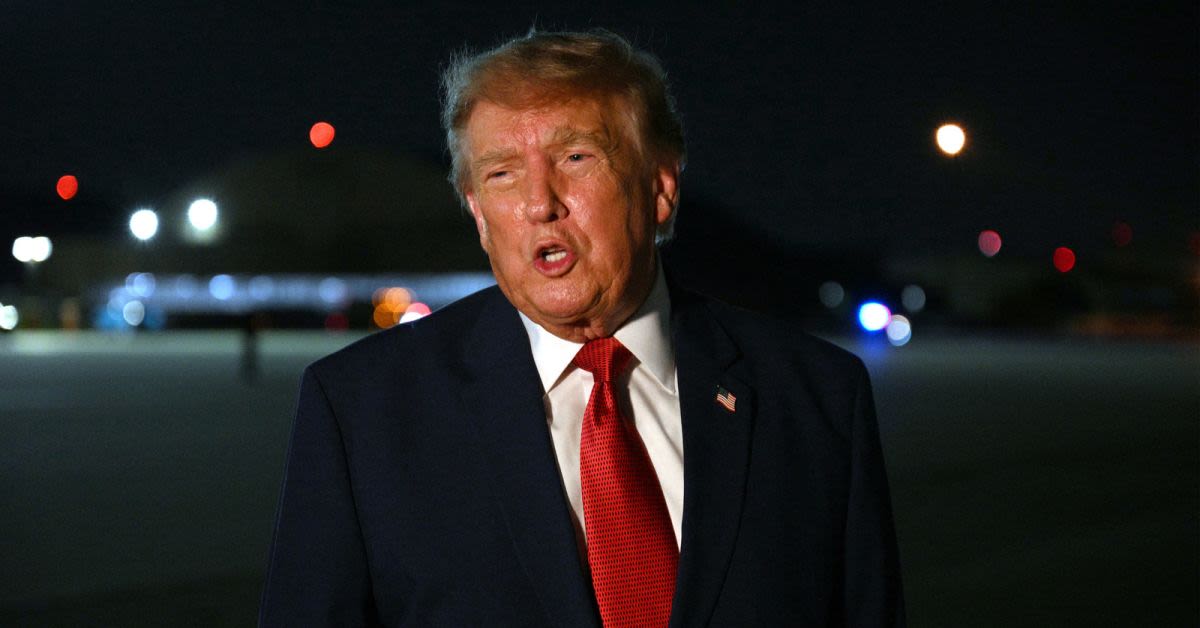
"Everybody asks me that question, and you know that the law is very strong on that," Trump said while speaking to reporters at Joint Base Andrews in Maryland. "I'd love to run, but the law is very strong." With that brief exchange, he effectively closed the door on the third-term chatter that both his critics and some of his most ardent supporters have entertained, often for very different reasons.
"I get asked by everyone, well, even tonight they're screaming at the event, '2028,'" he said, referring to the Patriot Games, which he had attended earlier that day. "No, everybody wants me to do it, but the law is very strong." The remark underscored that the pressure for a third run is not coming from Trump himself, but from a base that sees him as the most effective disruptor of the progressive agenda in modern political history.
The law to which Trump repeatedly pointed is the 22nd Amendment to the Constitution, adopted after Franklin D. Roosevelt broke the two-term precedent and entrenched himself in office. It provides in clear language:
No person shall be elected to the office of the President more than twice, and no person who has held the office of President, or acted as President, for more than two years of a term to which some other person was elected President shall be elected to the office of the President more than once. But this Article shall not apply to any person holding the office of President when this Article was proposed by the Congress, and shall not prevent any person who may be holding the office of President, or acting as President, during the term within which this Article becomes operative from holding the office of President or acting as President during the remainder of such term.
That language does more than bar a third electoral victory; it also blocks clever end-runs around the rule that some have floated in recent years. And, yes, that rules out the scheme of Trump running as the VP candidate on a Vance/Trump, or Rubio/Trump, or anyone/Trump ticket and then having the new president resign, leaving him in charge.
The 12th Amendment closes that door, as it states in part:
But no person constitutionally ineligible to the office of President shall be eligible to that of Vice-President of the United States.
Together, those provisions reflect a deliberate constitutional design: the presidency is not meant to be a lifetime post, no matter how popular or effective the officeholder may be. For conservatives who take the text of the Constitution seriously, Trumps public deference to these limits is a reminder that the rule of law, not personal ambition, must remain paramount.
Look, President Trump's place in history is secure. Aside from joining Grover Cleveland as the only presidents to have served two non-consecutive terms, Donald Trump has reshaped the Republican Party, making it more of a populist party, more attuned to the concerns and desires of working-class and middle-class Americans.
This was a trend that began under President Reagan in the 1980s, and I can remember pundits in the 1990s and the early 2000s describing the change of the GOP from being the "country club party" to being the "Sam's Club party." Trump accelerated that shift, forcing the partys leadership to reckon with the priorities of welders, truck drivers, and small business owners rather than the preferences of corporate boardrooms and Beltway consultants.
But two terms are enough. There's a reason that the 22nd Amendment was put in place, to ensure that new blood comes to the Oval Office every eight years.
And the Republican Party has a surfeit of good candidates right now: Vice President Vance, Secretary of State Marco Rubio, and Florida Governor Ron DeSantis, just to name a few possibilities. Meanwhile, who do the Democrats have? Kamala Harris, the Queen of Word Salads? The socialist Rep. Alexandria Ocasio-Cortez (NY-14), who never saw a communist platform plank she didn't like? Former Transportation Secretary "Pothole Pete" Buttigieg, who couldn't manage being chief executive of South Bend, Indiana, much less the United States?
It's a safe bet that the president was trolling the left with his tongue-in-cheek pronouncements about a third term. But his putting the matter to rest now, as the midterms fast approach and the 2028 election cycle starts up, is a good sign that he's laying the groundwork for the next generation.
Login