
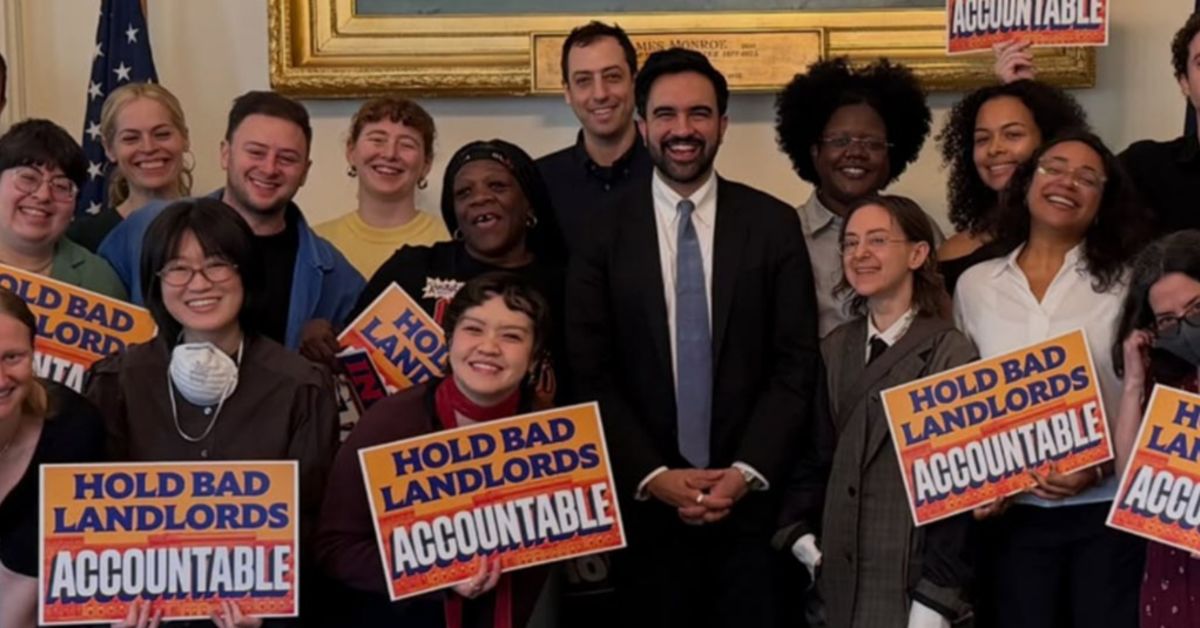
An activist at the center of New Yorks radical housing movement is drawing scrutiny for leading a rent strike while enjoying the benefits of a life steeped in wealth, celebrity, and inherited privilege.
According to the Gateway Pundit, Tracy Rosenthal, a prominent anti-rent organizer closely tied to socialist Assemblyman Zohran Mamdanis campaign and administration, is not the working-class victim she so often portrays in public appearances. As reported by the New York Post and highlighted by the outlet, Rosenthal is the daughter of Steven Rosenthal, a four-time Grammy-winning recording engineer and owner of the famed Magic Shop studio in SoHo, where he recorded rock icons including David Bowie, the Ramones, Blondie, Lou Reed, Sonic Youth, the Foo Fighters, and Coldplay.
Far from the image of a struggling tenant, Rosenthal grew up in a fashionable $1.7 million NoMad apartment in Manhattan, with what the Post described as elite access to the music industry. She reportedly attended the Grammys at least twice with her father, who built a lucrative career producing hit albums such as Coldplays 2008 Viva la Vida, which sold more than 10 million copies worldwide, the Foo Fighters 2014 Sonic Highways, and Bowies final album, 2016s Blackstar.
Despite this background, Rosenthal has styled herself as a champion of the proletariat, while refusing to pay rent on her own Brooklyn apartment for years. She currently occupies a $2,300-per-month unit in Bedford-Stuyvesant, where she has been on what she proudly calls a four-year rent strike since returning to New York City after a period in Los Angeles.
Her justification for withholding payment began, by her own account, with a pest complaint. She claimed that after spotting a cockroach in her hip Bed-Stuy apartment, she demanded the landlord hire an exterminator and, when that did not happen to her satisfaction, escalated the dispute into a full-blown political campaign.
Rosenthal has said she later discovered that the building contained more rental units than were legally approved and was facing foreclosure, and she used that information to organize fellow tenants into collectively refusing to pay rent. By the Posts tally, she has stiff[ed] the owner of at least $108,000 on her unit alone, effectively living rent-free while the propertys financial burden falls on others, including the bank and, ultimately, taxpayers and law-abiding borrowers.
Rather than treating her case as an individual landlord-tenant dispute, Rosenthal has turned it into a model for broader agitation. In public talks and online videos, she openly instructs audiences on how to avoid paying rent and how to pressure property owners through coordinated nonpayment.
One clip, highlighted by commentator Stu Smith, captures Rosenthal outlining what she calls a long term strategy to engineer systemic change by weaponizing mass delinquency. Asked what mass rent nonpayment would actually look like, Rosenthal describes building enough scale to create the kind of crisis necessary to extract major political concessions from government and the housing market.
In her own words, One way of thinking about abolishing rent is a permanent and general rent strike. That formulation is not a slip of the tongue; it is the core of her agendausing deliberate financial sabotage of property owners as a tool to push a hard-left vision of housing justice.
Critics see this as a textbook example of radical activism divorced from real-world responsibility, enabled by the cushion of family wealth. Rosenthals ability to forgo rent for years, while many working families struggle to meet monthly payments, underscores the disconnect between her revolutionary rhetoric and the lived reality of ordinary Americans who respect contracts and property rights.
From a conservative standpoint, her campaign raises fundamental questions about the rule of law, private property, and the moral hazard of normalizing organized nonpayment as a political tactic. When a communist nepo-baby, as detractors describe her, insists she has a right to occupy an apartment she does not own and refuses to pay for, it is not merely a personal disputeit is a direct challenge to the principles of individual responsibility and free-market exchange that underpin stable communities and a functioning housing system.
Login