
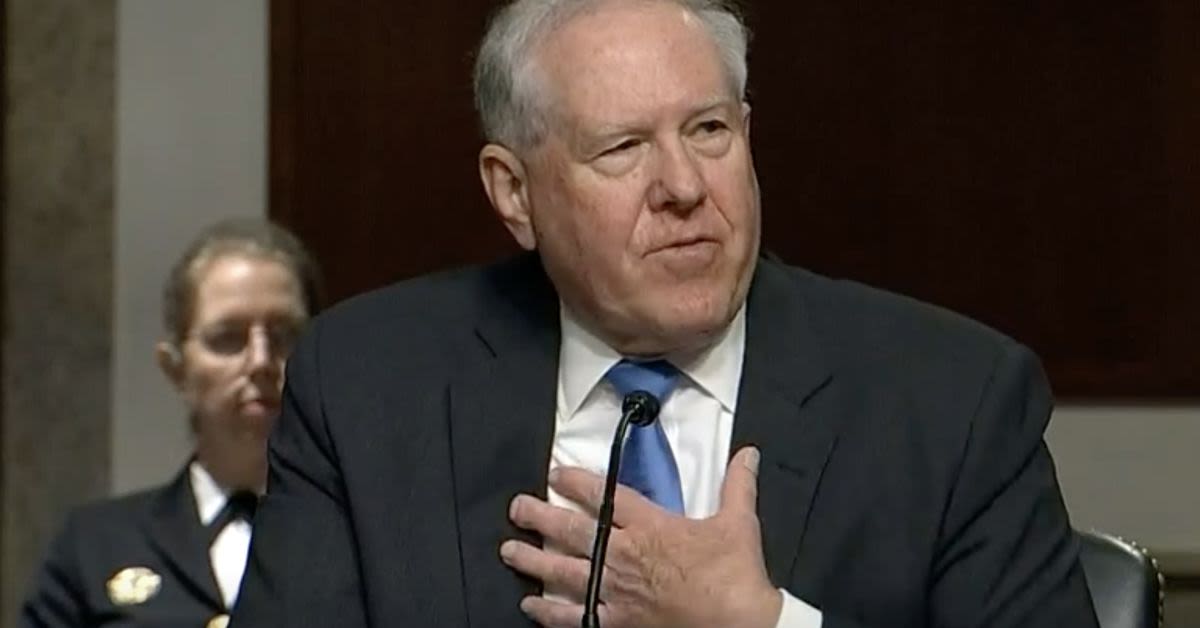
The Pentagon has stripped former Air Force Secretary Frank Kendall of his clearance after he allegedly leaked classified details about President Donald Trumps Air Force One to the liberal media, raising fresh questions about national security and partisan double standards in Washington.
According to The Gateway Pundit, the Department of War revoked Kendalls eligibility to access classified intelligence following his disclosure of sensitive information about Air Force One to The New York Times. The leak reportedly involved the Qatari-gifted Air Force One jet used by Trump, a symbol not only of presidential power but of American security and technological superiority.
In a sharply worded statement, Pentagon spokesman Sean Parnell announced the immediate action against the Biden-era Air Force chief. Effective immediately, the Department of War has REVOKED former Secretary of the Air Force Frank Kendalls eligibility for access to classified information and his ability to hold any sensitive position.
The Pentagon made clear that Kendalls alleged conduct crossed a bright red line. This action follows his unauthorized disclosure of classified information regarding Air Force Ones capabilities to a media outlet, Parnell stated, underscoring that such disclosures are treated as a grave breach of duty.
The statement further emphasized the seriousness of safeguarding national secrets, a principle conservatives have long argued should be applied consistently, regardless of political affiliation. Safeguarding classified information is a non-negotiable duty. Those who violate that trust forfeit the privilege of access and any role requiring it.
The controversy traces back to Trumps recent trip to Ankara, Turkey, for the NATO summit, where he flew in on the Qatari-gifted Air Force One and later announced that the aircraft would visit a U.S. base in the United Kingdom. He then departed Turkey on a different Air Force One plane, a move that immediately fueled speculation about potential security concerns surrounding the first jet.
Subsequently, federal agents served subpoenas to four New York Times reporters after the paper published sensitive details about alleged vulnerabilities on the presidential aircraft. According to the Times, leakers with knowledge of sensitive national security matters claimed the new plane lacked some of the advanced defensive systems installed on the other presidential aircraft, effectively broadcasting potential weaknesses to Americas adversaries.
Kendalls fall from grace is particularly striking given his extensive rsum and the immense trust previously placed in him by the defense establishment. According to his official Air Force biography, Frank Kendall was the 26th Secretary of the Air Force, responsible for organizing, training, and equipping the U.S. Air and Space Forces, overseeing an annual budget of more than $173 billion and the welfare of nearly 700,000 service members, Guardians, and civilian personnel.
The biography notes that Mr. Kendall has more than 50 years of experience in engineering, management, defense acquisition and national security affairs across private industry, government and the military. He worked as a consultant to defense firms, non-profit research organizations, and the Pentagon on strategic planning, engineering management and technology assessment, and is also an attorney who was active in the field of human rights, working primarily on a pro bono basis.
Before his senior government roles, Kendall served as Vice President of Engineering for defense giant Raytheon, directing engineering functions and internal research and development across the company. He also held a leadership post as Managing Partner at Renaissance Strategic Advisors, a Virginia-based consulting firm focused on the aerospace and defense sector.
Within the federal government, Kendall occupied several influential positions that gave him deep access to the nations most sensitive programs. He served as Under Secretary of Defense for Acquisition, Technology and Logistics, as well as Deputy Director of Defense Research and Engineering for Tactical Warfare Programs in the Office of the Secretary of Defense, and sat on the Army Science Board and the Defense Intelligence Agency Science and Technology Advisory Board.
Kendalls career began with service in uniform after graduating from the U.S. Military Academy at West Point, a pedigree often cited to bolster his credibility within the defense community. He served 11 years as an active duty Army officer, including assignments in Germany, teaching engineering at West Point, and in research and development positions, experience that makes the alleged leak all the more troubling to those who expect higher standards from senior military and civilian leaders.
The decision to revoke Kendalls clearance will likely intensify debate over how the federal government handles leaks, especially when they appear to benefit media outlets hostile to conservative leaders like Trump. For many on the right, the episode underscores the need for equal enforcement of classified information laws, whether the subject is a president or a Biden-appointed official entrusted with guarding the nations most closely held secrets.
Login